 2024, Vol. 41
扩展功能

文章信息
- 刘曙光, 周铭钰, 戴勇, 吴超凡, 张恒龙.
- LIU Shu-guang, ZHOU Ming-yu, DAI Yong, WU Chao-fan, ZHANG Heng-long
- 水性环氧乳化沥青超薄磨耗层层间黏结性能
- Interlayer Bonding Behavior of Waterborne Epoxy Emulsified Asphalt Ultra-thin Wearing Course
- 公路交通科技, 2024, 41(8): 66-77
- Journal of Highway and Transportation Research and Denelopment, 2024, 41(8): 66-77
- 10.3969/j.issn.1002-0268.2024.08.007
-
文章历史
- 收稿日期: 2024-03-02


2. 湖南大学 绿色先进土木工程材料及应用技术湖南省重点实验室, 湖南 长沙 410082;
3. 湖南交通职业技术学院 湖南省道路与轨道交通绿色建造与数智运维工程技术研究中心, 湖南 长沙 410132;
4. 湖南大学重庆研究院, 重庆 401121
2. Hunan Provincial Key Laboratory for Green & Advanced Civil Engineering Materials and Application Technology, Hunan University, Changsha, Hunan 410082, China;
3. Hunan Provincial Road and Rail Transit Green Construction and Digitally-enabled Operation Engineering Technology Research Center, Hunan Communication Polytechnic, Changsha, Hunan 410132, China;
4. Research Institute of Hunan University in Chongqing, Chongqing 401121, China
超薄磨耗层技术作为沥青路面预防性养护的重要手段之一,在降低对原路面标高的影响的同时,大大减少了材料的使用量,是一种环保型路面铺装技术[1-2]。目前国内外的研究主要集中在该技术的铺装材料改性、混合料路用性能和级配设计等方面,而对超薄磨耗层的层间黏结性能问题相对忽视[3-4]。层间结构的黏结性能直接关系到路面的整体性能,对路面的使用寿命具有重要影响,因此提升层间黏结性能成为当前亟需解决的关键问题[5]。
层间黏结性能受多种因素影响,如温度、黏结剂种类、洒布量和面层材料等。黏结层材料不仅要具备优异的黏结性能,还需满足环境友好、安全可靠、耐久性强等要求[6]。目前的研究主要采用聚苯乙烯丁二烯共聚物(SBR)或苯乙烯-丁二烯-苯乙烯嵌段共聚物(SBS)对乳化沥青进行改性,然而,该工艺存在成本昂贵和乳化困难等缺陷,且改性后的疲劳寿命并不理想[7]。水性环氧树脂(WER)是一种液相体系材料,研究表明其与乳化沥青相容性良好,能够有效提升乳化沥青的黏结性能[8-9]。此外,WER具备安全环保、低成本等优点,与固化剂混合后发生交联反应形成热固性材料,在工程领域受到广泛关注和应用[10-11]。将水性环氧乳化沥青(WEREA)作为道路黏结层材料,在展现出优越的抗剪强度和抗拔强度的同时,还表现出良好的抗剪切疲劳性能[12]。
复合结构层间的黏结对于传递车辆荷载和层间应力的分布至关重要,在实际路面工程中,黏结状况不佳不仅直接影响结构层之间的协同性,还将导致层间滑移、剥落等病害,严重影响面层功能的发挥[13-14]。剪切试验是评价层间黏结性能最常用的方法,常用层间抗剪强度来描述层间性能,以往的研究在模拟实际路面服役时的变量因素和评价指标较为简化,不能反映实际工程多样化的变量关系[15-16]。层间剪切性能与使用材料、黏结剂洒布量、环境温度和铺装结构等有关,因此在研究时需要综合考虑多方因素对层间黏结性能的协同影响[17-18]。
基于此,本研究开展层间直接剪切试验,通过剪切强度、剪切刚度、层间黏结能等性能指标,确定了3种超薄磨耗层铺装黏结剂的最佳洒布量,并探究各类因素对复合试件层间黏结性能的综合影响。
1 试验材料与方法 1.1 材料本研究采用70#基质沥青自制乳化沥青,固含量为64%,基本性能如表 1所示。水性环氧树脂体系包括A组分和B组分,其中A组分为WER,B组分为固化剂。WER的物理性能如表 2所示。
| 基本性能 | 技术要求 | 测试值 | |
| 破乳速度 | 慢裂或中裂 | 慢裂 | |
| 粒子电荷 | 阳离子(+) | 阳离子(+) | |
| 筛上剩余量(1.18 mm筛)/% | ≤0.10 | 0.03 | |
| 蒸发残留物性质 | 残留分含量/% | ≥55.0 | 63.8 |
| 溶解度/% | ≥97.5 | 99.0 | |
| 25 ℃针入度/(0.1 mm) | 45~150 | 69 | |
| 15 ℃延度/mm | ≥40 | 50 | |
| 恩格拉黏度E25 | 2~30 | 10 | |
| 与粗集料的黏附性(裹附面积) | ≥2/3 | >2/3 | |
| 与粗、细粒式集料拌和试验 | 均匀 | 均匀 | |
| 贮存稳定性/% | 1 d | ≤1.0 | 0.5 |
| 5 d | ≤5.0 | 2.3 | |
| 基本性能 | 质量标准 | 测试值 |
| 外观 | 白色黏稠乳状液体 | 白色黏稠乳状液体 |
| 固含量/% | 50 | 50 |
| 环氧当量/(g·eq-1) | 900~1 000 | 988 |
| pH值 | 6~8 | 7 |
1.2 乳化沥青黏结剂的制备与改性
本研究采用单循环式乳化沥青胶体磨对70#基质沥青进行乳化。选用慢裂型阳离子乳化剂,掺量为2.5%,沥青含量为63%。首先,按比例调配水、乳化剂和盐酸,制备乳化皂液。将皂液温度控制在60 ℃左右,同时调节pH值至2。然后,加热处理基质沥青,将温度升至140 ℃。操作胶体磨乳化机,先将皂液倒入并进行30 s剪切,同时均匀倒入沥青并搅拌。当搅拌剪切达到3 min且颗粒基本均匀时,打开阀门出料,即完成乳化沥青的制备。
制备WEREA黏结层的步骤为:首先,按3∶7的质量比混合A组分和乳化沥青,以500 r/min转速进行5 min的物理搅拌;接着,在混合物中加入B组分,其中A组分与B组分的质量比为10∶1,继续以500 r/min的转速进行5 min物理搅拌;最后,为排除操作流程对乳化沥青性能的影响,同样对不含WER的乳化沥青进行上述操作,并将其作为空白样。
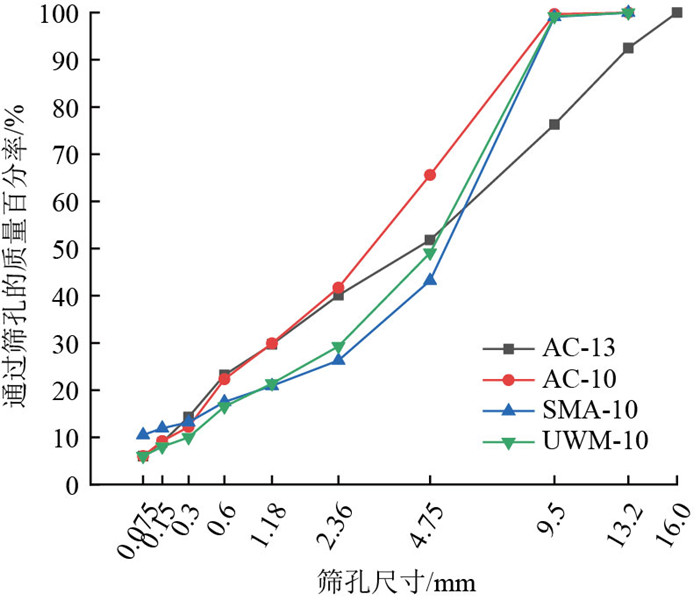
1.3 原始路面与加铺超薄磨耗层级配设计本研究使用石灰岩作为粗细集料,填料包括水泥和矿粉。矿粉是白云石经磨粉机细化加工而产生,水泥选用P.O 42.5标号的普通硅酸盐水泥,掺量为集料质量的1.5%。以AC-13模拟原始路面,选择AC-10,SMA-10,UWM-10这3种超薄磨耗层,4种级配曲线如图 1所示[19]。
|
| 图 1 超薄磨耗层级配曲线 Fig. 1 Gradation curves of ultra-thin wearing courses |
| |
1.4 混合料制备
首先,将粗细集料和外掺水倒入搅拌机中混合,按照特定比例加入预先配置好的沥青乳液,在常温下搅拌50 s;接着,加入相应量的矿粉和水泥到混合料中,再进行50 s的搅拌,确保混合料呈均匀的褐色;确认混合料搅拌均匀并且乳化沥青未提前破乳,即获得乳化沥青混合料。
1.5 复合试件成型方法为满足直接剪切试验的需求,制备成型超薄磨耗层加铺结构的复合试件。首先,制备AC-13级配的沥青混合料来模拟原始路面,其厚度为40 mm,车辙板尺寸为300 mm×400 mm×40 mm,成型后置于110 ℃烘箱中养护24 h。车辙板冷却后,在其表面涂抹定量的黏结剂,然后立即将新拌和的混合料铺满模具并进行碾压成型,超薄磨耗层厚度为20 mm。随后,将复合车辙板置于110 ℃烘箱中养护24 h,再于室温下静置24 h后脱模。最后,将复合试件切割成尺寸为90 mm×90 mm×60 mm的尺寸进行试验
1.6 直接剪切试验测试方法本研究采用多功能材料试验机UTM-30,参考AASHTO TP114-18方法进行操作。首先,将90 mm×90 mm×60 mm的试件置于环境箱中,保温不少于4 h;随后,根据不同的试验温度(15,25,35,50 ℃)进行单调直接剪切试验,采用位移控制加载方式,位移速率设定为2.54 mm/min。每种情况进行3组平行试件的测试[20-21]。
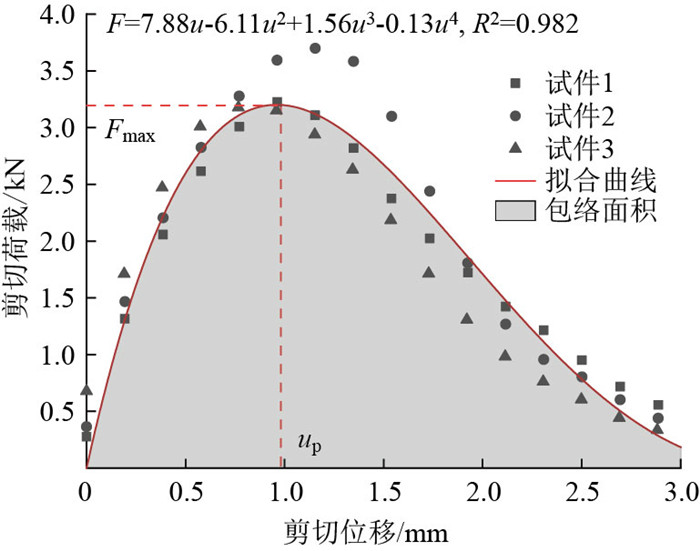
1.7 性能评价指标 1.7.1 剪切荷载-位移曲线将3组平行试样的剪切测试数据制成散点图,并呈现于坐标系中。通过对散点数据及其变化规律的分析,拟合得到荷载-位移曲线,其拟合方程为四次多项式:

|
(1) |
式中,F为剪切荷载;u为剪切位移;A,B,C,D为拟合参数。典型荷载-位移曲线如图 2所示。后续剪切强度、剪切刚度、层间黏结能等评价指标都是基于荷载-位移曲线展开分析讨论。
|
| 图 2 典型荷载-位移曲线 Fig. 2 Classical load-displacement curve |
| |
改性前后2种黏结层的荷载-位移曲线拟合参数如表 3和表 4所示。
| 级配 | 温度/℃ | 洒布量/(kg·m-2) | A | B | C | D | R2 |
| AC-10 | 15 | 0.6 | 4.50 | -1.68 | -0.12 | 0.07 | 0.949 |
| 0.9 | 4.36 | -0.90 | -0.28 | 0.06 | 0.980 | ||
| 1.2 | 3.67 | -0.56 | -0.28 | 0.05 | 0.980 | ||
| 1.5 | 4.45 | -1.11 | -0.24 | 0.07 | 0.978 | ||
| 25 | 0.6 | 4.09 | -2.62 | 0.60 | 0.05 | 0.988 | |
| 0.9 | 4.45 | -2.36 | 0.43 | 0.03 | 0.989 | ||
| 1.2 | 4.76 | -3.05 | 0.66 | 0.05 | 0.992 | ||
| 1.5 | 4.12 | -2.64 | 0.64 | 0.05 | 0.933 | ||
| 35 | 0.6 | 5.37 | -3.97 | 1.02 | -0.09 | 0.852 | |
| 0.9 | 4.70 | -3.17 | 0.77 | -0.06 | 0.938 | ||
| 1.2 | 4.82 | -3.77 | 1.01 | -0.09 | 0.857 | ||
| 1.5 | 4.82 | -4.20 | 1.17 | -0.11 | 0.869 | ||
| 50 | 0.6 | 1.01 | -0.89 | 0.26 | -0.02 | 0.911 | |
| 0.9 | 1.52 | -1.05 | 0.26 | -0.02 | 0.852 | ||
| 1.2 | 1.17 | -0.88 | 0.23 | -0.02 | 0.950 | ||
| 1.5 | 1.21 | -1.03 | 0.29 | -0.03 | 0.915 | ||
| SMA-10 | 15 | 0.6 | 7.37 | -4.89 | 1.10 | -0.08 | 0.924 |
| 0.9 | 9.49 | -6.83 | 1.66 | -0.13 | 0.955 | ||
| 1.2 | 6.65 | -3.0 | 0.40 | -0.01 | 0.981 | ||
| 1.5 | 7.31 | -4.88 | 1.10 | -0.08 | 0.898 | ||
| 25 | 0.6 | 6.09 | 5.25 | 1.47 | -0.13 | 0.859 | |
| 0.9 | 3.91 | 2.68 | 0.64 | -0.05 | 0.950 | ||
| 1.2 | 4.45 | 2.91 | 0.68 | -0.05 | 0.965 | ||
| 1.5 | 5.19 | 4.03 | 1.04 | 0.09 | 0.972 | ||
| 35 | 0.6 | 2.37 | 1.86 | 0.49 | -0.04 | 0.858 | |
| 0.9 | 3.30 | 2.57 | 0.66 | -0.06 | 0.851 | ||
| 1.2 | 2.92 | 1.98 | 0.49 | -0.04 | 0.859 | ||
| 1.5 | 2.18 | 1.66 | 0.44 | -0.04 | 0.854 | ||
| 50 | 0.6 | 1.27 | -1.11 | 0.31 | -0.03 | 0.854 | |
| 0.9 | 1.30 | -1.0 | 0.26 | -0.02 | 0.852 | ||
| 1.2 | 1.25 | -1.14 | 0.33 | -0.03 | 0.858 | ||
| 1.5 | 1.11 | -1.0 | 0.29 | -0.03 | 0.860 | ||
| UWM-10 | 15 | 0.6 | 8.92 | -7.61 | 2.10 | -0.19 | 0.908 |
| 0.9 | 9.10 | -7.16 | 1.88 | -0.16 | 0.942 | ||
| 1.2 | 8.52 | -5.51 | 1.33 | -0.11 | 0.970 | ||
| 1.5 | 9.66 | -6.65 | 1.56 | -0.12 | 0.985 | ||
| 25 | 0.6 | 4.58 | -3.55 | 0.94 | -0.08 | 0.920 | |
| 0.9 | 3.19 | -1.60 | 0.27 | -0.02 | 0.971 | ||
| 1.2 | 5.83 | -4.52 | 1.17 | -0.10 | 0.969 | ||
| 1.5 | 6.28 | -5.51 | 1.55 | -0.14 | 0.858 | ||
| 35 | 0.6 | 2.21 | -1.87 | 0.52 | -0.05 | 0.859 | |
| 0.9 | 3.34 | -2.60 | 0.71 | -0.06 | 0.858 | ||
| 1.2 | 2.30 | -1.99 | 0.56 | -0.05 | 0.855 | ||
| 1.5 | 1.95 | -1.82 | 0.53 | -0.05 | 0.857 | ||
| 50 | 0.6 | 1.26 | -1.16 | 0.34 | -0.03 | 0.857 | |
| 0.9 | 1.59 | -1.26 | 0.33 | -0.03 | 0.854 | ||
| 1.2 | 1.45 | -1.22 | 0.34 | -0.03 | 0.851 | ||
| 1.5 | 0.70 | -0.67 | 0.20 | -0.02 | 0.856 |
| 级配 | 温度/℃ | 洒布量/(kg·m-2) | A | B | C | D | R2 |
| AC-10 | 15 | 0.6 | 16.38 | -7.98 | 0.22 | 0.20 | 0.855 |
| 0.9 | 6.19 | 1.75 | -1.53 | 0.17 | 0.926 | ||
| 1.2 | 4.53 | 3.89 | -3.28 | 0.52 | 0.921 | ||
| 1.5 | 18.86 | -16.0 | 4.46 | -0.41 | 0.948 | ||
| 25 | 0.6 | 7.51 | -4.18 | 0.87 | -0.06 | 0.997 | |
| 0.9 | 5.83 | -1.63 | -0.11 | 0.04 | 0.981 | ||
| 1.2 | 6.59 | -4.22 | 0.87 | -0.06 | 0.933 | ||
| 1.5 | 5.66 | -3.61 | 0.77 | -0.06 | 0.966 | ||
| 35 | 0.6 | 2.13 | -1.70 | 0.45 | -0.04 | 0.878 | |
| 0.9 | 1.19 | -1.01 | 0.28 | -0.02 | 0.883 | ||
| 1.2 | 2.68 | -2.04 | 0.53 | -0.05 | 0.852 | ||
| 1.5 | 1.73 | -1.42 | 0.38 | -0.03 | 0.907 | ||
| 50 | 0.6 | 2.43 | -1.70 | 0.40 | -0.03 | 0.964 | |
| 0.9 | 2.62 | -1.99 | 0.52 | -0.05 | 0.856 | ||
| 1.2 | 1.91 | -1.27 | 0.29 | -0.02 | 0.859 | ||
| 1.5 | 1.94 | -1.50 | 0.40 | -0.03 | 0.854 | ||
| SMA-10 | 15 | 0.6 | 20.13 | -17.12 | 4.72 | -0.42 | 0.865 |
| 0.9 | 14.85 | -11.22 | 2.88 | -0.24 | 0.959 | ||
| 1.2 | 14.23 | -7.16 | 0.95 | -0.02 | 0.894 | ||
| 1.5 | 14.64 | -10.55 | 2.50 | -0.19 | 0.952 | ||
| 25 | 0.6 | 11.07 | -8.09 | 1.97 | -0.16 | 0.987 | |
| 0.9 | 9.51 | -5.71 | 1.07 | -0.06 | 0.901 | ||
| 1.2 | 6.66 | -3.36 | 0.57 | -0.03 | 0.993 | ||
| 1.5 | 7.63 | -5.49 | 1.31 | -0.10 | 0.927 | ||
| 35 | 0.6 | 6.03 | -4.40 | 1.08 | -0.09 | 0.980 | |
| 0.9 | 7.88 | -6.11 | 1.56 | -0.13 | 0.982 | ||
| 1.2 | 6.54 | -4.52 | 1.12 | -0.09 | 0.852 | ||
| 1.5 | 5.95 | -3.74 | 0.78 | -0.05 | 0.987 | ||
| 50 | 0.6 | 2.99 | -2.52 | 0.69 | -0.06 | 0.869 | |
| 0.9 | 4.77 | -4.03 | 1.10 | -0.10 | 0.851 | ||
| 1.2 | 4.98 | -3.38 | 0.79 | -0.06 | 0.966 | ||
| 1.5 | 3.26 | -2.75 | 0.76 | -0.07 | 0.857 | ||
| UWM-10 | 15 | 0.6 | 5.99 | -0.14 | -0.77 | 0.11 | 0.960 |
| 0.9 | 14.31 | -8.05 | 1.54 | -0.10 | 0.935 | ||
| 1.2 | 19.07 | -15.0 | 3.85 | -0.32 | 0.939 | ||
| 1.5 | 17.68 | -14.82 | 4.00 | -0.35 | 0.871 | ||
| 25 | 0.6 | 12.17 | -10.53 | 2.92 | -0.26 | 0.929 | |
| 0.9 | 7.11 | -3.31 | 0.50 | -0.02 | 0.981 | ||
| 1.2 | 10.16 | -8.13 | 2.13 | -0.18 | 0.964 | ||
| 1.5 | 11.30 | -9.60 | 2.62 | -0.23 | 0.883 | ||
| 35 | 0.6 | 6.14 | -4.12 | 0.99 | -0.08 | 0.955 | |
| 0.9 | 6.73 | -4.99 | 1.30 | -0.11 | 0.859 | ||
| 1.2 | 6.14 | -4.57 | 1.18 | -0.10 | 0.901 | ||
| 1.5 | 5.55 | -4.31 | 1.13 | -0.10 | 0.892 | ||
| 50 | 0.6 | 2.89 | -2.09 | 0.53 | -0.04 | 0.940 | |
| 0.9 | 3.23 | -1.92 | 0.40 | -0.03 | 0.949 | ||
| 1.2 | 3.40 | -2.67 | 0.71 | -0.06 | 0.858 | ||
| 1.5 | 3.37 | -2.79 | 0.76 | -0.07 | 0.850 |
1.7.2 剪切强度
层间剪切强度σ被定义为单位面积内承受的最大剪切荷载,计算为:

|
(2) |
式中,Fmax为荷载-位移拟合曲线中的峰值荷载;S为复合试件的剪切截面面积。
1.7.3 剪切刚度根据GDJTG/T A01—2015规程,剪切刚度G被定义为最大剪切强度与对应的层间剪切位移之比,反映了引起复合试件单位剪切变形所需的应力[20],计算为:

|
(3) |
式中up为荷载-位移拟合曲线中的峰值荷载对应的剪切位移。
1.7.4 层间黏结能层间黏结能被定义为荷载-位移拟合曲线的包络面积E,计算为:

|
(4) |
式中,F为荷载-位移拟合曲线中的荷载;x为剪切破坏后的位移;d为微分符号;u为拟合曲线中的位移。
2 结果与讨论 2.1 剪切破坏形态剪切试验后需要观察复合试件的破坏界面位置,该界面可能出现在黏结层内部、混合料结构与黏结层之间或混合料结构内部。层间破坏表现为当破坏情况完全发生在混合料内部时,可认为层间抗剪强度大于测试值。3种超薄磨耗层复合试件的剪切破坏界面均发生在层间,具体表现为超薄磨耗层铺装结构和模拟原始路面AC-13结构内未出现明显的结构性破坏,但产生了明显的相对滑移。这表明在剪切过程中,层间是最薄弱的位置,通过直接剪切试验测得的结果能够准确反映黏结层自身的破坏状况。
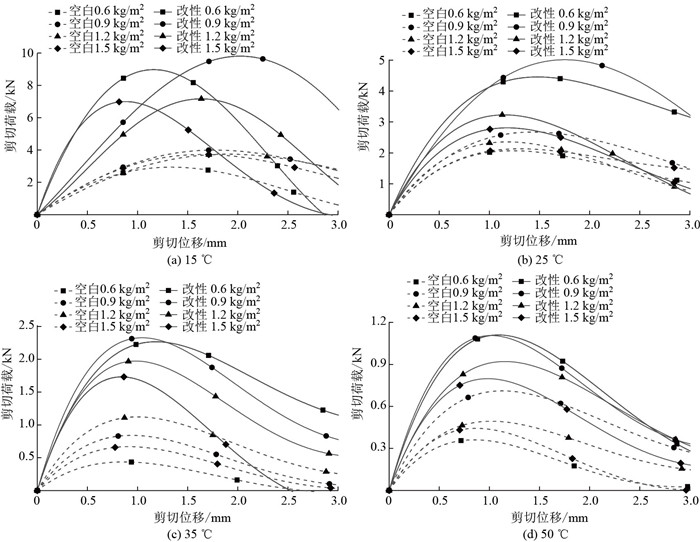
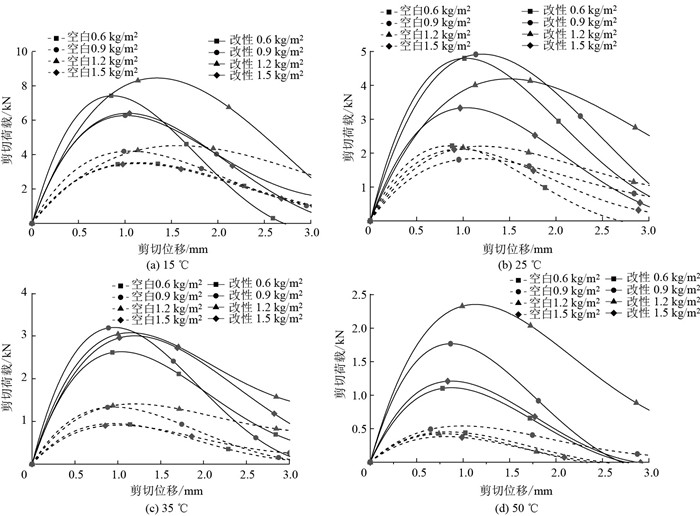
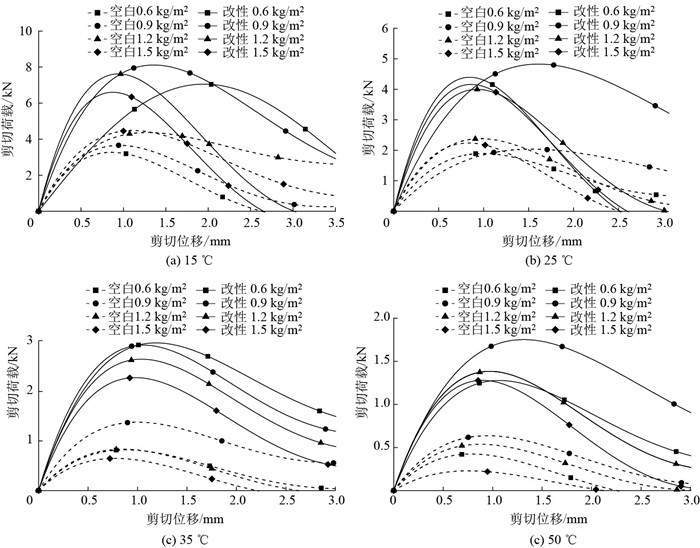
2.2 剪切荷载-位移曲线为深入了解在不同条件下超薄磨耗层的力学响应和破坏行为,AC-10,SMA-10,UWM-10这3种超薄磨耗层在4种温度下荷载-位移曲线随洒布量变化的情况如图 3~5所示。复合试件在剪切破坏过程中表现相似,其荷载-位移曲线呈现明显的弹性阶段、塑性阶段和破坏阶段[22]。在弹性阶段,荷载与试件层间滑动位移呈线性关系,剪切荷载逐渐增大;进入塑性阶段后,随着层间剪切位移的增加,剪切荷载上升速率减缓,直至达到峰值荷载;在破坏阶段,复合试件的剪切荷载在达到峰值后呈下降趋势,层间位移继续增大,最终导致上、下层明显分离。
|
| 图 3 AC-10荷载-位移曲线 Fig. 3 Load-displacement curves of AC-10 |
| |
|
| 图 4 SMA-10荷载-位移曲线 Fig. 4 Load-displacement curves of SMA-10 |
| |
|
| 图 5 UWM-10荷载-位移曲线结果 Fig. 5 Load-displacement curves of UWM-10 |
| |
观察发现,使用WEREA作为复合试件的黏结层时,其层间抗剪能力明显优于普通乳化沥青,而空白样在较小位移范围内即出现剪切荷载峰值,尤其在较高温度下二者的差距更加显著。相较于空白黏结层,低温环境下改性组的剪切荷载在达到峰值后下降速率更快,呈现出脆性破坏的特征。同时,WEREA黏结层的荷载-位移曲线更受其洒布量的影响,这表明WEREA作为黏结层时的洒布量需要更精准的控制,过多或过少均会对复合试件的黏结性能产生较大影响。后续剪切强度、剪切刚度、层间黏结能等评价指标都是基于荷载-位移曲线展开分析讨论。
2.3 剪切强度为了定量评估不同条件下路面结构层的力学性能,AC-10,SMA-10,UWM-10这3种超薄磨耗层在4种温度下的剪切强度随洒布量的变化情况如表 5所示。随着洒布量逐渐增大,复合试件的剪切强度呈现出先增大后减小的趋势。层间抗剪强度主要由黏结材料的黏结力和接触面骨料间的摩擦力构成,当黏结剂洒布量较少时,无法提供足够的黏结力,层间抗剪力主要由接触面骨料间的相互嵌挤产生的摩擦力提供[23]。适量的洒布量能确保良好的接触面积和均匀的应力传递,从而提高结构的抗剪力。随着洒布量的进一步增加,层间的沥青膜厚度也增大,当沥青膜厚度超过超薄磨耗层的构造深度时,影响到接触面骨料间的摩擦,最终会导致层间抗剪强度降低[24]。
| 级配 | 温度/℃ | 洒布量/(kg·m-2) | 空白组抗剪强度/MPa | 空白组极值位移/mm | 改性组抗剪强度/MPa | 改性组极值位移/mm |
| AC-10 | 15 | 0.6 | 0.363 | 1.335 | 1.108 | 1.161 |
| 0.9 | 0.494 | 1.771 | 1.211 | 2.024 | ||
| 1.2 | 0.462 | 1.901 | 0.885 | 1.633 | ||
| 1.5 | 0.460 | 1.656 | 0.864 | 0.876 | ||
| 25 | 0.6 | 0.256 | 1.232 | 0.550 | 1.480 | |
| 0.9 | 0.330 | 1.438 | 0.619 | 1.755 | ||
| 1.2 | 0.291 | 1.181 | 0.399 | 1.151 | ||
| 1.5 | 0.263 | 1.305 | 0.347 | 1.177 | ||
| 35 | 0.6 | 0.054 | 0.861 | 0.280 | 1.182 | |
| 0.9 | 0.104 | 0.939 | 0.287 | 1.048 | ||
| 1.2 | 0.139 | 1.002 | 0.244 | 0.981 | ||
| 1.5 | 0.083 | 0.915 | 0.214 | 0.842 | ||
| 50 | 0.6 | 0.045 | 0.847 | 0.137 | 1.091 | |
| 0.9 | 0.088 | 1.130 | 0.137 | 1.017 | ||
| 1.2 | 0.061 | 1.022 | 0.114 | 1.152 | ||
| 1.5 | 0.055 | 0.868 | 0.099 | 0.983 | ||
| SMA-10 | 15 | 0.6 | 0.436 | 1.144 | 0.916 | 0.865 |
| 0.9 | 0.519 | 1.056 | 0.774 | 1.011 | ||
| 1.2 | 0.558 | 1.574 | 1.044 | 1.344 | ||
| 1.5 | 0.430 | 1.135 | 0.790 | 1.032 | ||
| 25 | 0.6 | 0.273 | 0.853 | 0.592 | 1.029 | |
| 0.9 | 0.227 | 1.138 | 0.607 | 1.200 | ||
| 1.2 | 0.272 | 1.208 | 0.517 | 1.493 | ||
| 1.5 | 0.261 | 0.966 | 0.412 | 1.036 | ||
| 35 | 0.6 | 0.117 | 0.955 | 0.325 | 1.040 | |
| 0.9 | 0.165 | 0.959 | 0.395 | 0.959 | ||
| 1.2 | 0.174 | 1.195 | 0.380 | 1.151 | ||
| 1.5 | 0.113 | 1.009 | 0.371 | 1.198 | ||
| 50 | 0.6 | 0.056 | 0.838 | 0.137 | 0.874 | |
| 0.9 | 0.067 | 0.995 | 0.218 | 0.871 | ||
| 1.2 | 0.052 | 0.796 | 0.291 | 1.133 | ||
| 1.5 | 0.047 | 0.806 | 0.149 | 0.873 | ||
| UWM-10 | 15 | 0.6 | 0.404 | 0.860 | 0.871 | 1.952 |
| 0.9 | 0.452 | 0.954 | 1.002 | 1.357 | ||
| 1.2 | 0.539 | 1.288 | 0.941 | 0.943 | ||
| 1.5 | 0.553 | 1.109 | 0.815 | 0.874 | ||
| 25 | 0.6 | 0.234 | 0.990 | 0.542 | 0.844 | |
| 0.9 | 0.251 | 1.536 | 0.596 | 1.610 | ||
| 1.2 | 0.294 | 0.968 | 0.493 | 0.926 | ||
| 1.5 | 0.276 | 0.833 | 0.513 | 0.864 | ||
| 35 | 0.6 | 0.101 | 0.881 | 0.368 | 1.186 | |
| 0.9 | 0.170 | 1.000 | 0.362 | 1.058 | ||
| 1.2 | 0.103 | 0.848 | 0.327 | 1.040 | ||
| 1.5 | 0.080 | 0.776 | 0.281 | 0.981 | ||
| 50 | 0.6 | 0.052 | 0.785 | 0.158 | 1.063 | |
| 0.9 | 0.079 | 0.947 | 0.216 | 1.314 | ||
| 1.2 | 0.066 | 0.876 | 0.171 | 0.973 | ||
| 1.5 | 0.028 | 0.755 | 0.158 | 0.895 |
不同磨耗层类型均存在最佳洒布量,对应的剪切强度达到峰值,加铺结构的剪切强度峰值在4种温度下受环境温度的影响呈现小幅波动。综合分析4种温度下的剪切强度,确定AC-10,SMA-10,UWM-10超薄磨耗层的最佳洒布量分别为0.9,1.2,0.9 kg/m2,加入WER对最佳洒布量影响不大。在最佳洒布量下,随着温度升高,剪切强度呈现出明显的下降趋势,每上升10 ℃降低约50%,这表明温度是影响复合试件剪切强度的主要因素之一。随着试验温度从15 ℃上升至50 ℃,AC-10,SMA-10,UWM-10这3种超薄磨耗层空白黏结层的剪切强度分别由0.494,0.558,0.452 MPa降至0.088,0.052,0.079 MPa;WEREA黏结层复合试件分别由1.211,1.044,1.002 MPa降至0.137,0.291,0.216 MPa,降幅为75%~90%。在高温环境下,复合试件的整体层间黏结效果不佳,实际工程中应特别关注黏结层的高温性能[24]。比较2种黏结剂下的剪切强度,其中WEREA的黏结性能明显更优越,同时其峰值位移略高于空白样。WEREA固化后形成牢固的分子间交联结构,赋予黏结层材料更强的抗剪性能[25]。路面类型对剪切强度同样产生一定影响,在常温下的剪切强度由大到小排序为AC-10,UWM-10,SMA-10,而在高温下由大到小排序为SMA-10,UWM-10,AC-10。
2.4 剪切刚度剪切强度仅反映了复合试件在在极限破坏状态下的最大强度,然而从使用功能的角度出发,结构层之间发生较大的剪切变形即可被视为界面破坏失效[26]。本研究通过剪切刚度来评估复合试件黏结层抵抗剪变形的能力,不同磨耗层类型在4种温度下的剪切刚度随着洒布量的变化如表 6所示。由表可见,洒布量对剪切刚度的影响相较于剪切强度更为显著,而且这种影响呈现出不规律的变化。随着试验温度由15 ℃上升至50 ℃,这3种超薄磨耗层空白黏结层的剪切刚度分别由278.7,354.7,473.3 MN/m3降至77.7,65.8,82.9 MN/m3,而3种磨耗层的改性组分别从598.5,776.7,738.4 MN/m3降至134.3,256.5,164.5 MN/m3,降幅约为65%~80%。复合试件的剪切刚度随温度的变化规律与剪切强度基本一致,但下降幅度略有减缓,这表明复合试件在剪切过程中抵抗剪变形能力的减弱并非全由剪切强度的下降决定,还取决于剪切变形的发展程度。由于分子结构相对简单,空白样表现出较小的剪切刚度,WEREA黏结层在剪切过程中展现出的剪切刚度为空白样的1.5至3.0倍,具有更强的抵抗剪变形的能力。环氧树脂分子和沥青分子发生交联反应,环氧树脂固化后形成的三维网状结构降低了原本沥青乳液的热塑性,使得黏结剂朝着热固性的方向发展[27-28]。综合改性组剪切刚度结果,将3种超薄磨耗层的抗剪能力由大到小排序为SMA-10,UWM-10,AC-10。
| 级配 | 温度/℃ | 洒布量/(kg·m-2) | 空白组剪切刚度/(×102 MN·m-3) | 改性组剪切刚度/(×102 MN·m-3) |
| AC-10 | 15 | 0.6 | 2.718 | 9.545 |
| 0.9 | 2.787 | 5.985 | ||
| 1.2 | 2.431 | 5.420 | ||
| 1.5 | 2.779 | 9.861 | ||
| 25 | 0.6 | 2.074 | 3.718 | |
| 0.9 | 2.297 | 3.529 | ||
| 1.2 | 2.464 | 3.464 | ||
| 1.5 | 2.017 | 2.947 | ||
| 35 | 0.6 | 0.626 | 2.368 | |
| 0.9 | 1.106 | 2.742 | ||
| 1.2 | 1.382 | 2.484 | ||
| 1.5 | 0.903 | 2.540 | ||
| 50 | 0.6 | 0.527 | 1.256 | |
| 0.9 | 0.777 | 1.343 | ||
| 1.2 | 0.597 | 0.987 | ||
| 1.5 | 0.630 | 1.003 | ||
| SMA-10 | 15 | 0.6 | 3.812 | 10.593 |
| 0.9 | 4.910 | 7.659 | ||
| 1.2 | 3.547 | 7.767 | ||
| 1.5 | 3.787 | 7.659 | ||
| 25 | 0.6 | 3.204 | 5.756 | |
| 0.9 | 1.995 | 5.061 | ||
| 1.2 | 2.252 | 3.467 | ||
| 1.5 | 2.701 | 3.980 | ||
| 35 | 0.6 | 1.230 | 3.124 | |
| 0.9 | 1.720 | 4.119 | ||
| 1.2 | 1.457 | 3.301 | ||
| 1.5 | 1.119 | 3.097 | ||
| 50 | 0.6 | 0.666 | 1.571 | |
| 0.9 | 0.672 | 2.505 | ||
| 1.2 | 0.658 | 2.565 | ||
| 1.5 | 0.587 | 1.713 | ||
| UWM-10 | 15 | 0.6 | 4.693 | 4.463 |
| 0.9 | 4.733 | 7.384 | ||
| 1.2 | 4.188 | 9.981 | ||
| 1.5 | 4.988 | 9.323 | ||
| 25 | 0.6 | 2.361 | 6.427 | |
| 0.9 | 1.636 | 3.701 | ||
| 1.2 | 3.035 | 5.327 | ||
| 1.5 | 3.314 | 5.944 | ||
| 35 | 0.6 | 1.151 | 3.101 | |
| 0.9 | 1.704 | 3.425 | ||
| 1.2 | 1.215 | 3.146 | ||
| 1.5 | 1.034 | 2.868 | ||
| 50 | 0.6 | 0.667 | 1.483 | |
| 0.9 | 0.829 | 1.645 | ||
| 1.2 | 0.758 | 1.756 | ||
| 1.5 | 0.374 | 1.763 |
2.5 层间黏结能
为了全面评估超薄磨耗层与原始路面之间的黏结性能,本研究采用荷载-位移曲线的包络面积进行量化分析,较大的面积意味着需要更大的外力功才能使复合试件发生层间剪切破坏。通过层间黏结能反映层间抗剪力和剪切变形的综合效应,不同磨耗层在4种温度下的层间黏结能随洒布量的变化规律见表 7。
| 级配 | 温度/℃ | 洒布量/(kg·m-2) | 空白组层间黏结能/(N·m) | 改性组层间黏结能/(N·m) |
| AC-10 | 15 | 0.6 | 6.302 | 15.552 |
| 0.9 | 11.146 | 23.119 | ||
| 1.2 | 10.573 | 15.029 | ||
| 1.5 | 10.154 | 11.330 | ||
| 25 | 0.6 | 6.251 | 15.630 | |
| 0.9 | 7.421 | 13.862 | ||
| 1.2 | 5.510 | 6.673 | ||
| 1.5 | 7.930 | 6.411 | ||
| 35 | 0.6 | 0.759 | 6.969 | |
| 0.9 | 1.691 | 6.084 | ||
| 1.2 | 2.580 | 4.979 | ||
| 1.5 | 1.265 | 2.990 | ||
| 50 | 0.6 | 0.753 | 2.497 | |
| 0.9 | 1.849 | 2.771 | ||
| 1.2 | 1.224 | 2.330 | ||
| 1.5 | 0.820 | 1.884 | ||
| SMA-10 | 15 | 0.6 | 8.563 | 12.380 |
| 0.9 | 9.558 | 16.156 | ||
| 1.2 | 13.626 | 18.405 | ||
| 1.5 | 8.591 | 12.100 | ||
| 25 | 0.6 | 3.644 | 9.691 | |
| 0.9 | 4.916 | 10.162 | ||
| 1.2 | 6.316 | 12.412 | ||
| 1.5 | 4.361 | 6.559 | ||
| 35 | 0.6 | 1.865 | 5.866 | |
| 0.9 | 2.526 | 5.860 | ||
| 1.2 | 4.479 | 9.225 | ||
| 1.5 | 2.207 | 6.993 | ||
| 50 | 0.6 | 0.672 | 1.816 | |
| 0.9 | 1.160 | 2.849 | ||
| 1.2 | 0.562 | 5.775 | ||
| 1.5 | 0.601 | 2.122 | ||
| UWM-10 | 15 | 0.6 | 5.026 | 19.710 |
| 0.9 | 7.306 | 23.502 | ||
| 1.2 | 15.115 | 13.097 | ||
| 1.5 | 10.923 | 9.978 | ||
| 25 | 0.6 | 4.933 | 6.284 | |
| 0.9 | 6.699 | 15.579 | ||
| 1.2 | 4.657 | 6.932 | ||
| 1.5 | 3.283 | 6.178 | ||
| 35 | 0.6 | 1.600 | 9.122 | |
| 0.9 | 4.348 | 8.417 | ||
| 1.2 | 1.305 | 6.956 | ||
| 1.5 | 0.809 | 5.402 | ||
| 50 | 0.6 | 0.548 | 3.167 | |
| 0.9 | 1.279 | 5.014 | ||
| 1.2 | 0.944 | 3.056 | ||
| 1.5 | 0.272 | 2.329 |
综合分析洒布量对层间黏结能的影响,得出AC-10,SMA-10,UWM-10的洒布量分别为0.9,1.2,0.9 kg/m2时复合试件的层间黏结能最大,与剪切强度指标的分析结果一致。随着试验温度升高,复合试件黏结层的抗剪能力明显减弱,层间黏结能呈减小趋势,降幅为70%~90%。WEREA黏结层的层间黏结能显著高于空白样,尤其在较高温度下,SMA-10和UWM-10改性黏结层的层间黏结能达到空白样的5.0倍和3.9倍。WER的加入显著提升了黏结层的高温稳定性,热塑性乳化沥青向热固性方向发展,延长黏结层的使用寿命[29-30]。路面类型也对层间黏结能有一定影响,WEREA黏结层在常温下的层间黏结能由大到小排序为UWM-10,AC-10,SMA-10;而在高温下由大到小排序为SMA-10,UWM-10,AC-10,根据层间黏结能指标得出的超薄磨耗层铺装优劣排序与根据剪切强度和剪切刚度指标分析的结果基本一致。综上所述,尽管AC-10铺装在常温下具有较强的黏结性能,但在35 ℃后其性能衰减程度远大于SMA-10和UWM-10。
3 结论本研究根据剪切强度、剪切刚度、层间黏结能等一系列指标,探究了洒布量、试验温度、黏结剂类型、超薄磨耗层级配等因素对层间黏结性能的影响规律。
(1) 经过综合评估,确定了AC-10,SMA-10,UWM-10的推荐洒布量分别为0.9,1.2,0.9 kg/m2,加入WER对最佳洒布量的影响较小。
(2) 温度对黏结层性能影响显著。随着试验温度由15 ℃上升至50 ℃,复合试件的层间性能明显减弱,具体表现为剪切强度、剪切刚度、层间黏结能指标均减小,降幅达65%~90%。
(3) WEREA黏结剂的性能显著优于普通乳化沥青。尤其在较高温度下,改性黏结层的剪切强度、剪切刚度、层间黏结能分别为空白样的3.3,2.5,3.5倍。
(4) 3种超薄磨耗层级配中,SMA-10和UWM-10的黏结性能较为优越,尽管AC-10铺装在常温下的黏结性能较强,但在35 ℃后其性能衰减程度远大于SMA-10和UWM-10。
| [1] |
CUI W T, WU K H, CAI X, et al. Optimizing Gradation Design for Ultra-thin Wearing Course Asphalt[J].
Materials, 2020, 13(1): 189-203.
DOI:10.3390/ma13010189 |
| [2] |
曾梦澜, 彭良清, 吴超凡, 等. 超薄磨耗层沥青混合料使用性能试验研究[J]. 武汉理工大学学报, 2012, 34(4): 27-31. ZENG Meng-lan, PENG Liang-qing, WU Chao-fan, et al. Experimental Study of the Performance of Ultrathin Asphalt Friction Course[J]. Journal of Wuhan University of Technology, 2012, 34(4): 27-31. |
| [3] |
吴宇浩, 肖鹏, 吴帮伟, 等. 超薄磨耗层加铺路面层间抗剪性能试验[J]. 中国科技论文, 2022, 17(7): 739-745, 758. WU Yu-hao, XIAO Peng, WU Bang-wei, et al. Interlaminar Shear Resistance Test of Ultra-thin Wearing Layer Overlay Pavement[J]. China Sciencepaper, 2022, 17(7): 739-745, 758. DOI:10.3969/j.issn.2095-2783.2022.07.006 |
| [4] |
GUO M, ZHANG R, DU X L, et al. A State-of-the-art Review on the Functionality of Ultra-thin Overlays Towards a Future Low Carbon Road Maintenance[J].
Engineering, 2024, 32: 82-98.
DOI:10.1016/j.eng.2023.03.020 |
| [5] |
《中国公路学报》编辑部. 中国路面工程学术研究综述·2020[J]. 中国公路学报, 2020, 33(10): 1-66. Editorial Department of China Journal of Highway and Transport. Review on China's Pavement Engineering Research 2020[J]. China Journal of Highway and Transport, 2020, 33(10): 1-66. DOI:10.3969/j.issn.1001-7372.2020.10.001 |
| [6] |
DENG M, DING Y J, HE Z, et al. Investigation on Performances and Nano-adhesion Behavior of Ultra-thin Wearing Course Using Polyurethane As Binder[J].
Construction and Building Materials, 2021, 278: 122349.
DOI:10.1016/j.conbuildmat.2021.122349 |
| [7] |
刘梦梅, 韩森, 潘俊, 等. 水性环氧树脂乳化沥青在高温、低温和浸水条件下的粘结性能[J]. 材料导报, 2018, 32(10): 1716-1720. LIU Meng-mei, HAN Sen, PAN Jun, et al. The Adhesion Performance of a Waterborne Epoxy Resin Emulsified Asphalt: A Study Under High- & Low-temperature and Water-immersion Environments[J]. Materials Reports, 2018, 32(10): 1716-1720. DOI:10.11896/j.issn.1005-023X.2018.10.028 |
| [8] |
张烁, 张帅, 张恒龙, 等. 水性环氧乳化沥青残留物的老化性能[J]. 公路交通科技, 2023, 40(3): 1-7. ZHANG Shuo, ZHANG Shuai, ZHANG Heng-long, et al. Aging Properties of Waterborne Epoxy Emulsified Asphalt Residue[J]. Journal of Highway and Transportation Research and Development, 2023, 40(3): 1-7. DOI:10.3969/j.issn.1002-0268.2023.03.001 |
| [9] |
YIN Y Y, HAN S, KONG H Y, et al. Optimization and Performance Evaluation of Waterborne Epoxy Resin Modified Emulsified Asphalt Micro-surfacing Based on Tunnel Driving Environment[J].
Construction and Building Materials, 2022, 315: 125604.
DOI:10.1016/j.conbuildmat.2021.125604 |
| [10] |
CHEN J Q, DAN H C, DING Y J, et al. New Innovations in Pavement Materials and Engineering: A Review on Pavement Engineering Research 2021[J].
Journal of Traffic and Transportation Engineering, 2021, 8(6): 815-999.
|
| [11] |
YAO X G, TAN L Z, XU T. Preparation, Properties and Compound Modification Mechanism of Waterborne Epoxy Resin/Styrene Butadiene Rubber Latex Modified Emulsified Asphalt[J].
Construction and Building Materials, 2022, 318: 126178.
DOI:10.1016/j.conbuildmat.2021.126178 |
| [12] |
CAVALLI M C, CHEN D, CHEN Q, et al. Review of Advanced Road Materials, Structures, Equipment, and Detection Technologies[J].
Journal of Road Engineering, 2023, 3(4): 370-468.
|
| [13] |
刘曙光, 周铭钰, 戴勇, 等. 纤维增韧水性环氧乳化沥青混合料性能研究[J]. 公路交通科技, 2024, 41(4): 1-11. LIU Shu-guang, ZHOU Ming-yu, DAI Yong, et al. Study on Performance of Fiber-toughened Waterborne Epoxy Emulsified Asphalt Mixture[J]. Journal of Highway and Transportation Research and Development, 2024, 41(4): 1-11. DOI:10.3969/j.issn.1002-0268.2024.04.001 |
| [14] |
NIAN T F, LI S W, LI P, et al. Mechanical Response of Interlayer Structural Shear Performance of Asphalt Pavement with Functional Layer Considering Interlayer Contact State[J].
Case Studies in Construction Materials, 2023, 18: e01934.
DOI:10.1016/j.cscm.2023.01934 |
| [15] |
LI J, FAN S Y, ZHANG H L, et al. Effect of the Self-healing Properties of Asphalt Mixture on the Interlayer Shear Performance of Bridge Deck Pavement[J].
Construction and Building Materials, 2023, 378: 131123.
DOI:10.1016/j.conbuldmat.2023.131123 |
| [16] |
周志刚, 虢柱, 罗根传, 等. 水和超载对混凝土板沥青层间剪切疲劳寿命的影响[J]. 中国公路学报, 2017, 30(4): 9-15. ZHOU Zhi-gang, GUO Zhu, LUO Gen-chuan, et al. Effect of Moisture and Overload on Interfacial Shear Fatigue Life Between Asphalt Overlayer and Cement Concrete Pavement[J]. China Journal of Highway and Transport, 2017, 30(4): 9-15. |
| [17] |
LU Z, FENG Z G, YAO D D, et al. Bonding Performance Between Ultra-high Performance Concrete and Asphalt Pavement Layer[J].
Construction and Building Materials, 2021, 312: 125375.
DOI:10.1016/j.conbuildmat.2021.125735 |
| [18] |
AI C F, HE H Z, ZHANG X Y, et al. Investigation of Inter-layer Bonding Property in Asphalt Pavement Based on 3D Morphology of Reconstructed Interface[J].
Construction and Building Materials, 2022, 317: 125983.
DOI:10.1016/j.cohbuildmat.2021.125983 |
| [19] |
李正中, 柴东然, 耿磊, 等. 密级配抗滑超薄磨耗层材料UWM-10设计与路用性能研究[J]. 中外公路, 2019, 39(1): 243-248. LI Zheng-zhong, CHAI Dong-ran, GENG Lei, et al. Design and Performance Investigation on UWM-10 Dense Graded Anti-sliding Ultra-thin Wearing Course Material[J]. Journal of China & Foreign Highway, 2019, 39(1): 243-248. |
| [20] |
李嘉, 陈思远, 黄聪, 等. UHPC-SMA层间静力性能与疲劳寿命相联性[J]. 湖南大学学报(自然科学版), 2022, 49(3): 14-22. LI Jia, CHEN Si-yuan, HUANG Cong, et al. Correlation of Interlayer Monotonic Performances and Fatigue Life between UHPC and SMA[J]. Journal of Hunan University(Natural Sciences), 2022, 49(3): 14-22. |
| [21] |
杨玉晶. 基于直剪试验的黏层黏结效果影响因素研究[J]. 公路交通科技, 2022, 39(2): 68-76, 102. YANG Yu-jing. Study on Influencing Factors of Adhesive Layer Bonding Effect Based on Direct Shear Test[J]. Journal of Highway and Transportation Research and Development, 2022, 39(2): 68-76, 102. |
| [22] |
李嘉, 秦时髦, 张恒龙. 基于STC-SMA层间性能的沥青混合料设计与评估[J]. 材料导报, 2023, 37(5): 124-131. LI Jia, QIN Shi-mao, ZHANG Heng-long. Design and Evaluation of Asphalt Mixture Based on STC-SMA Interlayer Performance[J]. Materials Reports, 2023, 37(5): 124-131. |
| [23] |
艾长发, 李林育, 黄恒伟, 等. 沥青路面层间界面摩阻效应及其对层间抗剪强度影响机理[J]. 中国公路学报, 2023, 36(12): 47-63. AI Chang-fa, LI Lin-yu, HUANG Heng-wei, et al. Frictional-resistance Effect at the Interface Between Asphalt Layers and Its Influence Mechanism on Interlayer Shear Strength[J]. China Journal of Highway and Transport, 2023, 36(12): 47-63. |
| [24] |
CHEN J S, HUANG C C. Effect of Surface Characteristics on Bonding Properties of Bituminous Tack Coat[J].
Journal of the Transportation Research Board, 2010, 2180(1): 142-149.
|
| [25] |
BACHA M A, HORNYCH P, NGUYEN M L, et al. Evaluation of the Influence of Interface Bonding Condition on Mechanical Responses of Bituminous Pavement Surface Layers[J].
Transportation Engineering, 2023, 14: 100211.
DOI:10.1016/j.treng.2023.100211 |
| [26] |
周铭钰, 刘曙光, 吴超凡, 等. 基于水性环氧乳化沥青的超薄磨耗层级配设计及性能对比研究[J/OL]. 材料导报(2024-01-16) [2024-02-28]. http://kns.cnki.net/kcms/detail/50.1078.tb.20240116.1022.002.html. ZHOU Ming-yu, LIU Shu-guang, WU Chao-fan, et al. Comparative Study on Grade Design and Performance of Ultra-thin Abrasion Layer Based on Waterborne Epoxy Emulsified Asphalt[J/OL]. Materials Reports (2024-01-16) [2024-02-28]. http://kns.cnki.net/kcms/detail/50.1078.tb.20240116.1022.002.html. |
| [27] |
ZHANG S, LONG J, ZHANG H L, et al. Preparation and Properties of Cold-mixed Epoxy-asphalt Mixture Based on Fractal Theory[J].
Journal of Materials in Civil Engineering, 2023, 35(9): 04023297.
DOI:10.1061/jmcee7.mteng-16103 |
| [28] |
ZHANG S, ZHANG H L, ZHOU M Y. Investigation on the High-temperature Stability and Fatigue Behavior of Cold Mixed Epoxy Asphalt Mixture with Different Gradations[J].
Case Studies in Construction Materials, 2024, 20: e02694.
DOI:10.1016/j.cscm.2023.e02694 |
| [29] |
SHI S, ZANG D D, CHEN X, et al. Preparation and Properties of a Novel Waterborne Epoxy Resin Modified Emulsified Asphalt[J].
Construction and Building Materials, 2023, 371: 130767.
DOI:10.1016/j.conbuildmat.2023.130767 |
| [30] |
龚演, 严二虎, 袁海蛟, 等. 沥青路面玻璃纤维橡胶沥青碎石封层的层间黏结性能[J]. 公路交通科技, 2022, 39(增2): 1-9. GONG Yan, YAN Er-hu, YUAN Hai-jiao, et al. Interlayer Bonding Properties of Glass Fiber Rubber Asphalt Macadam Sealing Layer for Asphalt Pavement[J]. Journal of Highway and Transportation Research and Development, 2022, 39(S2): 1-9. |