 2024, Vol. 41
扩展功能

文章信息
- 林豪, 郭洪雨, 兰庆男, 王泽樑, 张志强.
- LIN Hao, GUO Hong-yu, LAN Qing-nan, WANG Ze-liang, ZHANG Zhi-qiang
- 大断面小净距隧道爆破施工合理间距及减振措施
- Reasonable Spacing and Vibration Reduction Measure for Tunnel Blasting with Large Section and Small Clear Distance
- 公路交通科技, 2024, 41(6): 165-172
- Journal of Highway and Transportation Research and Denelopment, 2024, 41(6): 165-172
- 10.3969/j.issn.1002-0268.2024.06.018
-
文章历史
- 收稿日期: 2022-07-31


2. 浙江义东高速公路有限公司, 浙江 东阳 322100;
3. 浙江数智交院科技股份有限公司, 浙江 杭州 310000;
4. 西南交通大学 土木工程学院, 四川 成都 610031
2. Zhejiang Yiwu-Dongyang Expressway Co., Ltd., Dongyang, Zhejiang 322100, China;
3. Zhejiang Institute of Communications Co., Ltd., Hangzhou, Zhejiang 310000, China;
4. School of Civil Engineering, Southwest Jiaotong University, Chengdu, Sichuan 610031, China
公路隧道在选线时受地形条件、地质环境等因素的限制,往往采用小净距隧道的设计方案。然而,小净距隧道施工时存在爆破振动相互影响的问题。因此,合理设计隧道两线间距,严格控制后行洞爆破振动,对于小径距隧道施工及运营期的安全具有重要意义[1-5]。
对于小净距隧道合理间距的研究,主要从塑性区分布、应力状态等方面开展。吴恒滨等[6]在分析围岩、支护结构变形特性的基础上,引入屈服接近度的概念评价其受力状态,并以此为依据提出合理间距的设计原则。王更峰等[7]通过模拟双侧壁导坑法、CRD法、台阶法、弧形导坑预留核心土法等施工方案,确定不同围岩级别下小净距隧道开挖方法及合理间距。张仁根等[8]考虑到小净距隧道爆破施工,提出Ⅳ、Ⅴ级围岩可根据塑性区范围确定隧道的合理间距。张海兵等[9]通过分析小净距隧道中岩墙应力、塑性区等分布规律,提出以中岩墙竖向应力近似均匀分布和塑性区未出现贯穿为合理间距的判别标准。孙闯等[10]通过研究弱节理小净距隧道中夹岩柱塑性区分布特征及其稳定性,并以此为基础确定弱节理小净距隧道的最小合理间距。
对于小净距隧道爆破振动控制措施的研究,主要从以下几个方面开展。管晓明等[11]采用多级楔形掏槽+分部爆破+孔外微差延时爆破控制技术,将超小净距隧道下穿深埋供水管线的振动速度控制在合理范围内,并安全穿越高风险源区。张俊兵等[12]研究上软下硬、软弱夹层等不良地质条件小净距隧道爆破减振技术,提出不同地质段采取预裂光面爆破、预留光爆层爆破的方法,将邻近隧道振速控制在合理范围之内。石洪超等[13]通过研究层状围岩小净距隧道常规开挖爆破、减振开挖爆破技术,提出采用掏槽炮孔间隔装药、孔内分段毫秒延迟起爆的方法,可有效控制中隔墙振动强度。杜小刚等[14]以沪昆客专小高山隧道下穿铁路隧道为工程依托,提出预设减振保护结构、现场振动监测实时调整精细化爆破设计方案等措施,确保超小净距下穿既有隧道安全施工。杨转运等[15]以张家山隧道小净距段为依托,探讨后行洞开挖方法、最大段装药量、间隔时间、爆破参数等施工措施对先行洞爆破振动的控制效果。
本研究侧重Ⅲ,Ⅳ,Ⅴ级围岩下后行洞爆破施工对相邻先行洞的振动影响,并划分不同围岩级别下的合理间距,同时开展小净距隧道减振孔应用技术研究,并通过现场监测评价其降振效果。
1 依托工程 1.1 工程概况义东高速西甑山隧道全长3.2 km,为6车道分离式特长公路隧道,设计行车速度100 km/h,单洞建筑界限总宽14.50 m,隧道开挖断面约为162 m2。该线小净距段主要为Ⅳ,Ⅴ级围岩,长约157 m,间距在10~20 m之间,具体见图 1。
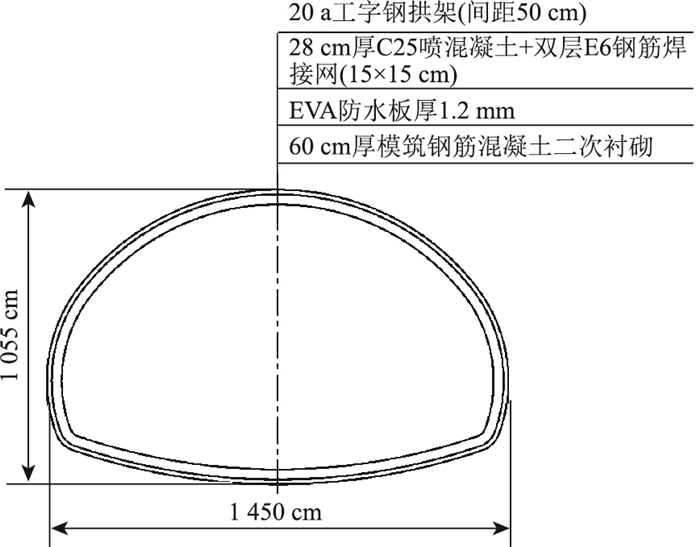
|
| 图 1 隧道结构设计参数 Fig. 1 Parameters for tunnel structure design |
| |
根据地勘资料显示,该段埋深20~100 m,地貌为丘陵斜坡区,地势略起伏,自然坡度约16°。中风化凝灰岩,岩质较坚硬,节理裂隙较发育,岩体完整性一般,显镶嵌碎裂状。该段水文地质条件较简单,地下水主要为基岩裂隙水,水量贫乏,开挖时沿节理面有滴水现象,降雨时可能有淋雨状出水。
1.2 振速限值确定结合西甑山隧道设计资料和相关文献[11-16]给出的建议值(见表 1),将爆破振速限值设置为7 cm/s,当爆破振速超过该值时,需采取减振、加固等措施,并加强振动监测。
2 小净距隧道合理间距分析 2.1 计算模型
综合考虑边界条件、埋深等因素,模型总体尺寸为长×宽×高=62 m×98 m×62 m。假设先行洞已施工二次衬砌,后行洞掌子面位于30 m处,初期支护紧跟掌子面,二次衬砌滞后掌子面18 m,循环进尺2 m,具体见图 2。
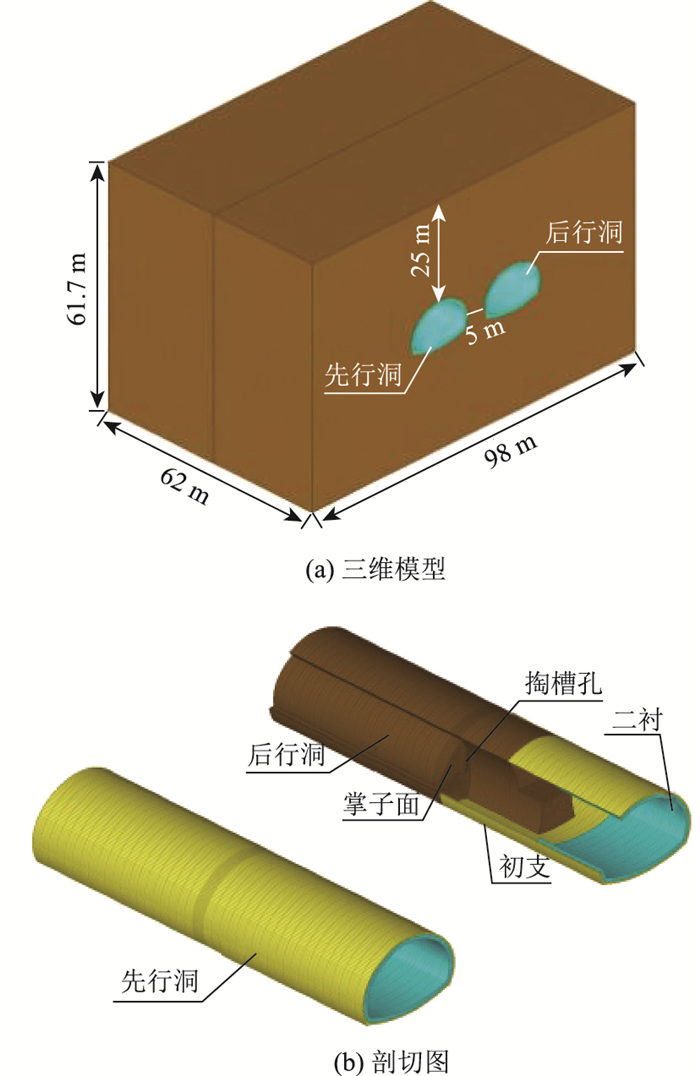
|
| 图 2 数值模型 Fig. 2 Numerical model |
| |
模型侧面、底面均约束其法向位移;顶部、隧道掌子面及已开挖隧道表面设置为自由边界,其余为无反射边界。
后行洞主要采用双侧壁导坑法开挖,本次计算主要研究后行洞靠近先行洞一侧开挖面掏槽孔爆破施工对先行洞衬砌结构振动的影响。掏槽孔采用耦合装药结构,掏槽孔布置及装药结构见图 3。雷管放置距炮孔底部20 cm,起爆总药量为23.94 kg,单段起爆药量为2.66 kg。
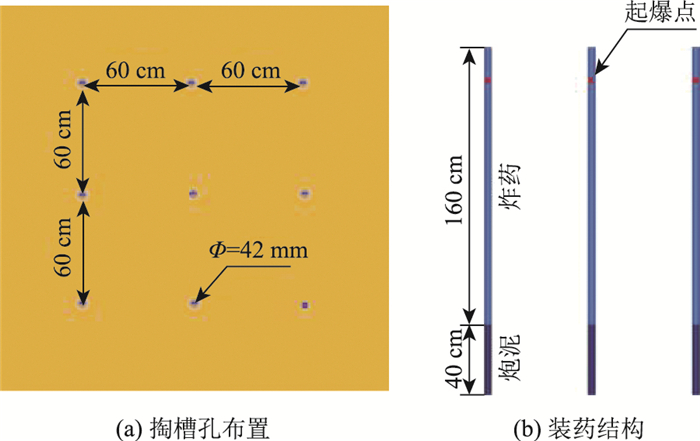
|
| 图 3 掏槽孔及装药结构布置 Fig. 3 Cut hole and charging structure arrangement |
| |
2.2 材料参数与计算工况
根据围岩级别、隧道两线间距,共分为12种工况见表 2及图 4。模型由围岩、衬砌、炸药、空气等材料组成,Ⅲ,Ⅳ,Ⅴ级围岩现场取样并通过单轴压缩试验确定其力学参数,衬砌、炸药及空气参考相关文献,如表 3所示。
| 计算工况 | 围岩级别 | 隧道两线间距/m |
| 工况1 | Ⅲ级 | 5 |
| 工况2 | 10 | |
| 工况3 | 15 | |
| 工况4 | 20 | |
| 工况5 | Ⅳ级 | 5 |
| 工况6 | 10 | |
| 工况7 | 15 | |
| 工况8 | 20 | |
| 工况9 | Ⅴ级 | 5 |
| 工况10 | 10 | |
| 工况11 | 15 | |
| 工况12 | 20 |
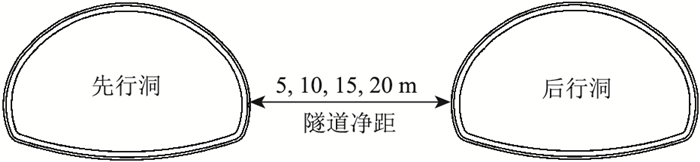
|
| 图 4 先、后行洞净距 Fig. 4 Net distance between first-excavation hole and subsequent hole |
| |
| 材料 | 弹性模量/ GPa |
泊松比 | 密度/ (g·cm―3) |
爆速/ (cm·μs―1) |
爆压/ GPa |
| Ⅲ级围岩 | 35 | 0.28 | 2.35 | — | — |
| Ⅳ级围岩 | 20 | 0.33 | 2.15 | — | — |
| Ⅴ级围岩 | 8 | 0.40 | 2.50 | — | — |
| 衬砌 | 26 | 0.20 | 2.20 | — | — |
| 炸药 | — | — | 1.20 | 0.55 | 12 |
| 空气 | — | — | 0.001 29 | — | — |
2.3 计算结果分析 2.3.1 先行洞振速分布规律
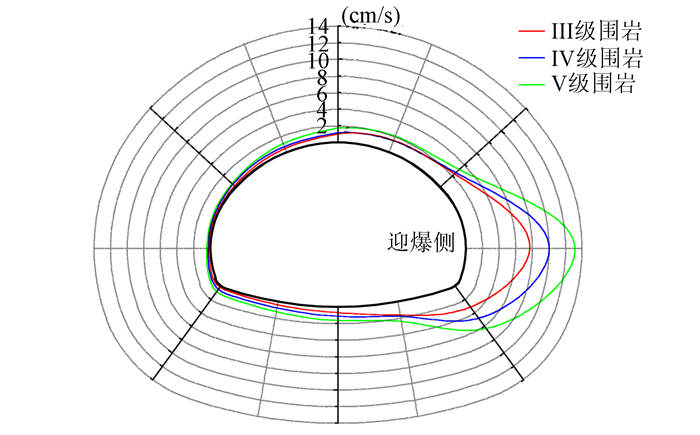
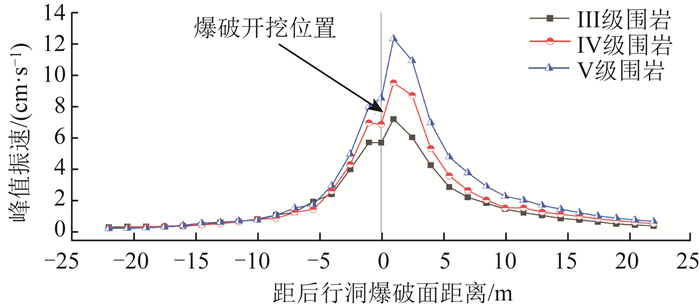
以隧道两线间距5 m为例,分析不同围岩级别先行洞横断面及迎爆侧边墙位置纵向振速分布规律(见图 5~6)。
|
| 图 5 先行洞横断面各监测点振速分布 Fig. 5 Vibration velocity distribution of each monitoring point on cross section of first-excavation hole |
| |
|
| 图 6 先行洞迎爆侧边墙振速沿纵向变化曲线 Fig. 6 Longitudinal variation curves of vibration velocity along blast-resistant side wall in first-excavation hole |
| |
分析图 5、6可得:(1)不同围岩级别下,先行洞横断面各监测点迎爆侧振速普遍大于背爆侧,背爆侧振速均小于2 cm/s,迎爆侧右边墙位置振速值最大,相邻侧拱腰、拱脚位置振速次之。(2)不同围岩级别下,先行洞右边墙振速随爆源距离的增大而非线性减小,先行洞前后5 m范围内振动响应敏感,振速最大值位于2 m处。(3)Ⅲ,Ⅳ,Ⅴ级围岩下先行洞二次衬砌迎爆侧右边墙振速分别为7.73,10.20,13.21 cm/s,表明随着围岩级别的减弱,先行洞二次衬砌的振动效应逐渐增强。
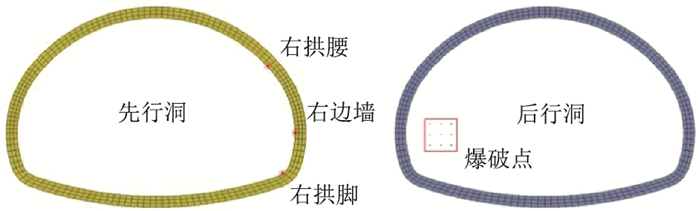
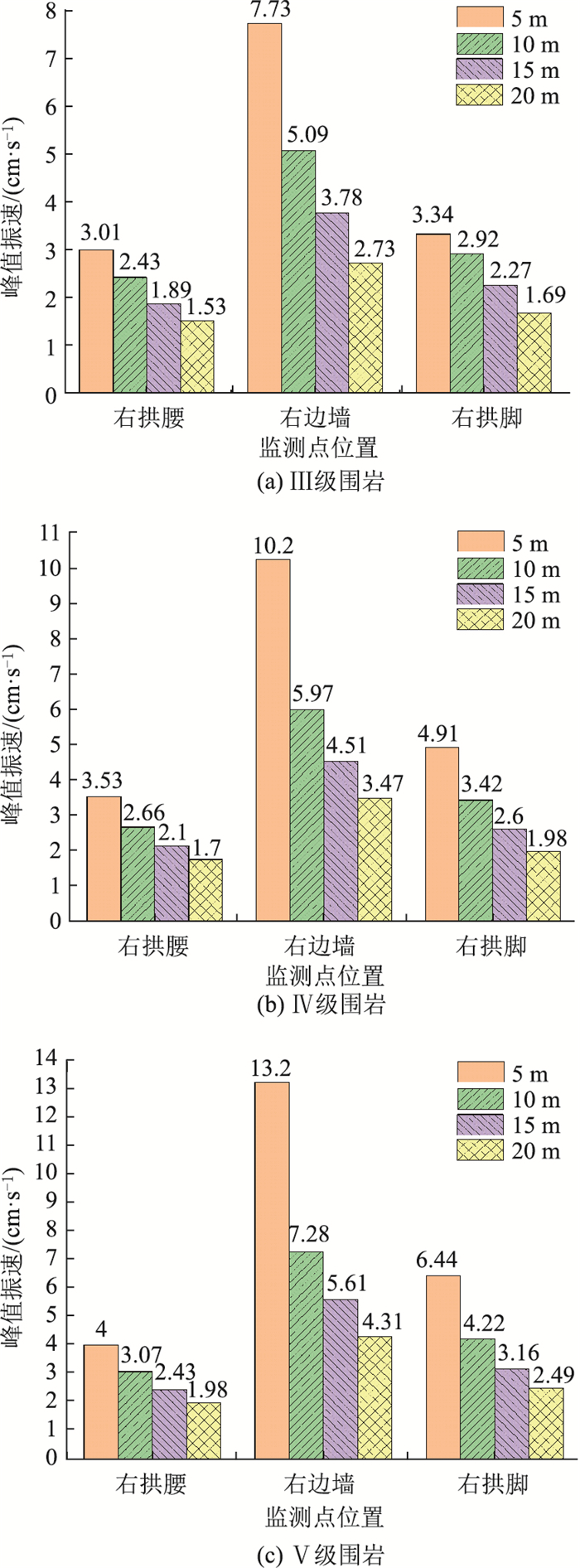
2.3.2 先行洞关键位置振速分析分析Ⅲ,Ⅳ,Ⅴ级围岩下,隧道两线间距分别为5,10,15,20 m时,先行洞迎爆侧拱腰、边墙、拱脚位置(见图 7)振速变化规律,如图 8所示。
|
| 图 7 监测点选取 Fig. 7 Monitoring point selection |
| |
|
| 图 8 各工况下先行洞峰值振速 Fig. 8 Peak vibration velocity of first-excavation hole under various working conditions |
| |
由图 8可得:(1)随着隧道两线间距增大,先行洞右拱腰、右边墙、右拱脚振速平均降幅分别约为20.9%,29.8%,24.4%,表明增大间距对先行洞右边墙降幅程度影响最大,右拱脚次之,右拱最小。(2)不同围岩条件下,当隧道两线间距分别为10,15,20 m时,相对于隧道间距5 m时先行洞振速平均值分别减小为39.7%,54.8%,66.2%,表明爆破应力波随间距的增加可快速衰减且释放能量较多,衬砌结构振动响应敏感程度随之降低。
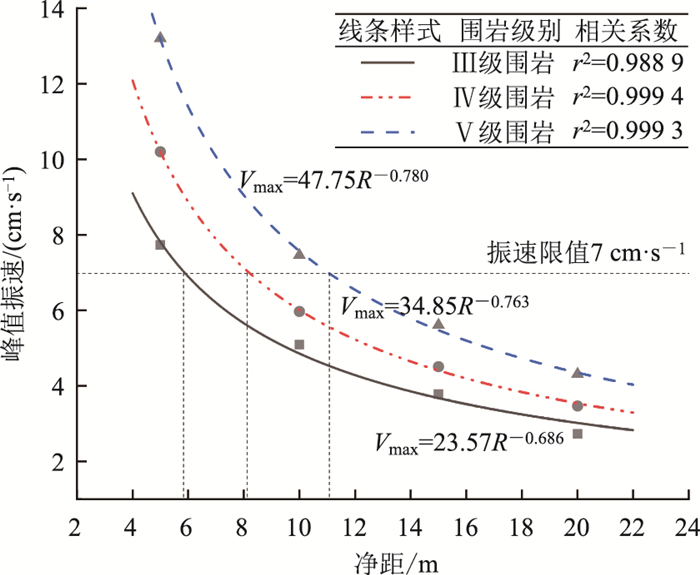
2.3.3 基于爆破振速划分合理间距以先行洞右边墙位置振速为基础,通过非线性曲线拟合确定先行洞最大振速Vmax与隧道两线间距R的回归关系,如图 9所示。
|
| 图 9 最大振速值与间距拟合曲线 Fig. 9 Fitting curves of maximum vibration velocity value and spacing |
| |
通过图 9拟合曲线可得:(1)不同围岩条件下,先行洞监测点振速均随间距的增大呈现非线性减小的趋势,二者呈指数函数关系。(2)根据振速限值和拟合曲线关系,得到Ⅲ,Ⅳ,Ⅴ级围岩下隧道合理间距分别为5.8,8.2,11.1 m,小于该值时后行洞爆破施工可能会引起先行洞衬砌结构破坏,需要采取减振加固措施,以减小先行洞迎爆侧振动响应,同时加强监测。
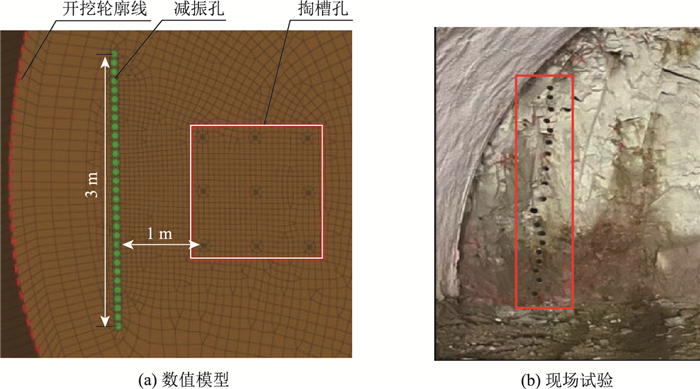
3 小净距隧道减振孔降振效果分析 3.1 振孔计算模型及现场布置为探究小净距隧道减振孔降振效果,在前文三维数值模型的基础上,后行洞掌子面迎爆侧布设1排31个减振孔,直径为8 cm,间距设置为10 cm,如图 10(a)所示。
|
| 图 10 后行洞减振孔布置 Fig. 10 Damping holes arrangement in subsequent hole |
| |
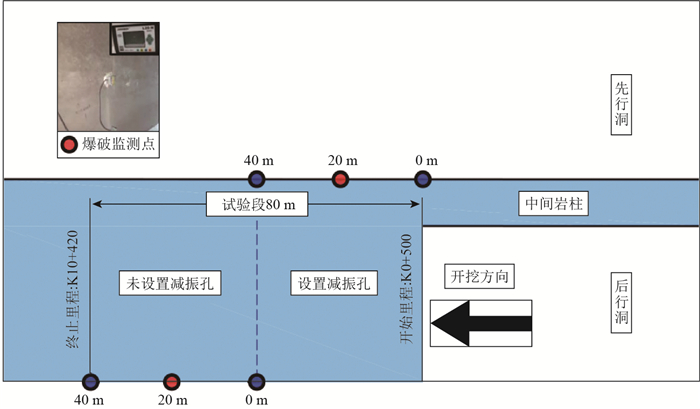
在西甑山隧道小净距段开展减振孔现场试验,里程为K10+420~K10+500,Ⅳ级围岩,隧道两线间距15~20 m之间,减振孔布设方式见图 10(b)。监测范围为后行洞掌子面前方80 m内对应的先行洞边墙位置,0~40 m段未设置减振孔,监测点设置在20 m处;40~80 m段设置减振孔,监测点设置在60 m处,见图 11。
|
| 图 11 现场监测点布置及安装 Fig. 11 Layout and installation of on-site monitoring points |
| |
3.2 结果分析
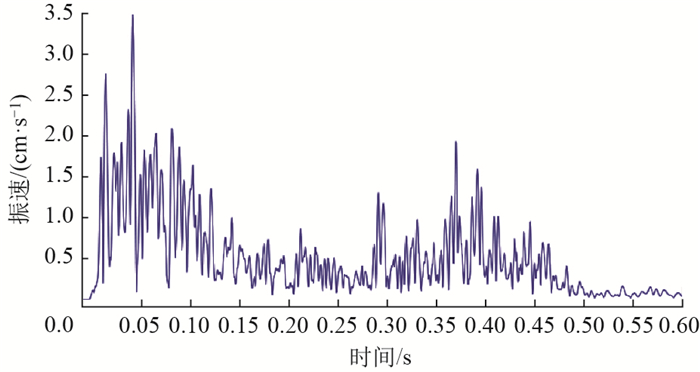
后行洞不同爆破开挖位置和先行洞监测点振速关系(见表 4、图 12),分析可知:(1)无论是否布置减振孔,随着先行洞监测点与后行洞掌子面逐渐从接近、穿越、远离的过程中,先行洞边墙处逐渐从迎爆侧转变为背爆侧而呈现先增大后减小的规律。(2)当后行洞开挖至― 15~25 m范围时,设置减振孔后振速值变化明显,此时计算值设置减振孔相比于未设置的减振率提高18.7%,而实际监测中减振率提高32.6%,二者相差不大表明减振孔在小净距隧道后行洞开挖过程中,能够有效降低先行洞的爆破振动。通过分析可知,爆破施工中产生的应力波会发生反射、透射和绕射现象。当后行洞爆破面设置减振孔时,应力波传播过程中会产生绕射效应,从而延长应力波的传播路径并使其能量发生耗散。(3)无论是否设置减振孔,实际监测振速最大值为3.49 cm/s,远小于7 cm/s的限值,此时先行洞二次衬砌振速值满足安全控制的要求。
| 后行洞开挖距离/m | 5.50 | 14.50 | 20.00 | 25.50 | 30.00 | 34.50 | |
| 振速计算值/ (cm·s―1) |
未设置减振孔 | 0.40 | 2.01 | 3.26 | 0.93 | 0.55 | 0.36 |
| 设置减振孔 | 0.32 | 1.76 | 2.82 | 0.88 | 0.49 | 0.29 | |
| 振速监测值/ (cm·s―1) |
未设置减振孔 | 0.83 | 2.93 | 3.50 | 2.00 | 0.97 | 0.22 |
| 设置减振孔 | 0.70 | 2.10 | 2.27 | 1.30 | 0.70 | 0.15 | |
|
| 图 12 现场监测衬砌最大振速时程曲线 Fig. 12 Tim-history curve of maximum vibration velocity of lining monitored on site |
| |
4 结论
(1) 采用先行洞迎爆侧边墙位置振速最大,随着隧道两线间距增大,边墙位置振速变化明显。以先行洞边墙振速为基础,通过拟合出围岩级别-衬砌振速-隧道净距关系曲线,并采用文献调研、工程类比确定振速限值,结合二者划分小净距隧道合理间距。
(2)Ⅲ,Ⅳ,Ⅴ级围岩下小净距隧道合理间距分别为5.8,8.2,11.1 m,小于该值时需加强衬砌结构振动监测,必要时采取减振加固措施。
(3) 当后行洞爆破面设置减振孔时,应力波传播过程中会产生绕射效应,从而延长应力波的传播路径并使其能量发生耗散。通过现场减振孔试验显示,计算值、监测值相比未设置的减振率提高18.7%,32.6%,二者相差不大,表明减振孔在小净距隧道降振效果明显。
(4) 实际监测振速最大值3.49 cm/s,远小于7 cm/s的限值,此时先行洞二次衬砌振速值满足安全控制的要求。
| [1] |
夏才初, 龚建伍, 唐颖, 等. 大断面小净距公路隧道现场监测分析研究[J]. 岩石力学与工程学报, 2007, 26(1): 44-50. XIA Cai-chu, GONG Jian-wu, TANG Ying, et al. Study on Site Monitoring of Large-section Highway Tunnels with Small Clear Spacing[J]. Chinese Journal of Rock Mechanics and Engineering, 2007, 26(1): 44-50. |
| [2] |
安欣, 孙毅, 李涛, 等. 高速公路隧道出口与互通出口最小净距研究[J]. 公路交通科技, 2021, 38(9): 132-140. AN Xin, SUN Yi, LI Tao, et al. Study on Minimum Clear Distance Between Expressway Tunnel Exit and Interchange Exit[J]. Journal of Highway and Transportation Research and Development, 2021, 38(9): 132-140. DOI:10.3969/j.issn.1002-0268.2021.09.017 |
| [3] |
万桂军, 刘春舵, 关瑞士, 等. 浅埋小净距隧道含软弱夹层段开挖变形与围岩应力分析[J]. 公路交通科技, 2022, 39(7): 131-138. WAN Gui-jun, LIU Chun-duo, GUAN Rui-shi, et al. Analysis on Excavation Deformation and Surrounding Rock Stress of Shallow Buried Small Clear Distance Tunnel with Weak Interlayer[J]. Journal of Highway and Transportation Research and Development, 2022, 39(7): 131-138. DOI:10.3969/j.issn.1002-0268.2022.07.017 |
| [4] |
姚勇, 何川. 并设小净距隧道爆破振动响应分析及控爆措施研究[J]. 岩土力学, 2009, 30(9): 2815-2822. YAO Yong, HE Chuan. Analysis of Blasting Vibration Response of Parallel Set Small Clear-distance Tunnels and Blasting Control Measures[J]. Rock and Soil Mechanics, 2009, 30(9): 2815-2822. DOI:10.3969/j.issn.1000-7598.2009.09.048 |
| [5] |
龚彦峰, 王智勇, 张俊儒, 等. 五车道大跨分岔隧道小净距段中夹岩柱支护效果研究[J]. 公路交通科技, 2021, 38(8): 123-133. GONG Yan-feng, WANG Zhi-yong, ZHANG Jun-ru, et al. Study on Supporting Effect of Middle Rock Pillars in Small Clear Distance Section of Long-span Forked Tunnel with Five lanes[J]. Journal of Highway and Transportation Research and Development, 2021, 38(8): 123-133. DOI:10.3969/j.issn.1002-0268.2021.08.017 |
| [6] |
吴恒滨, 张学富, 周元辅, 等. 小净距大断面隧道合理净距研究[J]. 重庆交通大学学报(自然科学版), 2010, 29(1): 63-68. WU Heng-bin, ZHANG Xue-fu, ZHOU Yuan-fu, et al. Reasonable Spacing of Closely Spaced Tunnels with Large Cross-Section[J]. Journal of Chongqing Jiaotong University(Natural Science), 2010, 29(1): 63-68. |
| [7] |
王更峰, 熊晓晖, 张永兴, 等. 大跨小净距隧道合理开挖方法与支护参数对比研究[J]. 公路交通科技, 2011, 28(3): 101-107. WANG Geng-feng, XIONG Xiao-hui, ZHANG Yong-xing, et al. Comparative Study of Rational Excavation Method and Support Parameter for Large-span Small-spacing Tunnel[J]. Journal of Highway and Transportation Research and Development, 2011, 28(3): 101-107. |
| [8] |
张仁根, 吴文琦. 爆破开挖时小净距隧道的合理间距研究[J]. 公路, 2011(8): 277-281. ZHANG Ren-Geng, WU Wen-qi. A Study on Reasonable Spacing of Neighborhood Tunnel During Blasting Excavation[J]. Highway, 2011(8): 277-281. |
| [9] |
张海兵, 林锋, 秦阳. 层状围岩中小净距隧道合理净距研究[J]. 公路, 2020, 65(9): 309-313. ZHANG Hai-bing, LIN Feng, QIN Yang. Study on Reasonable Clear Distance of Small and Medium Distance Tunnel in Layered Surrounding Rock[J]. Highway, 2020, 65(9): 309-313. |
| [10] |
孙闯, 敖云鹤, 张家鸣. 弱节理小净距隧道合理净距及围岩稳定性研究[J]. 公路交通科技, 2020, 37(5): 108-115. SUN Chuang, AO Yun-he, ZHANG Jia-ming. Study on Reasonable Clear Distance and Surrounding Rock Stability of Weak Jointed Small Clear Distance Tunnel[J]. Journal of Highway and Transportation Research and Development, 2020, 37(5): 108-115. DOI:10.3969/j.issn.1002-0268.2020.05.013 |
| [11] |
管晓明, 余志伟, 宋景东, 等. 隧道超小净距下穿深埋供水管线爆破监测及减振技术研究[J]. 土木工程学报, 2017, 50(增2): 160-166. GUAN Xiao-ming, YU Zhi-wei, SONG Jing-dong, et al. Blasting Monitoring and Vibration Reduction Technology of Tunnel Underpass Deep Buried Water Supply Pipe Line with Ultra-small Clear Distance[J]. China Civil Engineering Journal, 2017, 50(S2): 160-166. |
| [12] |
张俊兵, 胡国伟. 浅埋不良地质条件下小净距隧道掘进与减振爆破技术研究[J]. 铁道工程学报, 2011, 28(1): 51-57. ZHANG Jun-bing, HU Guo-wei. Research on Driving and Damping Blast Technologies for Construction of Shallow Small Clear-distance Tunnel under Favorable Geological Conditions[J]. Journal of Railway Engineering Society, 2011, 28(1): 51-57. |
| [13] |
石洪超, 邹新宽, 张继春, 等. 层状围岩小净距隧道减振掘进爆破技术试验研究[J]. 爆破, 2015, 32(4): 1-5. SHI Hong-chao, ZOU Xin-kuan, ZHANG Ji-chun, et al. Experimental Study on Vibration Reduction Blasting in Small-distance Tunnel in Stratiform Surrounding Rock[J]. Blasting, 2015, 32(4): 1-5. |
| [14] |
杜小刚, 程玉泉, 林从谋. 超小净距下穿高铁隧道减振爆破技术[J]. 工程爆破, 2017, 23(2): 44-48. DU Xiao-gang, CHENG Yu-quan, LIN Cong-mou. Blasting Vibration Reduction Technology for High-speed Railway Tunnel Under Ultra-small Distance[J]. Engineering Blasting, 2017, 23(2): 44-48. |
| [15] |
杨转运, 刘会, 吴汉辉. 小净距隧道施工中减振技术研究[J]. 现代交通技术, 2006, 3(4): 37-41. YANG Zhuan-yun, LIU Hui, WU Han-hui. Study on the Technology of Blasting Vibration Control in Construction of Small Clear Distance Tunnel[J]. Modern Transportation Technology, 2006, 3(4): 37-41. |
| [16] |
蒋楠, 周传波, 罗钢, 等. 铁路隧道混凝土衬砌爆破振动安全判据[J]. 中南大学学报(自然科学版), 2012, 43(7): 2746-2750. JIANG Nan, ZHOU Chuan-bo, LUO Gang, et al. Blasting Vibration Safety Criterion of Railway Tunnel Concrete Lining[J]. Journal of Central South University (Science and Technology), 2012, 43(7): 2746-2750. |
| [17] |
胡守云, 周传波, 蒋楠, 等. P波作用下机场跑道的爆破安全振动速度研究[J]. 华南理工大学学报(自然科学版), 2018, 46(4): 129-136. HU Shou-yun, ZHOU Chuan-bo, JIANG Nan, et al. Study on Safety Blasting Vibration Velocity for Concrete Airport Runway Subjected to P-waves[J]. Journal of South China University of Technology (Natural Science Edition), 2018, 46(4): 129-136. |
| [18] |
林从谋, 陈礼彪, 蒋丽丽, 等. 高速公路扩建大断面特小净距隧道爆破稳定控制技术研究[J]. 岩石力学与工程学报, 2010, 29(7): 1371-1378. LIN Cong-mou, CHEN Li-biao, JIANG Li-li, et al. Research on Blasting Stability Control Technology of Large-span Highway Tunnel with Super-small Clear Spacing at Highway Expansion Project[J]. Chinese Journal of Rock Mechanics and Engineering, 2010, 29(7): 1371-1378. |
| [19] |
凌同华, 曹峰, 张胜, 等. 分岔隧道过渡段的爆破振动特性研究[J]. 振动与冲击, 2018, 37(2): 43-50. LING Tong-hua, CAO Feng, ZHANG Sheng, et al. Blast Vibration Characteristics of Transition Segment of a Branch Tunnel[J]. Journal of Vibration and Shock, 2018, 37(2): 43-50. |
| [20] |
刘玉山, 陈建平. 大轩岭小净距隧道爆破振动监测与分析[J]. 爆破, 2008, 25(2): 92-94. LIU Yu-shan, CHEN Jian-ping. Monitoring and Analysis of Blasting Vibration in Daxuanling Tunnel with Small Clear Space[J]. Blasting, 2008, 25(2): 92-94. |
| [21] |
何本国, 朱永全, 张志强. 超小净距隧道不同爆破方式现场试验研究[J]. 铁道科学与工程学报, 2010, 7(5): 65-69. HE Ben-guo, ZHU Yong-quan, ZHANG Zhi-qiang. Study on In-situ Test for Different Blasting Methods of the Super Small-Distance Tunnel[J]. Journal of Railway Science and Engineering, 2010, 7(5): 65-69. |