 2024, Vol. 41
扩展功能

文章信息
- 周锦强, 王海林, 杨雄, 曹峰.
- ZHOU Jin-qiang, WANG Hai-lin, YANG Xiong, CAO Feng
- 动态公交专用道分区控制方法设计及适用性分析
- Design and Applicability Analysis on Zoning Control Method for Dynamic Bus Lane
- 公路交通科技, 2024, 41(2): 166-172
- Journal of Highway and Transportation Research and Denelopment, 2024, 41(2): 166-172
- 10.3969/j.issn.1002-0268.2024.02.017
-
文章历史
- 收稿日期: 2021-11-25


 ,
, 优先发展公共交通是缓解城市交通拥堵的主要举措之一,公交专用道为最常用和最有效的技术手段,但现有公交专用道在保障公交优先通行的同时,也存在时段性闲置和通行能力利用不足等问题,增加了其他车辆出行时间成本。
为提高现有公交专用道使用的灵活性和高效性,Viegas等[1-2]首次系统的提出了动态公交专用道概念,并在里斯本进行了实地试验,理论与试验结果均表明动态公交专用道能获得较好的运营效果。在Viegas等研究内容的基础上,海内外学者进行了一系列研究。Eichler等[3],Nguyen[4],Levin等[5]和Wu等[6]拓展与完善了动态公交专用道的控制方法和运行规则。Qiu等[7],Wu等[8]和谢秋峰等[9]探讨了不同控制方法下,动态公交专用道所适用的交通流条件。此外,亦有研究探讨了智能网联汽车(Connected and Automated Vehicles,CAVs)通过自动驾驶、车车通信等方式动态使用公交专用道的方法[10-15]。例如:胡兴华等[10]基于车路协同环境,构建了交叉口群公交优先绿波协调控制双层规划模型,增加了交叉口整体通行效益。庞明宝等[11]探讨了智能网联车环境下,自动驾驶车辆借用公交专用道的控制方法。上述文献在理论研究方面取得了诸多成果。
本研究从工程实践的角度出发,在现有研究基础上,充分考虑公交停靠站的影响,依据公交停靠站划分清空区域范围,提出动态公交专用道分区控制方法,并结合可变情报板,对交叉口速度诱导方法进行了更进一步的研究。
1 动态公交专用道分区控制方法本研究所述的动态公交专用道分区控制方法包含清空区域、控制逻辑和运行规则3个主要概念,以及速度诱导措施,具体内容如下文所述。
1.1 清空区域清空区域是指将道路划分为一定长度的固定区域,在这些区域执行控制逻辑和运行规则[16-17]。本研究依据公交停靠站的几何位置确定清空区域的长度与数量,以路中型公交停靠站为例,具体划分方法如下:
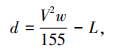
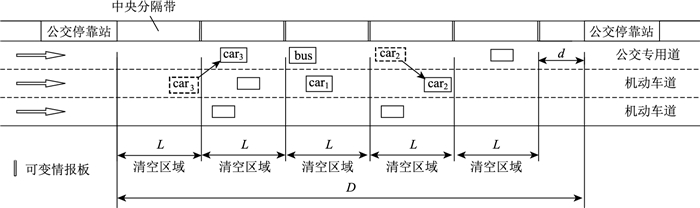
设相邻公交停靠站间距为D,相邻公交停靠站间清空区域的数量为n,清空区域长度为L(见图 1)。其他车辆应在公交停靠站前完成车道变换行为,不得影响公交停靠站的正常运营,因此可在公交停靠站前预设一段其他车辆变换车道的距离d,取值参考渐变段计算方法,即:
|
(1) |
|
| 图 1 清空区域划分示意图 Fig. 1 Schematic diagram of clearing area division |
| |
式中,V为85%位设计速度;w为车道宽度。
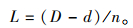
由图 1可得以下几何关系:
|
(2) |
式中,L为清空区域长度是动态公交专用道运营效果主要影响因素之一,后文将通过数值模拟的方法,分析其作用机理。
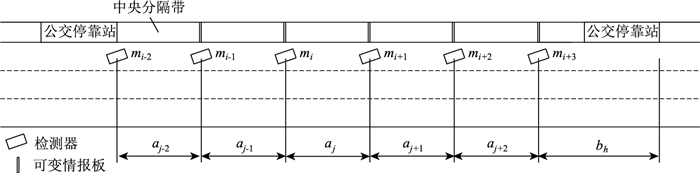
1.2 控制逻辑动态公交专用道的核心思想是根据公交车使用公交专用道的情况,动态开放公交专用道给其他车辆使用。本研究通过可变情报板提示公交专用道的使用状态,进而引导其他车辆进出公交专用道,实现动态公交专用道功能,可变情报板和检测器设置于清空区域边界(见图 2)。
|
| 图 2 可变情报板与检测器布设 Fig. 2 Layout of variable information board and detector |
| |
由图 2可知,清空区域和公交停靠站范围内区间组成全体分区集合。因此,设全体分区构成集合U={u1, u2, u3,…, ui},所有检测器构成集合M={m1, m2, m3,…, mi},所有清空区域构成集合A={a1, a2, a3,…, aj},所有公交停靠站范围内区间构成集合B={b1, b2, b3,…, bh},(i,j,h∈N+),ui与mi相互对应,A⊂U,B⊂U,bh内公交专用道为常规公交专用道,不与其他车辆共享。所有检测器均为车辆类型检测器,当检测到第1辆公交车时,产生标识1,依此类推,当检测到第k辆公交车时,产生标识k,k用于动态公交专用道分区控制逻辑运算。
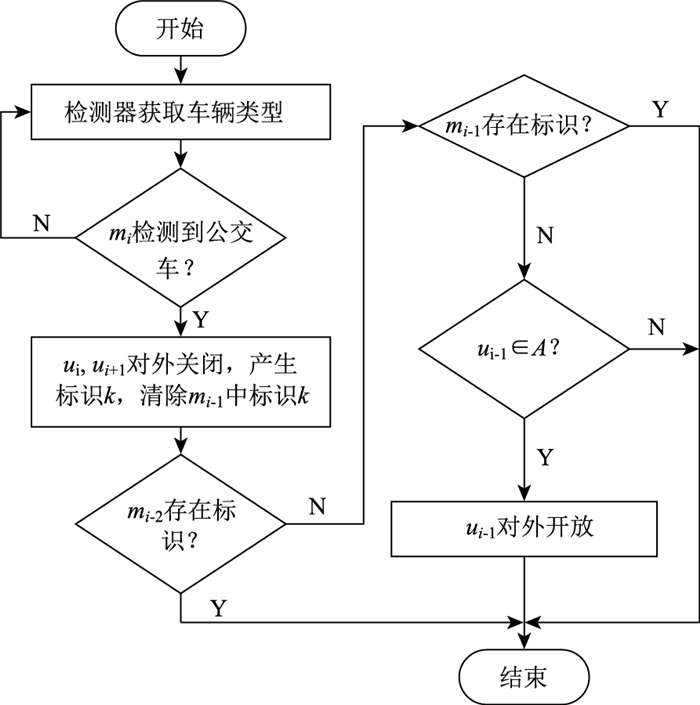
为保障公交车的路权,在公交车所在区间下游预留一个区间,其他车辆不能使用。动态公交专用道分区控制逻辑如下:检测器获取车辆类型,当mi检测到公交车时,产生标识k,ui,ui+1内公交专用道对外关闭,可变情报板给出公交专用道对外关闭提示。然后判别ui-1是否对其他车辆开放,其方法为:如果mi-2,mi-1均不存在标识,且ui-1∈A,则ui-1对外开放,可变情报板给出公交专用道对外开放提示(见图 3)。
|
| 图 3 动态公交专用道分区控制逻辑 Fig. 3 Logic of zoning control on dynamic bus lane |
| |
1.3 运行规则
清空区域内其他车辆根据可变情报板提示共享公交专用道,具体运行规则如下:
(1) 公交车使用公交专用道,可变情报板提示公交专用道对外关闭时,其他车辆不允许进入公交专用道(见图 1中car1),正在公交专用道行驶的其他车辆须驶离(见图 1中car2)。
(2) 公交车未使用公交专用道,可变情报板提示公交专用道对外开放时,其他车辆可驶入,借用公交专用道行驶(见图 1中car3)。
(3) 在公交车之前进入交叉口公交专用进口道的其他车辆,可继续行驶,通过交叉口后再变换车道。
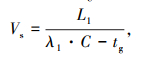
1.4 速度诱导措施可变情报板指示公交专用道使用状态的同时,可发布速度诱导信息,提高车辆在绿灯时间内通过交叉口的概率。本研究将交叉口上游可变情报板与交叉口信号控制机进行联动设计,获得所属相位当前绿灯时长等参数,从而计算机动车诱导速度Vs,Vs计算方法为:Vs(λ1·C-tg)=L1,即:
|
(3) |
式中,tg为所属相位当前绿灯时长;λ1为绿信比;L1为可变情报板与交叉口停止线的距离。
2 适用条件模拟及仿真分析影响动态公交专用道分区控制效果的主要参数为车辆饱和度、清空区域长度和公交发车间隔[6]。选取兰州市BRT部分线路为研究对象,基于Visual Studio 2019开发环境,搭建C++与Vissim4.3-COM联合仿真平台,探讨不同参数组合条件下(见表 1),动态公交专用道分区控制方法运营效益与运行特性。
| 清空区域长度/m | 公交发车间隔/s | 车辆饱和度 |
| 50 | 60 | 0.1 |
| 100 | 90 | 0.2 |
| 150 | 120 | 0.3 |
| 200 | 150 | 0.4 |
| — | — | 0.5 |
| — | — | 0.6 |
| — | — | 0.7 |
| — | — | 0.8 |
2.1 研究区域简介
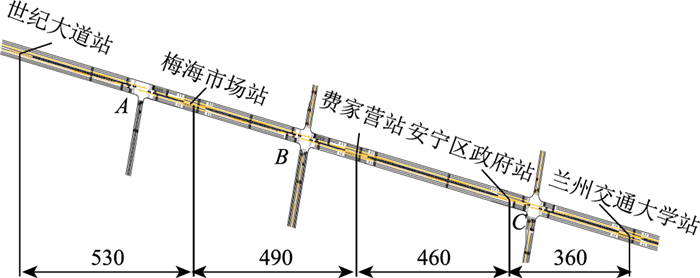
选取兰州BRT兰州交通大学站与世纪大道站间道路为案例开展研究,该道路单向布设有1条路中型BRT专用道和3条机动车道,共有BRT中途停靠站4座(见图 4)。BRT车辆具有专属路权,其他车辆不允许使用,根据本研究所述方法,将BRT专用道设为动态公交专用道。
|
| 图 4 研究区域(单位:m) Fig. 4 Study area (unit: m) |
| |
2.2 仿真环境设定
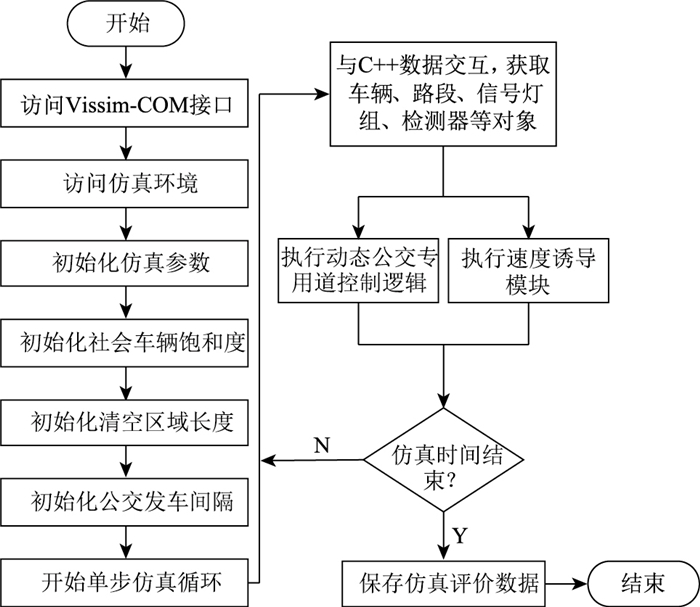
基于Visual Studio 2019开发环境,通过C++与微观仿真软件Vissim4.3-COM实现数据交互(见图 5),对表 1中组合条件分别进行联合仿真试验,每组试验时间为3 600 s。仿真试验前,选取兰州市两条实际路段,根据行程时间校正Vissim软件参数:观察到的车辆数取3辆,平均停车间距取2 m,消失前的等待时间取60 s,最小车头时距取2 s/pcu,随机种子取30[18]。经检验,校正值与实测值误差在5%以内。
|
| 图 5 仿真试验流程 Fig. 5 Flow chart of simulation test |
| |
2.3 适用条件模拟与评价
根据不同组合条件下模拟试验的评价结果,分析不同动态公交专用道分区控制方法下交通状况运营效果,具体内容如下文所述。
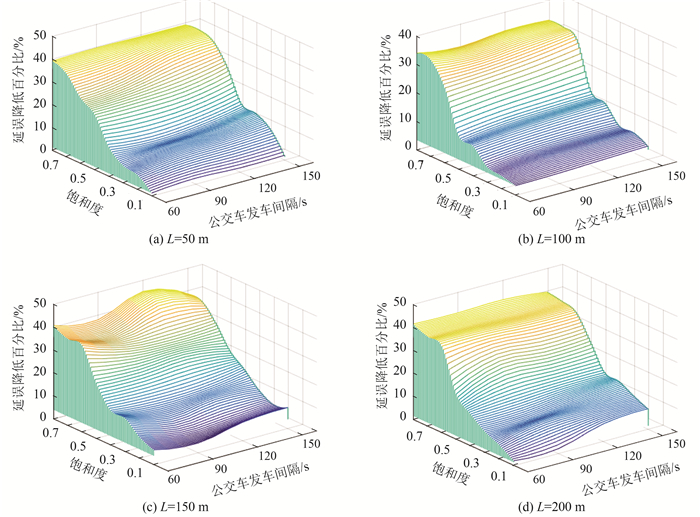
2.3.1 不同组合条件下其他车辆运营效果模拟不同的车辆饱和度λ、清空区域长度L及公交发车间隔F的组合条件,均影响着车辆的延误,对于其他车辆,取不同的L进行模拟,获得了不同的模拟结果(见图 6)。
|
| 图 6 不同组合条件下其他车辆运营效果影响 Fig. 6 Influence of other vehicle operation effects under different combination conditions |
| |
模拟结果表明:当清空区域长度和公交发车间隔一定时,随着车辆饱和度的增加,其他车辆使用公交专用道的需求增加,当λ>0.4时,其他车辆车均延误显著下降,动态公交专用道能取得较好的效果。而当车辆饱和度较低时,交通运行状况良好,其他车辆车均延误较低,没有必要实施动态公交专用道。
当车辆饱和度和公交发车间隔一定时,清空区域长度在50~200 m范围内,其他车辆延误均能明显下降,实施动态公交专用道效果明显。
当车辆饱和度和清空区域长度一定时,随着公交发车间隔的增大,公交车头时距增大,公交专用道提供给其他车辆使用的时间也越多,其他车辆车均延误逐渐下降,实行动态公交专用道能获得较大收益。
因此,当车辆饱和度大于0.4时,清空区域长度在50~200 m时,其他车辆车均明显降低,动态公交专用道分区控制运营效果良好。
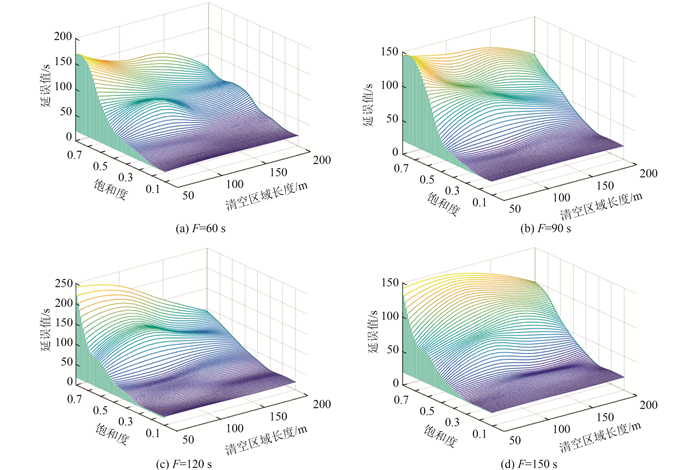
2.3.2 不同组合条件下公交车运营效果模拟在其他车辆改善效果较佳时,分析公交车车均延误与车辆饱和度λ、清空区域长度L及公交发车间隔F的关系(见图 7)。结果显示:在清空区域长度和公交发车间隔一定时,当λ>0.6时,由于车辆饱和度过高,其他车辆无法及时驶离公交专用道,导致公交车车均延误迅速增长。在车辆饱和度和公交发车间隔一定时,随着清空区域长度的增加,公交车受其他车辆借用公交专用道行驶的影响逐渐减小,车均延误呈下降趋势。当车辆饱和度和清空区域长度一定时,由于公交车具有专属路权,其车均延误随公交发车间隔的变化并不明显。
|
| 图 7 不同组合条件下公交车运营效果影响 Fig. 7 Influence of bus operation effects under different combination conditions |
| |
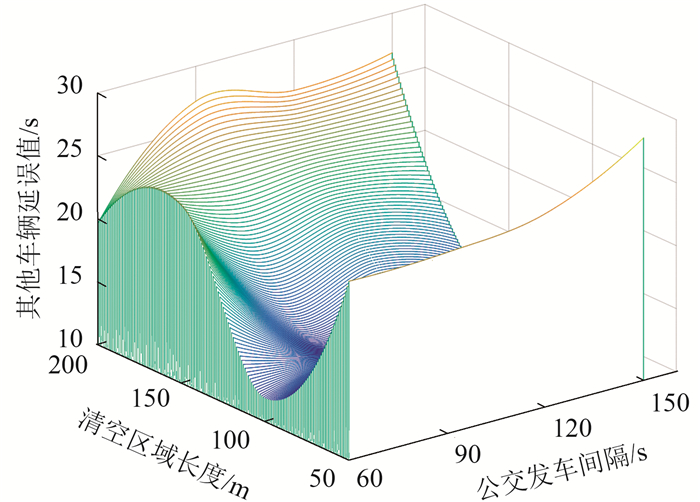
此外,本研究进一步分析了饱和度固定情况下,不同清空区域长度和公交发车频率对社会车辆运营效果的影响。以饱和度λ=0.5为例(见图 8)进行说明。由图 8可知,当清空区域长度为100 m时,其他车辆延误值较低。而清空区域过长或过短,其他车辆的运营效果均会受影响。这是因为当清空区域过长时,其他车辆使用动态公交专用道的时间会减少。而当清空区域过长时,其他车辆由于频繁变更车道,延误值也会受影响。
|
| 图 8 λ=0.5时其他车辆运营效果影响 Fig. 8 Influence of other vehicle operation effects when λ=0.5 |
| |
综上,当0.4<λ<0.6,L=100 m时,其他车辆收益较大,公交车所受影响较小,在保障了公交优先的同时,也考虑了其他车辆出行的合理需求,实行动态公交专用道分区控制策略综合运营效益最佳。
3 结论本研究设计了由公交停靠站划分清空区域的动态公交专用道分区控制方法,并结合实例,通过C++ 与Vissim-COM联合仿真,得到该方法所适用的交通条件,得到的主要结论如下:
当饱和度在0.4~0.6,清空区域长度为100 m时,其他车辆收益较大,公交车所受影响较小,在保障了公交优先的同时,也考虑了其他车辆出行的合理需求,实行动态公交专用道分区控制策略综合运营效益最佳。
本研究所述动态公交专用道分区控制方法所需的硬件设施投资较低,总体实施效果较好,具有一定的可推广性。在未来的研究中,可进一步基于数学优化的思想,通过数学模型来得到最优控制方案。
| [1] |
VIEGAS J, LU B. The Intermittent Bus Lane Signals Setting within an Area[J].
Transportation Research Part C: Emerging Technologies, 2004, 12(6): 453-469.
DOI:10.1016/j.trc.2004.07.005 |
| [2] |
VIEGAS J M, ROQUE R, LU B C, et al. The Intermittent Bus Lane System: Lisbon Demonstration Project[J].
Public Transport International, 2007, 56(3): 40-43.
|
| [3] |
EICHLER M, DAGANZO C F. Bus Lanes with Intermittent Priority: Strategy Formulae and an Evaluation[J].
Transportation Research Part B: Methodological, 2006, 40(9): 731-744.
DOI:10.1016/j.trb.2005.10.001 |
| [4] |
NGUYEN V N. Partial Dynamic Bus Lanes for Heavily Loaded Traffic Conditions in Motorcycle Dependent Cities (MDCs)[J].
Journal of the Eastern Asia Society for Transportation Studies, 2017, 12: 1363-1382.
|
| [5] |
LEVIN M W, KHANI A. Dynamic Transit Lanes for Connected and Autonomous Vehicles[J].
Public Transport, 2018, 10(3): 399-426.
DOI:10.1007/s12469-018-0186-2 |
| [6] |
WU W, HEAD L, YAN S, et al. Development and Evaluation of Bus Lanes with Intermittent and Dynamic Priority in Connected Vehicle Environment[J].
Journal of Intelligent Transportation Systems, 2018, 22(4): 301-310.
DOI:10.1080/15472450.2017.1313704 |
| [7] |
QIU F, LI W, ZHANG J, et al. Exploring Suitable Traffic Conditions for Intermittent Bus Lanes[J].
Journal of Advanced Transportation, 2015, 49(3): 309-325.
DOI:10.1002/atr.1265 |
| [8] |
WU D, DENG W, SONG Y, et al. Evaluating Operational Effects of Bus Lane with Intermittent Priority under Connected Vehicle Environments[J].
Discrete Dynamics in Nature and Society, 2017(12): 1-13.
|
| [9] |
谢秋峰, 李文权, 贾晓欢, 等. 设置间歇式公交专用进口道的流量条件研究[J]. 交通运输工程与信息学报, 2012, 10(2): 117-124. XIE Qiu-feng, LI Wen-quan, JIA Xiao-huan, et al. Research on Traffic Flow Conditions for Set Intermittent Bus-only Approach[J]. Journal of Transportation Engineering and Information, 2012, 10(2): 117-124. |
| [10] |
胡兴华, 朱晓宁, 隆冰. 车路协同下考虑绿波协调的公交优先控制[J]. 交通运输系统工程与信息, 2017, 17(3): 74-82. HU Xing-hua, ZHU Xiao-ning, LONG Bing. A Bus Priority Control Model Considering Green Wave Coordination under Cooperative Vehicle Infrastructure System[J]. Journal of Transportation Systems Engineering and Information Technology, 2017, 17(3): 74-82. |
| [11] |
庞明宝, 柴紫欣, 巩丹阳. 混合交通下智能网联车借道公交专用车道控制[J]. 交通运输系统工程与信息, 2021, 21(4): 118-124. PANG Ming-bao, CHAI Zi-xin, GONG Dan-yang. Control of Connected and Automated Vehicles Driving on Dedicated Bus Lane under Mixed Traffic[J]. Journal of Transportation Systems Engineering and Information Technology, 2021, 21(4): 118-124. |
| [12] |
CHEN X, LIN X, HE F, et al. Modeling and Control of Automated Vehicle Access on Dedicated Bus Rapid Transit Lanes[J].
Transportation Research Part C, 2020, 120: 102795.
DOI:10.1016/j.trc.2020.102795 |
| [13] |
GONG S, DU L. Cooperative Platoon Control for a Mixed Traffic Flow Including Human Drive Vehicles and Connected and Autonomous Vehicles[J].
Transportation Research Part B, 2018, 116: 25-61.
DOI:10.1016/j.trb.2018.07.005 |
| [14] |
WANG X, LIN X, LI M. Aggregate Modeling and Equilibrium Analysis of the Crowdsourcing Market for Autonomous Vehicles[J].
Transportation Research Part C, 2021, 132: 103362.
DOI:10.1016/j.trc.2021.103362 |
| [15] |
李超群. 面向动态公交专用道的信号优先控制方法研究[D]. 长沙: 长沙理工大学, 2017. LI Chao-qun. Research on Signal Priority Control Method for Dynamic Bus Lane[D]. Changsha: Changsha University of Science & Technology, 2017. |
| [16] |
孙剑, 杨晓光. 微观交通仿真模型系统参数校正研究—以VISSIM的应用为例[J]. 交通与计算机, 2004, 22(3): 3-6. SUN Jian, YANG Xiao-guang. Study on System Parameter Calibration of Microscopic Traffic Simulation Model—Taking the Application of VISSIM as an Example[J]. Journal of Transportation and Computer, 2004, 22(3): 3-6. |
| [17] |
汪林. 基于预测的快速公交信号优先设计及效果仿真[J]. 公路交通科技, 2017, 34(6): 129-135. WANG Lin. Signal Priority Design for Bus Rapid Transit Based on Prediction Method and Effect Simulation[J]. Journal of Highway and Transportation Research and Development, 2017, 34(6): 129-135. DOI:10.3969/j.issn.1002-0268.2017.06.019 |
| [18] |
柳祖鹏, 李克平, 何雅琴, 等. 基于时间距离轨迹的公交站点布设优化[J]. 公路交通科技, 2019, 36(6): 103-111. LIU Zu-peng, LI Ke-ping, HE Ya-qin, et al. Optimization of Bus Stop Layout Based on Time Distance Trajectory[J]. Journal of Highway and Transportation Research and Development, 2019, 36(6): 103-111. DOI:10.3969/j.issn.1002-0268.2019.06.014 |