 2023, Vol. 40
扩展功能

文章信息
- 杨胜丰, 黄东青, 谌旎偲, 尹威, 颜可珍.
- YANG Sheng-feng, HUANG Dong-qing, CHEN Ni-cai, YIN Wei, YAN Ke-zhen
- 基于近似Kramers-Kronig关系的动态模量Sigmoidal模型力学演进研究
- Study on Mechanical Evolution of Dynamic Modulus Sigmoidal Model Based on Approximate Kramers-Kronig Relation
- 公路交通科技, 2023, 40(12): 66-73
- Journal of Highway and Transportation Research and Denelopment, 2023, 40(12): 66-73
- 10.3969/j.issn.1002-0268.2023.12.008
-
文章历史
- 收稿日期: 2022-12-02


 ,
, 2. 湖南大学 土木工程学院, 湖南 长沙 410082;
3. 长沙学院 土木工程学院, 湖南 长沙 410022
2. College of Civil Engineering, Hunan University, Changsha Hunan 410082, China;
3. College of Civil Engineering, Changsha University, Changsha Hunan 410022, China
沥青路面材料的力学性能受车辆荷载和环境温度的影响而表现出动力学性质,因此沥青路面设计越来越多地采用动力学方法。无论是国内沥青路面设计规范,还是美国公路战略研究计划(NCHRP)提出的力学-经验设计方法(MEPDG)[1],均将动力学思想纳入沥青路面设计理念之中,并将沥青混合料视为典型的黏弹性材料,考虑温度和荷载频率因素对材料力学参数的影响[2-3]。
为描述沥青混合料这种动态黏弹力学性质,研究者通常基于时-温等效原理,建立沥青混合料黏弹力学参数的主曲线,预测其宽温和宽频范围的线性黏弹力学性质[4-5]。美国各州公路和运输工作者协会(AASHTO)提出了表征沥青混合料动力学性质(动态模量)的Sigmoidal模型[6-7]。Zeng等[8]基于CA模型,提出了描述动态模量和相位角动态力学规律的MCAM模型。Zhao等[9]基于Sigmoidal模型,模拟围压和加载频率的影响,提出了水平移位因子模型。从上述方法可知,沥青混合料的动态力学性质研究经历了单一黏弹参数、双黏弹参数及不同受力状态等多方面的发展。以上研究均围绕沥青混合料的动态模量数学模型开展研究,有部分研究忽略了相位角(损失模量)这一重要参数;另有部分研究虽然考虑了相位角,但是相位角与动态模量未采用同一套模型参数,不满足黏弹力学所要求的因果关系。Booij和Thoone[10]提出了复变函数域内黏弹参数的Kramers-Kronig近似关系式,该方法可为数学方法模拟黏弹性力学性质提供新的思路。
本研究从Sigmoidal方程出发,基于近似Kramers-Kronig关系式分别建立了表征沥青混合料动态模量与相位角的两类Sigmoidal模型表达式,以两种沥青混合料动态模量试验为例,分析了实测数据与模型预测值之间的关系,并对比分析了不同模型计算结果。
1 理论基础首先,根据文献[1, 11],复数模量E*(iω) 由实部存储模量E′(ω)和虚部损失模量E″(ω)如式(1)所示:

|
(1) |
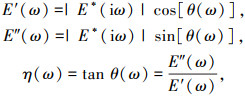
复数模量E*(iω)、存储模量E′(ω)、损失模量E″(ω)三者之间的数学关系如式(2)所示:
|
(2) |
式中,|E*(iω)|为动态模量;ω为角频率;θ(ω)为相位角;η(ω)为损耗因子;i为虚数,i2=-1。
美国公路合作计划(NCHRP)项目A-37提出动态模量主曲线拟合的Sigmoidal模型[12]。

|
(3) |
式中,|E*|为动态模量; α,β,γ,δ,λ为模型拟合系数;ωr为缩减频率。
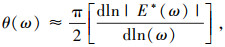
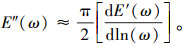
Booij和Thoone[10]根据Kramers-Kronig关系得到了动态模量|E*(iω)|与相位角θ(ω)、损失模量与存储模量之间的近似解析表达式,分别如(4)~(5)所示:
|
(4) |
|
(5) |
根据式(4),得到Sigmoidal模型的相位角解析式如(6)所示:

|
(6) |
式中,θ(ωr)为相位角,其模型参数与式(3)一致,式(3)与式(6)组成的模型为Sigmoidal Ⅰ-Ⅰ模型。
Yang和You[13]认为式(6)缺乏准确性,将式(6)中增加一个参数c得到式(7):

|
(7) |
式中,θ(ωr)为相位角方程,除参数c外,其模型参数与式(3)一致,式(3)与式(7)组成的模型称为Sigmoidal Ⅰ-Ⅱ模型。
式(6)~(7)为相位角函数,均由Sigmoidal函数推导得出,将Sigmoidal Ⅰ-Ⅰ模型和Sigmoidal Ⅰ-Ⅱ模型统称为Sigmoidal Ⅰ类模型,
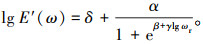
1.2 Sigmoidal Ⅱ模型根据AASHTO R62-131[6],沥青混合料的存储模量同样可以采用Sigmoidal模型表征,即:
|
(8) |
将式(8)代入式(5)后,化简得到损失模量的解析式如(9)所示:

|
(9) |
式(9)由存储模量的Sigmoidal函数根据式(5)推导得到,式(8)~(9)采用同一套参数组成的解析式,满足黏弹性因果关系,称之为Sigmoidal Ⅱ类模型。
2 主曲线构造根据文献[1],利用黏弹性材料的时-温等效性质,得到参考温度下黏弹函数模型主曲线需要借助移位因子和目标函数,模型的拟合效果可以采用目标函数和拟合优度评价。
2.1 移位因子计算本研究选择Sigmoidal模型的二次多项式(10)计算模型的移位因子。

|
(10) |
式中,αT为温度移位因子;T为试验温度;T0为参考温度;C1,C2为常数,无量纲。
缩减频率与角频率之间的关系如式(11)所示:

|
(11) |
根据Kramers-Kronig法则,由复数模量(存储模量)的解析式可以获得相位角(损失模量)解析式,且从式(2)可知,动态模量综合了损失模量、存储模量及相位角的相关信息[14-15],将其应用于构建目标函数,能够有效避免拟合信息过多。

|
(10) |
参考式(12),采用动态模量和相位角构造目标函数如式(13)所示:
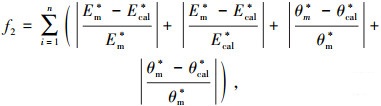
|
(13) |
式中,f1,f2为目标函数,Em*,Ecal*,θm和θcal分别为动态模量、相位角的测试值和预测值。
2.3 拟合优度本研究拟合优度计算参考文献[11],采用标准误差比计算决定系数(R2),并根据决定系数接近1的程度评价模型准确性。
3 模型验证本研究采用AC-10和AC-16两种沥青混合料对Sigmoidal模型及其导出模型进行验证。沥青混合料制备及动态模量试验过程参考文献[1],应用黏弹性时-温等效原理[16-18],选择21 ℃作为参考温度,以式(12)或(13)作为目标函数,通过最优化目标函数,得到动态模量和相位角的主曲线。
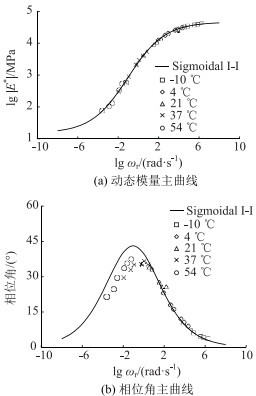
3.1 Sigmoidal Ⅰ类模型验证 3.1.1 Sigmoidal Ⅰ-Ⅰ模型验证采用式(12),建立AC-10和AC-16两种沥青混合料Sigmoidal Ⅰ-Ⅰ模型黏弹参数主曲线(动态模量和相位角主曲线),以AC-16沥青混合料为例,其黏弹参数主曲线如图 1所示。
|
| 图 1 AC-16沥青混合料Sigmoidal Ⅰ-Ⅰ模型验证 Fig. 1 Sigmoidal Ⅰ-Ⅰ model validation for AC-16 asphalt mixture |
| |
从图 1中可知,Sigmoidal Ⅰ-Ⅰ模型对动态模量的拟合较好,主要是目标函数以动态模量的最优化为目标,得到了最佳的拟合效果。从图 1(b)中可知,沥青混合料在中高温度,拟合曲线偏离实测曲线较明显,说明采用近似Kramers-Kronig关系仍然存在着一定误差。但是,相位角模型曲线呈“钟”型,且具有一个峰值。如果采用相位角作为目标函数,则式(6)能描述相位角,但是动态模量主曲线欠光滑,这说明采用Sigmoidal Ⅰ-Ⅰ类模型的两个公式,均能够描述沥青混合料黏弹力学性质,但无法协同一致使得拟合效果达到最佳。
从表 1可知,α,β,δ,γ均为Sigmoidal模型参数,两种沥青混合料存在一定差异,动态模量的拟合优度RD2大于相位角的拟合优度RP2,两种沥青混合料RD2均为0.99,说明动态模量测试值与预测值吻合较好。两种混合料的移位因子系数C1相差不大,C2的数量级一致,但计算得到的移位因子存在一定的差异(参考温度下除外)。
| 沥青混合料 | α | β | δ | γ | C1 | C2 | RD2 | RP2 | f1 | -10 ℃ | 4 ℃ | 21 ℃ | 37 ℃ | 54 ℃ |
| AC-10 | 3.36 | -0.45 | 1.29 | -0.52 | 0.11 | 4.89×10⁻⁴ | 0.99 | 0.83 | 2.79 | 3.93 | 2.04 | 0 | -1.66 | -3.15 |
| AC-16 | 3.49 | -0.57 | 1.18 | -0.55 | 0.12 | 4.25×10⁻⁴ | 0.99 | 0.79 | 3.03 | 4.06 | 2.12 | 0 | -1.77 | -3.42 |
3.1.2 Sigmoidal Ⅰ-Ⅱ模型验证
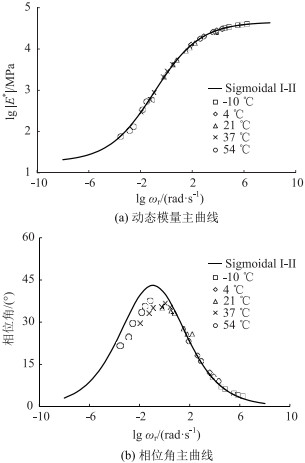
与Sigmoidal I\|I模型方法相似,建立Sigmoidal Ⅰ-Ⅱ模型黏弹参数主曲线如图 2所示。从图 2中可知,Sigmoidal Ⅰ-Ⅱ模型与Sigmoidal Ⅰ-Ⅰ模型建立黏弹参数主曲线模型相似,模型相位角函数增加了参数c,该参数与相位角幅值相关。该模型动态模量与相位角模型参数不同,不满足黏弹性因果关系,所以该模型仅由线黏弹性Kramers-Kronig关系推导,且后续进行了改进。如果以相位角作为目标函数的主要控制信息,同样能够较好地实现对相位角的拟合,与Sigmoidal Ⅰ-Ⅰ模型类似,动态模量主曲线较目标函数(12)拟合结果欠光滑。
|
| 图 2 AC-16沥青混合料Sigmoidal Ⅰ-Ⅱ模型验证 Fig. 2 Sigmoidal Ⅰ-Ⅱ model validation for AC-16 asphalt mixture |
| |
表 2中,参数c控制着相位角主曲线的上下移动,当c值变化时,动态模量不受影响,说明该模型黏弹参数不满足黏弹性因果关系;当c为1时,退化为Sigmoidal Ⅰ-Ⅰ类模型,此时,黏弹参数之间满足因果关系。同样,模型动态模量拟合优度RD2大于相位角的拟合优度RP2。AC-10沥青混合料f1值相对AC-16更小,说明AC-10沥青混合料得到了更好的拟合。
| 沥青混合料 | c | α | β | δ | γ | C1 | C2 | RD2 | RP2 | f1 | -10 ℃ | 4 ℃ | 21 ℃ | 37 ℃ | 54 ℃ |
| AC-10 | 0.95 | 3.52 | -0.50 | 1.15 | -0.50 | 0.110 | 5.08×10⁻⁴ | 1.0 | 0.86 | 2.70 | 3.90 | 2.02 | 0 | -1.63 | -3.08 |
| AC-16 | 0.99 | 3.40 | -0.53 | 1.26 | -0.57 | 0.116 | 4.42×10⁻⁴ | 1.0 | 0.81 | 3.10 | 4.03 | 2.10 | 0 | -1.75 | -3.35 |
3.1.3 目标函数对Sigmoidal Ⅰ类模型影响
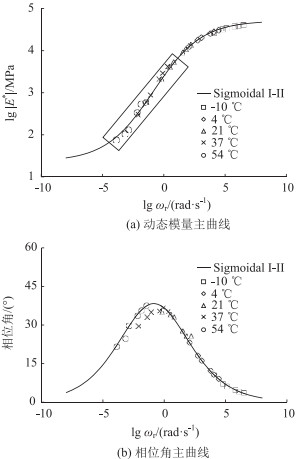
为了更进一步地探索黏弹性因果关系,基于Sigmoidal Ⅰ-Ⅱ模型解析式,采用式(13)作为目标函数,以AC-16沥青混合料为例,得到动态模量和相位角主曲线如图 3所示。
|
| 图 3 AC-16沥青混合料Sigmoidal Ⅰ-Ⅱ模型验证(目标函数f2) Fig. 3 Sigmoidal Ⅰ-Ⅱ model validation for AC-16 asphalt mixture with objective function f2 |
| |
从图 3(b)中可知,相位角预测曲线和实测曲线吻合较好,说明拟合时,考虑相位角因素能够促进相位角主曲线拟合。然而,从图 3(a)中可知,动态模量主曲线高频时与实测值吻合不佳,低频时实测值“离散”在主曲线两侧。AC-10混合料出现类似的现象,在此不再赘述,两种混合料Sigmoidal Ⅰ-Ⅰ模型同样出现类似的现象。因此,Sigmoidal Ⅰ类模型虽然能够用于表征沥青混合料黏弹性力学性质,但两个参数不能实现最佳的拟合。
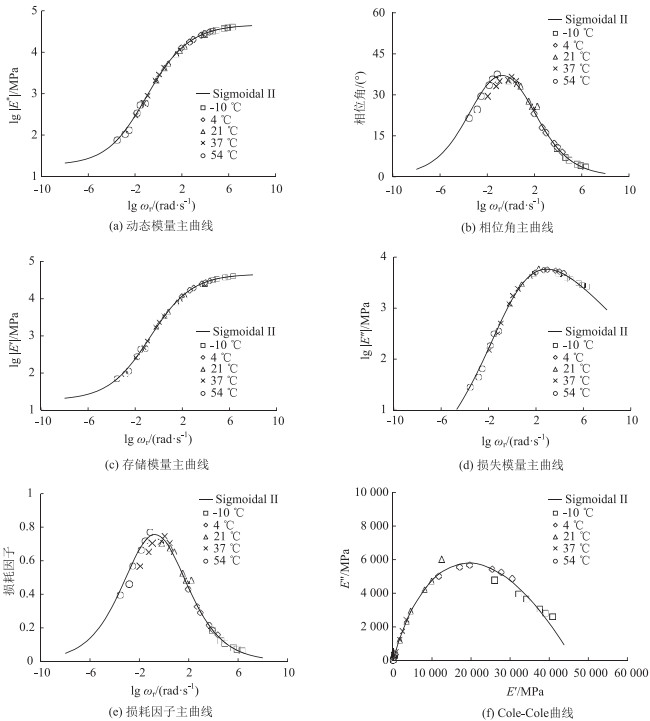
3.2 Sigmoidal Ⅱ模型验证与Sigmoidal Ⅰ-Ⅰ模型相似,以AC-16沥青混合料为例,基于时-温等效原理,采用式(8)~(9)及(12),并结合式(2)建立SigmoidalⅡ模型的所有黏弹函数(动态模量、相位角、存储模量、损失模量)主曲线及Cole-Cole曲线如图 4所示,两种混合料的模型拟合参数见表 3。
|
| 图 4 AC-16沥青混合料Sigmoidal Ⅱ模型验证 Fig. 4 Sigmoidal Ⅱ model validation for AC-16 asphalt mixture |
| |
| 沥青混合料 | α | β | δ | γ | C1 | C2 | RD2 | RP2 | f1 | -10 ℃ | 4 ℃ | 21 ℃ | 37 ℃ | 54 ℃ |
| AC-10 | 3.39 | -0.35 | 1.27 | -0.52 | 0.11 | 5.7×10⁻⁴ | 1.00 | 0.96 | 2.62 | 3.93 | 2.04 | 0 | -1.66 | -3.15 |
| AC-16 | 3.40 | -0.42 | 1.27 | -0.57 | 0.12 | 4.9×10⁻⁴ | 1.00 | 0.98 | 2.87 | 4.12 | 2.14 | 0 | -1.76 | -3.35 |
从图 4(a)和(c)可知,动态模量和存储模量的主曲线形状类似,均为“S”形,预测曲线和实测值吻合较好,说明该模型可以表征这两个黏弹力学参数。从图 4(d)可知,同样式(9)能够较好地描述沥青混合料损失模量的峰值和峰宽,所以该解析式是合理有效的。从图 4(b)可知,相位角主曲线同样可以测试值较好地吻合,并呈现“钟”型特征。图 4(e)为损耗因子主曲线,因为损耗因子是相位角的正切函数值,因此其主曲线与相位角主曲线类似。图 4(f)Cole-Cole曲线,其实测值呈现出“拱”型特征,同样模型预测曲线能够描述其形状。
综上所述,Sigmoidal Ⅱ模型所有黏弹函数的预测曲线与实测值吻合较好,且所有黏弹参数的解析式为同一套模型参数,满足黏弹性因果关系,所以Sigmoidal Ⅱ模型能够较好地描述沥青混合料的动态黏弹参数。AC-10沥青混合料表现出类似的性质,在此不再一一说明。
从表 3可知,两种沥青混合料的模型参数α,β,δ,γ变化较小,动态模量拟合优度(RD2)接近1,相位角拟合优度(RP2)0.95以上,说明Sigmoidal Ⅱ模型能够较好地描述沥青混合料的动态模量和相位角。除参考温度外,两种沥青混合料各温度下移位因子存在一定差异。
4 模型对比分析从上述模型动态模量和相位角主曲线可知,Sigmoidal Ⅰ-Ⅰ模型和Sigmoidal Ⅱ模型对的黏弹参数均采用同一套模型参数,满足线黏弹性因果关系,而Sigmoidal Ⅰ-Ⅱ模型两个黏弹参数非同一套模型参数,不满足线黏弹性因果关系。
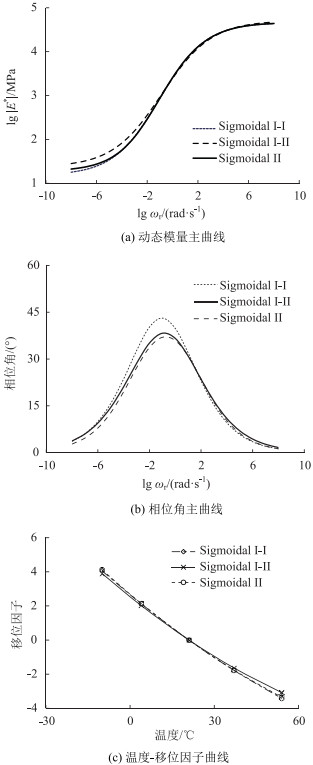
图 5(a)~(c)分别为3个模型的动态模量主曲线、相位角主曲线及移位因子。由图 5(a)可知:3个模型动态模量主曲线的区别主要体现在高、低频,低频的区分更为明显。Sigmoidal Ⅰ-Ⅰ模型和Sigmoidal Ⅱ模型仅在低频上存在一定的区别。
|
| 图 5 AC-16沥青混合料3个模型对比 Fig. 5 Comparison of 3 models for AC-16 asphalt mixture |
| |
从图 5(b)可以看出:3个模型相位角主曲线呈现“钟”型特征,3个模型的峰值不同,Sigmoidal Ⅱ模型最小且与测试值吻合较好,Sigmoidal Ⅰ-Ⅱ模型c值控制模型函数的上下平移,因此,该模型较Sigmoidal Ⅰ-Ⅰ模型能更好地表征相位角主曲线。
由图 5(c)可知:在测试温度范围内,Sigmoidal Ⅰ-Ⅱ模型和Sigmoidal Ⅱ模型的移位因子基本上相同。Sigmoidal Ⅰ-Ⅰ模型与另外2个模型的区别,主要在低温、高温条件下,其中高温(低频)条件下区别更大。
5 结论本研究基于Booij和Thoone提出的近似Kramers-Kronig关系式,从Sigmoidal函数出发,分别建立了沥青混合料相位角和损失模量的解析式模型,采用2种沥青混合料对模型进行验证,得到了如下主要结论:
(1) 采用时-温等效原理建立了Sigmoidal函数导出的3个模型的黏弹函数(动态模量和相位角)主曲线,与AASHTO R 62-131规范对比,3个模型均提出了相位角主曲线解析式,且相位角主曲线呈现“钟”型特征。
(2) 采用目标函数f1和f2均能建立Sigmoidal Ⅰ-Ⅰ模型和Sigmoidal Ⅰ-Ⅱ模型黏弹函数主曲线,目标函数的选择影响黏弹参数主曲线拟合效果。对比Sigmoidal Ⅰ-Ⅰ模型,除c为1时,Sigmoidal Ⅰ-Ⅱ模型黏弹参数之间不满足黏弹性因果关系。
(3) 对比其他两个模型,Sigmoidal Ⅱ模型能够较好地描述沥青混合料的动态黏弹参数,动态模量和相位角主曲线的拟合优度均大于0.95,且满足线性黏弹性因果关系,能用于沥青混合料动态黏弹力学性能表征。
综上所述,基于线性黏弹性力学的近似Kramers-Kronig关系并构建适当的目标函数,将Sigmoidal数学模型演进成力学模型是可行的。
| [1] |
杨胜丰. 沥青及沥青混合料动态黏弹性分数阶本构模型研究[D]. 长沙: 湖南大学, 2020: 1-113. YANG Sheng-feng. Research on Dynamic Viscoelastic Fractional Constitutive Model of Asphalt Binders and Mixtures [D]. Changsha: Hunan University, 2020: 1-113. |
| [2] |
索智, 谭祎天, 张亚, 等. 骨架密实型沥青稳定碎石混合料动态模量研究[J]. 建筑材料学报, 2022, 25(2): 206-213. SUO Zhi, TAN Yi-tian, ZHANG Ya, et al. Dynamic Modulus of Skeleton Dense Asphalt Treated Base Mixture[J]. Journal of Building Materials, 2022, 25(2): 206-213. DOI:10.3969/j.issn.1007-9629.2022.02.014 |
| [3] |
查旭东, 李聪, 邹博, 等. RIOHTrack下面层沥青混合料低温性能试验评价[J]. 公路交通科技, 2022, 39(6): 1-8. ZHA Xu-dong, LI Cong, ZOU Bo, et al. Experimental Evalution of Low Temperature Performance of Asphalt Mixture in Bottom Surface Layer of RIOHTrack[J]. Journal of Highway and Transportation Research and Development, 2022, 39(6): 1-8. |
| [4] |
张晨晨, 钱振东, 王旭东, 等. 基于DMA方法的沥青砂浆动态弯拉黏弹特性[J]. 公路交通科技, 2019, 36(3): 22-28. ZHANG Chen-chen, QIAN Zhen-dong, WANG Xu-dong, et al. Dynamic Flexural-tensile Viscoelastic Property of Asphalt Mortar Based on DMA Method[J]. Journal of Highway and Transportation Research and Development, 2019, 36(3): 22-28. |
| [5] |
王志臣, 郭乃胜, 赵颖华, 等. 沥青混合料黏弹性主曲线模拟及换算[J]. 工程力学, 2017, 34(2): 242-248. WANG Zhi-chen, GUO Nai-sheng, ZHAO Ying-hua, et al. Viscoelastic Master Curve Simulation and Conversion of Asphalt Mixtures[J]. Engineering Mechanics, 2017, 34(2): 242-248. |
| [6] |
AASHTO R 62-131, Developing Dynamic Modulus Master Curves for Asphalt Mixtures [S].
|
| [7] |
AASHTO T 342-11, Determining Dynamic Modulus of Hot Mix Asphalt(HMA) [S].
|
| [8] |
ZENG M, BAHIA H U, ZHAI H, et al. Rheological Modeling of Modified Asphalt Binders and Mixtures[J].
Asphalt Paving Technology: Association of Asphalt Paving Technologists-proceedings of the Technical Sessions, 2001, 70: 403-441.
|
| [9] |
ZHAO Y, TANG J, LIU H. Construction of Triaxial Dynamic Modulus Master Curve for Asphalt Mixtures[J].
Construction and Building Materials, 2012, 37: 21-26.
DOI:10.1016/j.conbuildmat.2012.06.067 |
| [10] |
BOOIJ H C, THOONE G P J M. Generalization of Kramers-Kronig Transforms and some Approximations of Relations between Viscoelastic Quantities[J].
Rheologica Acta, 1982, 21(1): 15-24.
DOI:10.1007/BF01520701 |
| [11] |
颜可珍, 杨胜丰, 黎国凯, 等. 沥青混合料动态黏弹性分数阶导数模型[J]. 中国公路学报, 2022, 35(5): 12-22. YAN Ke-zhen, YANG Sheng-feng, LI Guo-kai, et al. Fractional Derivative Model for Dynamic Viscoelasticity of Asphalt Mixtures[J]. Chinese Journal of Highway and Transport, 2022, 35(5): 12-22. |
| [12] |
XU Q, SOLAIMANIAN M. Modelling Linear Viscoelastic Properties of Asphalt Concrete by the Huet-sayegh Model[J].
International Journal of Pavement Engineering, 2009, 10(6): 401-422.
DOI:10.1080/10298430802524784 |
| [13] |
YANG X, YOU Z P. New Predictive Equations for Dynamic Modulus and Phase Angle Using a Nonlinear Least-squares Regression Model[J].
Journal of Materials in Civil Engineering, 2015, 27(3): 04014131-04014133.
DOI:10.1061/(ASCE)MT.1943-5533.0001070 |
| [14] |
SHAN L, TAN Y, ZHANG H, et al. Analysis of Linear Viscoelastic Response Function Model for Asphalt Binders[J].
Journal of Materials in Civil Engineering, 2016, 28(6): 040160101-040160108.
|
| [15] |
SHAN L, XU Y, HE H, et al. Optimization Criterion of Viscoelastic Response Model for Asphalt Binders[J].
Construction and Building Materials, 2016, 113: 553-60.
DOI:10.1016/j.conbuildmat.2016.02.184 |
| [16] |
余苗, 赵晓宁, 陈海峰, 等. 橡胶颗粒改性沥青混合料黏弹性研究[J]. 公路交通科技, 2023, 40(2): 1-7. YU Miao, ZHAO Xiao-ning, CHEN Hai-feng, et al. Study on Viscoelasticity of Crumb Rubber Modified Asphalt Mixture[J]. Journal of Highway and Transportation Research and Development, 2023, 40(2): 1-7. |
| [17] |
黄优, 刘朝晖, 王旭东, 等. 沥青混合料动态模量梯形梁与SPT试验比较研究[J]. 中南大学学报(自然科学版), 2017, 48(11): 3092-3099. HUANG You, LIU Zhao-hui, WANG Xu-dong, et al. Comparison of HMA Dynamic Modulus between Trapezoid Beam Test and SPT[J]. Journal of Central South University(Science and Technology), 2017, 48(11): 3092-3099. DOI:10.11817/j.issn.1672-7207.2017.11.029 |
| [18] |
石志勇, 李倩倩, 王旭东. 不同荷载模式下沥青混合料的动态模量依赖模型[J]. 公路交通科技, 2021, 38(2): 9-15, 47. SHI Zhi-yong, LI Qian-qian, WANG Xu-dong. Dynamic Modulus Dependence Model of Asphalt Mixture under Different Load Modes[J]. Journal of Highway and Transportation Research and Development, 2021, 38(2): 9-15, 47. |