 2023, Vol. 40
扩展功能

文章信息
- 蒋应军, 张文辉, 张嘉伟, 范江涛, 易勇.
- JIANG Ying-jun, ZHANG Wen-hui, ZHANG Jia-wei, FAN Jiang-tao, YI Yong
- 不同成型方法SMA-13混合料性能评价
- Performance Evaluation on SMA-13 Mixture by Different Molding Methods
- 公路交通科技, 2023, 40(10): 35-42
- Journal of Highway and Transportation Research and Denelopment, 2023, 40(10): 35-42
- 10.3969/j.issn.1002-0268.2023.10.005
-
文章历史
- 收稿日期: 2022-01-12


 ,
, 沥青玛蹄脂碎石(SMA)因良好骨架密实结构和路用性能而被广泛应用。目前,SMA设计方法普遍采用Marshall法,SGC法,Hveem法等,其差别主要在于成型方法的不同[1]。Marshall法属于击实成型法,可根据实际情况调整设计参数[2-5];Hveem法属于揉搓压实法,是美国根据实际经验提出的最典型的碾压方法[6];SGC法属于旋转压实法,对试件同时施加使试件旋转的力及竖向力[7]。随着我国交通快速发展,交通量增加迅速,车辆荷载也不断提升,Marshall法设计与我国工程实际不匹配,难以适应现代交通。我国规范设计指标取值简单,适用范围不明确等,导致路面更易出现车辙、裂缝、水毁等病害[8]。
针对这些问题,道路研究者进行了一系列的研究:Zaumanis等[9-11]研究发现Marshall法交通量划分简单,不能准确模拟车轮对路面的影响;Zhang等[6]指出Hveem法中沥青性能相关性低且体积参数未作为设计指标;张书华[12]研究说明SGC法设计性能优异,但设备昂贵,难以普及;肖燕等[13]研究认为SGC法设计SMA沥青混合料温度敏感性低;随后Allpressr等[14]对旋转压实、振动压实、轮碾压实及现场机械压实的沥青混合料力学性能进行了对比研究,指出旋转压实和振动压实的沥青混合料具有更好的力学强度和永久抗变形能力;蒋应军等[15-19]基于VVTM,对AC-20和ATB-30混合料做了相关研究,指出VVTM碾压效果更接近路面现场碾压效果,力学性能更佳且成型试件密度约为Marshall试件密度的1.02倍,发现VVTM试件与路面现场芯样力学强度相关性高达92.1%,具有良好的路用性能,然而到目前为止,关于振动成型方法在SMA混合料设计当中的运用和研究仍然相对较少。
鉴于此,本研究以SMA-13沥青混合料为研究对象,通过室内试验对比研究VVTM,SGC法和Marshall法设计的SMA-13试件体积参数,路用性能和耐久性。验证了VVTM的可靠性和优越性,完善SMA-13的相关设计规范,为我国SMA-13设计提供更多的方法选择,提供理论支撑、实践基础。
1 原材料与试验方法 1.1 原材料与级配(1) 沥青
沥青使用韩国某牌SBS改性沥青,技术性质见表 1。实测指标满足《公路沥青路面施工技术规范》(JTG F40—2004)要求。
| 指标 | 测试值 | 规范值 | |
| 25 ℃针入度/(0.1 mm) | 72 | 60~80 | |
| 5 ℃延度/cm | 43 | ≥30 | |
| 软化点(环球法)/℃ | 83 | ≥55 | |
| 135 ℃运动黏度/(Pa·s) | 2.0 | ≤3.0 | |
| 15 ℃密度/(g·cm-3) | 1.04 | 实测记录 | |
| RTFOT残留物 | 质量损失/% | -0.29 | ±1.0 |
| 针入度比/% | 70 | ≥60 | |
| 5 ℃延度/cm | 27 | ≥20 | |
(2) 细集料
细集料来自陕西某建设的石灰岩机制砂,各指标见表 2。
| 指标 | 测试值 | 规范值 |
| 表观密度/(g·cm-3) | 2.78 | ≥2.5 |
| 坚固性/% | 4.7 | ≤12 |
| 砂当量/% | 90 | ≥60 |
| 棱角/s | 32.8 | ≥30 |
(3) 粗集料
粗集料使用来自陕西商洛的玄武岩碎石,指标见表 3。
| 指标 | 下列规格集料技术指标测试值 | 规范值 | ||
| 9.5~16 mm | 4.75~9.5 mm | 2.36~4.75 mm | ||
| 表观相对密度/(g·cm-3) | 2.98 | 2.98 | 2.76 | ≥2.6 |
| 针片状颗粒含量/% | 7.5 | 6.2 | ≤12 | |
| 压碎值/% | 14 | 14 | 14 | ≤26 |
| 磨耗值/% | 15 | 15 | 15 | ≤28 |
| 磨光值 | 43 | 43 | 43 | ≥40 |
| 对沥青的黏附性(级) | 5.0 | 5.0 | 5.0 | ≥5 |
(4) 矿粉和纤维
矿粉为陕西商洛洛南某矿业有限公司生产提供的矿粉,纤维类型为木质素纤维,纤维掺量0.5%,技术性质略。
(5) 级配
以SMA-13沥青混合料为研究对象,级配组成见表 4[20]。
| 筛孔尺寸/mm | 16.0 | 13.2 | 9.5 | 4.75 | 2.36 | 1.18 | 0.6 | 0.3 | 0.15 | 0.075 |
| 质量通过百分率/% | 100.0 | 91.2 | 63.5 | 28.8 | 24.5 | 20.4 | 15.2 | 13.3 | 11.6 | 9.5 |
1.2 试验方案
(1) 力学性能
SMA-13性能试验包括马歇尔稳定度(MS)、抗剪强度(τd)、动稳定度(DS)、劈裂强度(Ri)、低温弯曲应变(εi)、残留稳定度(MS0)、残留强度比(TSR)等试验均按照《公路工程沥青及沥青混合料试验规程》[21](JTG E20—2011)中的试验方法进行。
(2) 老化性能
短期老化:用小型拌和机在标准条件下拌和混合料,拌和均匀后以21 kg/m2密度摊铺在盘中,放入烘箱在(135±3)℃温度强制通风条件下加热4 h,混合料每小时翻拌一次,完成短期老化。
长期老化:在完成短期老化的基础上,制作3种设计方法的试件,放入烘箱在(85±3)℃温度强制通风后连续加热5 d,自然冷却不少于16 h至室温,完成长期老化。
沥青回收:烘箱老化后,利用离心抽提仪抽提沥青溶液,达到透明清澈停止,然后在离心管中用高速离心法除去矿粉,离心力大于770g,离心时间大于30 min。然后采用阿布森法从抽提液中回收沥青,从抽提开始到回收结束全过程时间应小于8 h。
(3) 疲劳性能
采用MTS810万能试验机进行间接拉伸疲劳试验,采用正弦波荷载作为应力控制模式加载,以模拟路面在行车荷载作用下的实际波形,加载频率为10 Hz,应力水平分别为0.3,0.4,0.5,0.6,0.7,试验温度为15 ℃。
1.3 不同设计方法设计参数| 设计参数 | 下列方法SMA-13设计标准 | ||
| VVTM | Marshall法 | SGC法 | |
| 试件尺寸/mm | Φ100×h63.5 | Φ101×h63.5 | Φ101×h63.5 |
| 压实功 | 振动击实65 s | 双面击实75次 | 旋转击实100次 |
| VV/% | 2.5~4.0 | 3.0~4.0 | 3.5~5.0 |
| VFA/% | 74~83 | 75~85 | 70~80 |
| VMA/% | ≥14.5 | ≥17 | ≥13.5 |
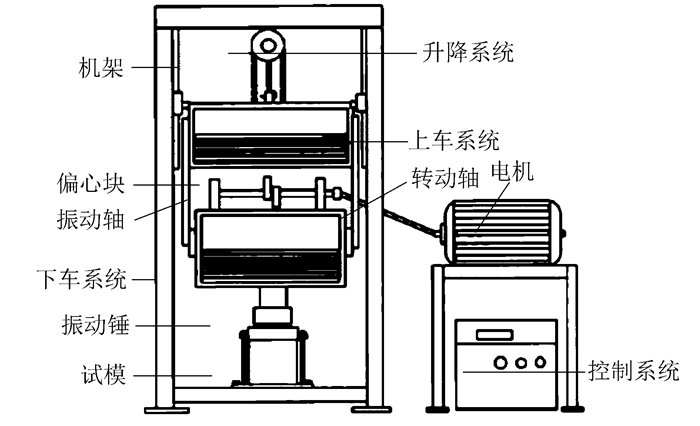
VVTM采用的垂直振动压实仪构造见图 1,工作时只有垂直方向产生正弦激振力,无水平方向激振力。振动仪参数:工作重量为3.0 kN(上车系统1.2 kN,下车系统1.8 kN),工作频率为37 Hz,名义振幅为1.2 mm。
|
| 图 1 振动击实试验仪构造 Fig. 1 Equipment structure of vibration compaction tester |
| |
2 试验结果与分析 2.1 不同方法对体积参数与级配影响 2.1.1 体积参数
3种设计方法成型试件的最佳油石比及体积参数结果见表 6。
| 设计方法 | 不同方法设计SMA-13体积参数 | ||||
| 最佳油石比/% | 密度/(g·cm-3) | VV/% | VMA/% | VFA/% | |
| Marshall法 | 5.7 | 2.52 | 4.2 | 17.0 | 76.1 |
| SGC法 | 5.4 | 2.55 | 4.0 | 16.5 | 76.0 |
| VVTM | 5.4 | 2.58 | 3.0 | 15.0 | 81.0 |
如表 6所示,3种成型方法下混合料最佳油石比及体积参数均有所不同,VVTM和SGC法SMA-13比Marshall法SMA-13最佳油石比减少了0.3%,密度分别提高了2%,1%,VV分别减小了1.2%,0.2%,VMA减小了2.0%,0.5%,而VFA,VVTM增大了5%,SGC法减少了0.1%,说明VVTM试件的压实程度最大。这可能是因为VVTM成型试件时,对混合料施加了振动作用,集料处于振动状态,静摩擦力逐渐转变为动摩擦力,内摩阻力会减小,集料移动更加充分,易达到密实,而且骨架结构完整,从而提高路面性能。
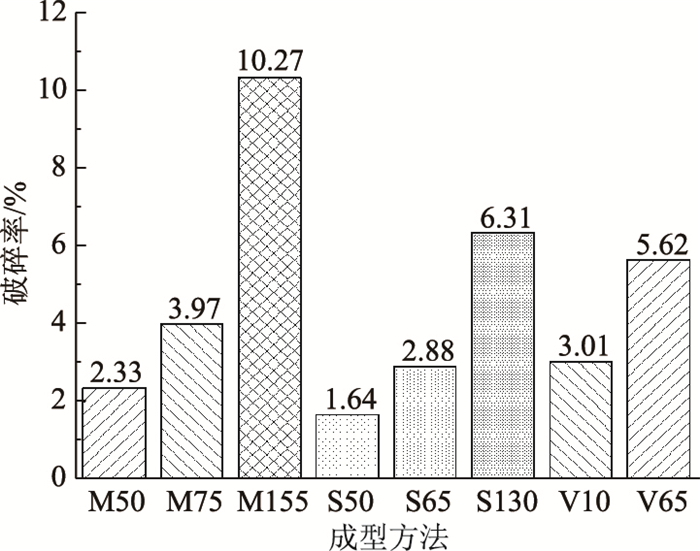
2.1.2 级配SMA-13混合料最佳油石比下不同压实方式和压实功下试件的矿料级配见表 7,各试件粒径4.75 mm以上粗集料破碎率见图 2。
| 成型方式 | 通过下列筛孔孔径(mm)质量百分率/% | |||||||||
| 16.0 | 13.2 | 9.5 | 4.75 | 2.36 | 1.18 | 0.6 | 0.3 | 0.15 | 0.075 | |
| 原级配 | 100.0 | 95.1 | 62.6 | 27.0 | 20.5 | 19.0 | 16.1 | 13.1 | 12.1 | 10.2 |
| Marshall50 | 100.0 | 95.4 | 63.8 | 28.8 | 21.3 | 19.7 | 16.9 | 13.6 | 12.7 | 10.6 |
| Marshall75 | 100.0 | 95.9 | 64.6 | 30.0 | 22.4 | 20.3 | 17.1 | 14.1 | 13.2 | 10.8 |
| Marshall155 | 100.0 | 96.9 | 66.8 | 34.5 | 23.4 | 21.1 | 17.8 | 14.2 | 13.1 | 10.9 |
| VVTM10 | 100.0 | 95.6 | 64.0 | 29.2 | 22.0 | 20.1 | 16.9 | 13.7 | 12.6 | 10.5 |
| VVTM65 | 100.0 | 96.3 | 65.7 | 31.1 | 22.6 | 205 | 17.3 | 14.2 | 13.2 | 11.1 |
| SGC50 | 100.0 | 95.4 | 63.5 | 28.1 | 21.3 | 19.6 | 16.4 | 13.6 | 12.5 | 10.3 |
| SGC65 | 100.0 | 95.7 | 63.8 | 29.2 | 21.6 | 19.7 | 16.8 | 13.6 | 12.6 | 10.4 |
| SGC130 | 100.0 | 96.5 | 66.3 | 31.6 | 22.7 | 20.5 | 17.3 | 14.2 | 13.1 | 10.9 |
|
| 图 2 不同成型方法试件4.75 mm以上粗集料破碎率 Fig. 2 Fragmentation rates of coarse aggregate above 4.75 mm specimens by different molding methods |
| |
由表 7和图 2可知,成型方式相同时,压实功越大,粗集料破碎越多。Marshall法、SGC法、VVTM压实度增加1%,粗集料破碎率分别增加2.8%,1.8%,1.2%;压实功相同时,VVTM和SGC法试件粗集料破碎率较小。SGC50较Marshall50粗集料破碎率降低0.69%;SGC65,VVTM10较Marshall75粗集料破碎率分别降低0.96%,1.09%;SGC130,VTM65较Marshall155粗集料破碎率分别降低3.97%,4.65%。压实功越大,SGC法,VVTM较Marshall法试件粗集料破碎率降低幅度越大。这是因为Marshall法压实是靠冲击作用使矿料颗粒发生移动来达到压实效果,试件的两端都会出现破碎;SGC法在试件压实过程中,边旋转试件,边对试件施加竖向力,能够更好地模拟实际路面施工状态,有效降低了集料的破碎;VVTM施加振动压力波,集料破碎情况接近路面芯样。
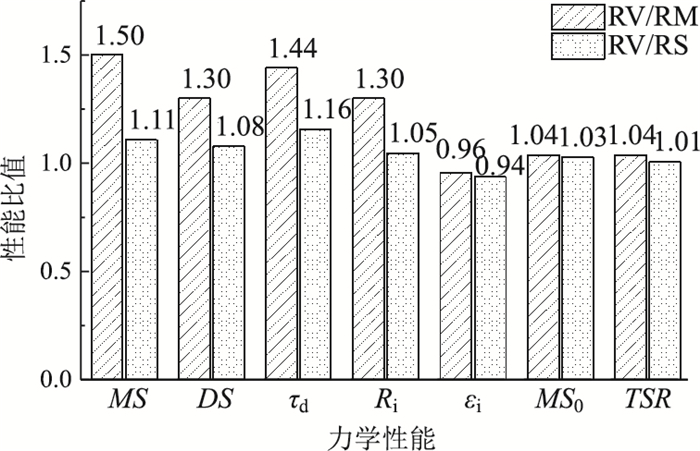
2.2 不同方法对路用性能影响 2.2.1 力学性能3种方法设计SMA-13的结果见表 8和图 3。表中RM,RS,RV分别指Marshall法、SGC法、VVTM试件性能。
| 测试指标 | 不同方法设计SMA-13力学性能 | ||
| Marshall法 | SGC法 | VVTM | |
| MS/kN | 14.3 | 19.0 | 21.2 |
| DS/(次·mm-1) | 5 758 | 6 914 | 7 450 |
| τd/MPa | 1.2 | 1.5 | 1.7 |
| Ri/MPa | 3.4 | 4.2 | 4.4 |
| εi/μξ | 3 216 | 3 287 | 3 081 |
| MS0/% | 90 | 91 | 94 |
| TSR/% | 85 | 87 | 88 |
|
| 图 3 性能对比 Fig. 3 Performance comparison |
| |
由表 8和图 3可知,矿料级配一定,在各自最佳油石比下,VVTM设计混合料的性能相比于Marshall法试件,SGC法试件有明显提升,VVTM试件马歇尔稳定度、动稳定度、抗剪强度、劈裂强度比Marshall法试件分别提高了50%,30%,44%,30%,即力学性能提高至少30%;比SGC法试件提高了11%,8%,16%,5%,即力学性能提高至少5%。同时可以反映出高温稳定性有大幅度提升;低温稳定性略有降低;水稳定性提升约3%。
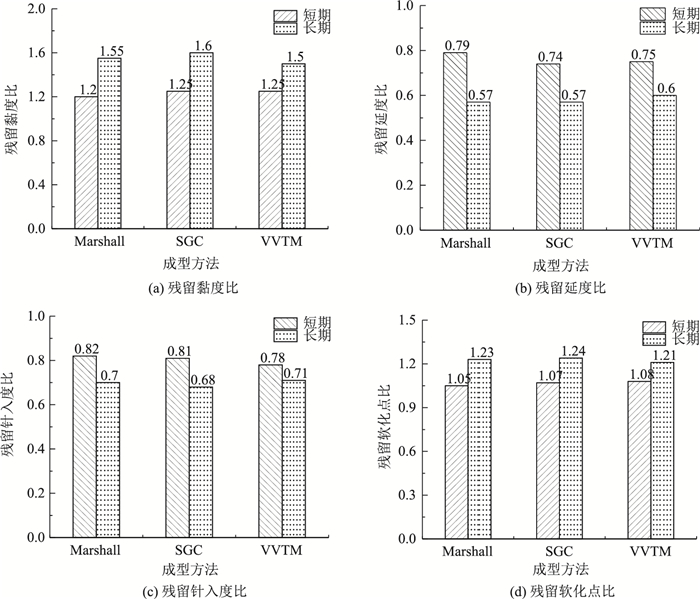
2.2.2 抗老化性能回收沥青完成之后,进行了针入度(25 ℃),黏度(135 ℃),延度(5 ℃)及软化点试验,并与原样沥青进行对比,以评价老化过程对沥青性能的影响,表中R代表沥青性能,下标S,L分别表示短期老化过程和长期老化过程。试验结果见表 9。
| 沥青性能 | 原样沥青 | Marshall法 | SGC法 | VVTM | |||||
| RS | RL | RS | RL | RS | RL | ||||
| 针入度/(0.1 mm) | 65.0 | 53.0 | 45.5 | 52.5 | 44.5 | 50.5 | 46.0 | ||
| 延度/cm | 41.4 | 32.6 | 23.8 | 30.8 | 23.5 | 31.2 | 24.7 | ||
| 软化点/℃ | 85.0 | 89.5 | 104.5 | 91.0 | 105.0 | 91.5 | 103.0 | ||
| 黏度/(Pa·s) | 2.0 | 2.4 | 3.1 | 2.5 | 3.2 | 2.5 | 3.0 | ||
对表 9中不同混合料提取的沥青测试结果进行对比,结果见图 4。
|
| 图 4 沥青老化性能对比 Fig. 4 Comparison of asphalt ageing performance |
| |
表 9和图 4可知,不同方法设计SMA-13老化回收后,沥青性能的变化趋势相同,即老化程度增加,针入度和延度降低,软化点和黏度增加。相同老化时间下,VVTM设计的沥青混合料比Marshall法和SGC法沥青经短期老化之后性能变化幅度更大,抗老化性能较差;经过长期老化后,变化幅度更小,抗老化性能提升。
短期内老化时,沥青膜厚度越大,混合料的抗老化性能更好,VVTM沥青用量较少,导致沥青膜厚度较小,所以经短期老化过程之后,VVTM试件中沥青的老化程度更深。而沥青混合料的长期老化主要受氧气、水、光照等外界因素的影响,VVTM试件具有较大的密度及较小的空隙率,外界的水、氧气、光照不易进入混合料内部,故混合料老化程度较小,所以考虑路面使用时VVTM设计的SMA混合料具有更好地抗老化性能。
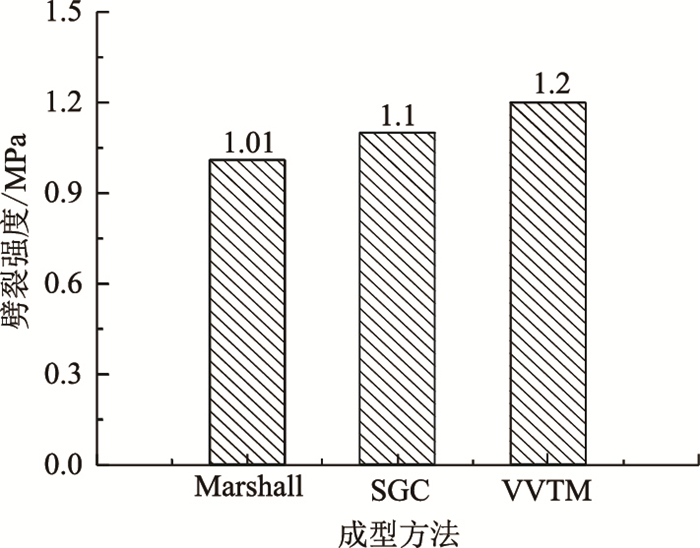
2.2.3 抗疲劳性能劈裂强度在MTS810试验机上进行测量。劈裂强度试验结果见图 5,疲劳试验结果见表 10。
|
| 图 5 劈裂强度试验结果 Fig. 5 Splitting strength test result |
| |
| 设计方法 | 不同应力水平S对应的疲劳次数N | ||||
| 0.3 | 0.4 | 0.5 | 0.6 | 0.7 | |
| Marshall法 | 17 130 | 4 694 | 2 071 | 717 | 306 |
| 22 697 | 5 764 | 2 345 | 889 | 415 | |
| 19 831 | 3 577 | 1 217 | 1 135 | 460 | |
| 23 135 | 4 229 | 2 849 | 1 216 | 675 | |
| 17 119 | 4 700 | 2 074 | 715 | 306 | |
| SGC法 | 23 429 | 3 745 | 1 527 | 840 | 419 |
| 22 718 | 6 137 | 2 413 | 1 158 | 684 | |
| 19 362 | 4 641 | 3 412 | 1 373 | 535 | |
| 26 696 | 5 823 | 3 012 | 1 528 | 482 | |
| 23 048 | 5 089 | 2 590 | 1 224 | 536 | |
| VVTM | 20 454 | 4 258 | 1 715 | 1 014 | 485 |
| 25 324 | 6 111 | 2 520 | 1 209 | 592 | |
| 26 462 | 6 658 | 3 475 | 1 475 | 743 | |
| 28 292 | 7 190 | 3 751 | 1 588 | 811 | |
| 20 451 | 4 259 | 1 725 | 1 004 | 486 | |
由表 10可知,VVTM试件的劈裂强度相较于Marshall法试件和SGC法试件分别提升20%和9%。因为VVTM试件压实时的振动压力波使得试件骨架结构更加密实,提高混合料的内摩擦力和黏结力。
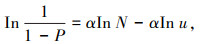
疲劳寿命离散性大,采用Weibull分布对疲劳试验数据进行整理分析具有良好的相关性[21]。疲劳寿命N服从两参数Weibull分布,建立失效概率和疲劳寿命之间的对应关系。
|
(1) |
令y=InIn

|
(2) |
式中,α为形状参数;u为尺度参数;N为疲劳寿命; n为随机变量N的特征值。
根据式(1)和表 10得到不同应力水平下的回归系数α, β和相关系数R2,在不同应力水平条件下,线性回归相关性系数R2均大于0.9,Weibull分布处理数据结果良好。
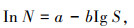
由式(2)反算不同失效概率下SMA-13混合料疲劳寿命N,然后采用式(3)计算疲劳方程回归系数和相关系数(R2),结果如表 11所示。
|
(3) |
| 设计方法 | 系数 | 不同失效概率(%)下疲劳方程系数 | |||||
| 5 | 10 | 20 | 30 | 40 | 50 | ||
| Marshall法 | a | 1.419 7 | 1.571 8 | 1.727 8 | 1.827 0 | 1.902 3 | 1.966 0 |
| b | 5.098 3 | 4.907 8 | 4.715 1 | 4.590 6 | 4.497 0 | 4.418 2 | |
| R2 | 0.995 0 | 0.996 5 | 0.997 3 | 0.997 3 | 0.997 0 | 0.996 5 | |
| SGC法 | a | 1.723 5 | 1.834 2 | 1.938 0 | 2.002 6 | 2.052 3 | 2.094 6 |
| b | 4.563 5 | 4.481 6 | 4.398 8 | 4.347 6 | 4.308 0 | 4.274 1 | |
| R2 | 0.982 4 | 0.987 7 | 0.991 2 | 0.992 2 | 0.992 3 | 0.991 8 | |
| VVTM | a | 1.733 3 | 1.840 4 | 1.960 0 | 2.034 3 | 2.091 3 | 2.140 1 |
| b | 4.473 7 | 4.413 4 | 4.338 3 | 4.292 5 | 4.257 2 | 4.226 3 | |
| R2 | 0.965 4 | 0.978 0 | 0.987 9 | 0.992 4 | 0.994 7 | 0.995 9 | |
式中,a,b为方程待定回归系数;S为应力水平;N为疲劳寿命。
研究表明,应力比S=0.45是疲劳寿命N发生大幅改变的分界点[22],采用S=0.45进行疲劳寿命分析,结果见表 12。
| 失效概率/% | 不同方法下疲劳寿命 | ||
| Marshall法 | SGC法 | VVTM | |
| 5 | 1 603 | 1 941 | 2 201 |
| 50 | 2 987 | 3 749 | 4 159 |
由表 12可知,VVTM设计的SMA-13疲劳寿命较Marshall法最少提高了31%,较SGC法最少提高了10%, 即VVTM设计的SMA-13沥青混合料具有更好的抗疲劳性能。
SMA-13混合料疲劳方程式(3)中的回归系数a越大,表征应力作用下材料抗疲劳性能越好;回归系数b越小,表征材料对应力变化越不敏感,材料的抗疲劳性能越好[23]。由表 11可知,VVTMa值在各个失效概率下普遍大于Marshall法和SGC法,b值全部小于Marshall法和SGC法。
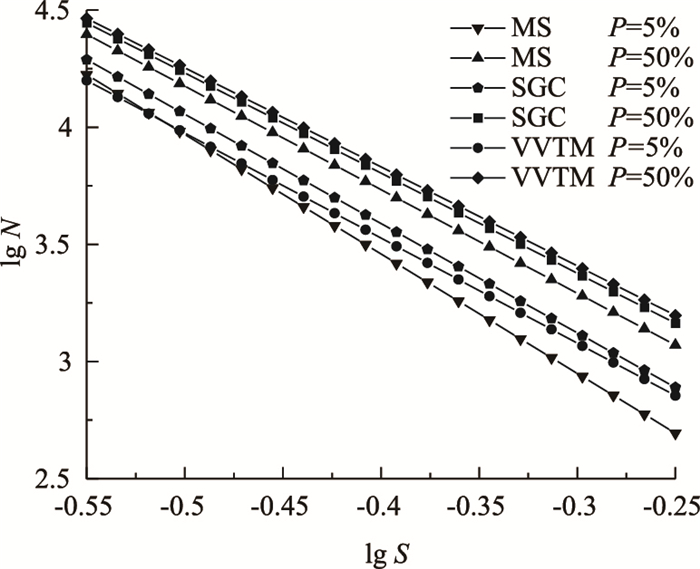
根据表 11中数据,以lg N纵坐标,lg S为横坐标绘图,见图 6。
|
| 图 6 不同设计方法混合料lg N-lg S曲线 Fig. 6 Lg N-lg S curves of mixture by different methods |
| |
由表 11及图 6可知,采用不同方法设计的SMA-13混合料,lg S随lg N呈线性变化,相关性强,且不同的成型方法对SMA-13的疲劳性能影响显著;VVTM设计SMA-13混合料的疲劳特性良好,对应力变化敏感性良好,具有一定的抗疲劳优势;5%失效概率下VVTM明显优于其他两种方法,对比分析失效概率为5%及50%时VVTM试件下的疲劳预估寿命曲线可知,在不同失效概率下SMA-13混合料的疲劳寿命存在较大差异,在低失效概率下不同方法差异明显,失效概率增大导致各方法差异减小。
3 结论(1) VVTMSMA-13比Marshall法SMA-13最佳油石比减少了0.3%,密度提高了2%,VV减小了1.2%,VMA减小了2.0%,而VFA增大了5%,VVTM试件的压实程度最大,相同压实功下VVTM试件集料破碎率最小。
(2) VVTM设计混合料的路用性能和耐久性更好,矿料级配一定时,在各自最佳油石比下,与Marshall法相比马歇尔稳定度、抗剪强度、动稳定度、劈裂强度分别提高了50%,44%,30%,30%;与SGC法试件相比,分别提高了11%,16%,8%,5%。
(3) 采用室内试验方法模拟SMA混合料的短期老化和长期老化过程,在长期老化后VVTM设计SMA-13具有较好地抗老化性能。
(4) 随着应力水平的增加,疲劳次数均呈下降趋势;VVTM疲劳方程截距a值更大,斜率b值更小,在不同应力水平下VVTM设计混合料都具有更好的抗疲劳性能。且在S=0.45应力水平下VVTM设计的SMA-13疲劳寿命较Marshall法最少提高了31%,较SGC法最少提高了10%。
| [1] |
蒋应军, 张勇, 张大强, 等. 不同方法设计SMA沥青混合料路用性能评价[J]. 公路交通技术, 2020, 36(3): 31-36. JIANG Ying-jun, ZHANG Yong, ZHANG Da-qiang, et al. Performance Evaluation of SMA Asphalt Mixture Design by Different Methods[J]. Technology of Highway and Transport, 2020, 36(3): 31-36. |
| [2] |
冯小伟, 支鹏飞. 基于马歇尔试验的AR-SMA-13橡胶沥青混合料线膨胀性能研究[J]. 公路交通科技, 2016, 33(3): 31-36. FENG Xiao-wei, ZHI Peng-fei. Study of Linear Expansion Performance of AR-SMA-13 Asphalt Rubber Mixture Based on Marshall Test[J]. Journal of Highway and Transportation Research and Development, 2016, 33(3): 31-36. DOI:10.3969/j.issn.1002-0268.2016.03.006 |
| [3] |
GOETZ W H. The Evolution of Asphalt Concrete Mix Design[J]. Asphalt Concrete Mix Design: Development of More Rational Approaches. ASTM International, 1989.
|
| [4] |
XU B, CHEN J Y, ZHOU C H, et al. Study on Marshall Design Parameters of Porous Asphalt Mixture using Limestone as Coarse Aggregate[J].
Construction and Building Materials, 2016, 124: 846-854.
DOI:10.1016/j.conbuildmat.2016.08.005 |
| [5] |
TAN Y Q, SUN Z Q, GONG X B, et al. Design Parameter of Low-temperature Performance for Asphalt Mixtures in Cold Regions[J].
Construction & Building Materials, 2017, 155: 1179-1187.
DOI:10.3973/j.issn.1672-741X.2017.09.018 |
| [6] |
ZHANG C, WANG H N, YOU Z P, et al. Compaction Characteristics of Asphalt Mixture with Different Gradation Type Through Superpave Gyratory Compaction and X-ray CT Scanning[J].
Construction and Building Materials, 2016, 129: 243-255.
DOI:10.1016/j.conbuildmat.2016.10.098 |
| [7] |
HAN D D, WEI L Y, ZHANG J X. Experimental Study on Performance of Asphalt Mixture Designed by Different Method[J].
Procedia Engineering, 2016, 137: 407-414.
DOI:10.1016/j.proeng.2016.01.275 |
| [8] |
由诗园. 沥青路面早期车辙破坏原因分析[J]. 工程建设与设计, 2019(16): 78-79. YOU Shi-yuan. Causes Analysis of Early Rutting Damage of Asphalt Pavement[J]. Construction & Design for Engineering, 2019(16): 78-79. |
| [9] |
ZAUMANIS M, POULIKAKOS L D, PARTL M N. Performance-based Design of Asphalt Mixtures and Review of Key Parameters[J].
Materials & Design, 2018, 141: 185-201.
|
| [10] |
TAPKIN S, KESKIN M. Rutting Analysis of 100 mm Diameter Polypropylene Modified Asphalt Specimens Using Gyratory and Marshall Compactors[J].
Materials Research, 2013, 16(2): 546-563.
DOI:10.1590/S1516-14392013005000016 |
| [11] |
刘宏晋. AC-25S沥青混合料马歇尔设计方法研究[J]. 公路交通技术, 2016, 32(4): 15-21, 25. LIU Hong-jin. Study on Marshall Design Method for AC-25 S Asphalt Mixture[J]. Technology of Highway and Transport, 2016, 32(4): 15-21, 25. |
| [12] |
张书华. 贝雷法和CAVF法在AK-13A和SMA-13的混合料级配设计中的应用[J]. 公路交通科技, 2018, 35(9): 15-20. ZHANG Shu-hua. Application of Bailey Method and CAVF Method in Designing Mixture Gradation of AK-13A and SMA-13[J]. Journal of Highway and Transportation Research and Development, 2018, 35(9): 15-20. DOI:10.3969/j.issn.1002-0268.2018.09.003 |
| [13] |
肖燕. 基于图像分析技术的不同压实方法沥青混合料级配变化特征研究[J]. 公路交通技术, 2016, 32(1): 42-47. XIAO Yan. Research on Change Features of Gradation of Asphalt Mixture in Different Compaction Methods Based on Image Processing Technique[J]. Technology of Highway and Transport, 2016, 32(1): 42-47. |
| [14] |
ALLPRESS C, ARTAMENDI I, ALLEN B, et al. Effect of Laboratory Compaction Method on the Mechanical Properties of Bituminous Materials[J].
International Journal of Pavement Engineering & Asphalt Technology, 2017, 18(1): 44-61.
|
| [15] |
蒋应军, 赵占林, 李明杰. 两种方法设计沥青混合料的疲劳特性[J]. 江苏大学学报(自然科学版), 2016, 37(4): 473-478. JIANG Ying-jun, ZHAO Zhan-lin, LI Ming-jie. Two Methods to Design the Fatigue Characteristics of Asphalt Mixture[J]. Journal of Jiangsu University (Natural Science Edition), 2016, 37(4): 473-478. |
| [16] |
蒋应军, 孔令飞, 陈浙江. ATB-30沥青混合料VVCM与马歇尔设计对比[J]. 公路交通科技, 2015, 32(6): 6-11. JIANG Ying-jun, KONG Ling-fei, CHEN Zhe-jiang. Comparison of VVCM and Marshall Method for ATB-30 Asphalt Mixture Design[J]. Journal of Highway and Transportation Research and Development, 2015, 32(6): 6-11. DOI:10.3969/j.issn.1002-0268.2015.06.002 |
| [17] |
薛金顺, 蒋应军, 陈豫, 等. 垂直振动压实SRX稳定碎石力学性能影响因素研究[J]. 硅酸盐通报, 2018, 37(4): 1387-1392, 1429. XUE Jin-shun, JIANG Ying-jun, CHEN Yu, et al. Influence Factors of Mechanical Property of SRX Stabilized Crushed Stone Base on Vertical Vibration Test Method[J]. Bulletin of the Chinese Ceramic Society, 2018, 37(4): 1387-1392, 1429. |
| [18] |
蒋应军, 韩占闯, 胡永林. 冷再生混合料垂直振动成型法设计与评价[J]. 南京理工大学学报, 2019, 43(2): 186-192. JIANG Ying-jun, HAN Zhan-chuang, HU Yong-lin. Design and Evaluation of Vertical Vibration Molding Method for Cold Recycled Mixture[J]. Journal of Nanjing University of Science and Technology, 2019, 43(2): 186-192. |
| [19] |
张毅, 薛金顺, 陈浙江, 等. 成型方法对ATB-30混合料性能的影响[J]. 公路交通科技, 2014, 31(10): 1-6. ZHANG Yi, XUE Jin-shun, CHEN Zhe-jiang, et al. Effect of Compaction Methods on Performance of ATB-30 Asphalt Mixture[J]. Journal of Highway and Transportation Research and Development, 2014, 31(10): 1-6. DOI:10.3969/j.issn.1002-0268.2014.10.001 |
| [20] |
薛金顺. SMA混合料振动压实试验方法及设计关键技术[D]. 西安: 长安大学, 2018. XUE Jin-shun. Research on Vertical Vibration Test Method and Key Technology of SMA Mixture[D]. Xi'an: Chang'an University, 2018. |
| [21] |
JTG E20—2011, 公路工程沥青及沥青混合料试验规程[S]. JTG E20—2011, Standard Test Methods of Bitumen and Bituminous Mixture of Highway Engineering [S]. |
| [22] |
JIANG Y J, LIU H P, XUE J S. Fatigue Performance of Vertical Vibration Compacted Cement-stabilized Recycled Pavement Materials[J].
Journal of Testing and Evaluation, 2018, 46(5): 2251-2264.
|
| [23] |
易勇, 蒋应军, 谭云鹏, 等. 不同成型方式乳化沥青冷再生混合料力学特性研究[J]. 重庆大学学报, 2021, 44(5): 50-58. YI Yong, JIANG Ying-jun, TAN Yun-peng, et al. Mechanical properties of emulsified asphalt cold recycling mixture with different forming methods[J]. Journal of Chongqing University, 2021, 44(5): 50-58. |