 2023, Vol. 40
扩展功能

文章信息
- 孙文昊, 王加庆, 陈立保
- SUN Wen-hao, WANG Jia-qing, CHEN Li-bao
- 胶州湾第二海底隧道车行横通道合理宽度研究
- Study on Reasonable Width of Vehicle Cross Passages of Jiaozhou Bay Second Subsea Tunnel
- 公路交通科技, 2023, 40(3): 158-165
- Journal of Highway and Transportation Research and Denelopment, 2023, 40(3): 158-165
- 10.3969/j.issn.1002-0268.2023.03.019
-
文章历史
- 收稿日期: 2021-06-24


 ,
, 2. 水下隧道技术国家地方联合工程研究中心,湖北 武汉 430063;
3. 青岛城市建筑设计院有限公司,山东 青岛 266061
2. National-Local Joint Engineering Research Center of Underwater Tunnelling Technology, Wuhan Hubei 430063;
3. Qingdao Urban Architecture Design Co., Ltd., Qingdao Shandong 266061
城市水下隧道作为担负两岸重要交通任务的枢纽设施,对于缓解城市交通拥堵及加强两岸联系具有十分重要的意义[1-3]。同时城市水下隧道往往两端出口高,中间低,加之隧道内部行车主要以客车为主,人员相对密集,隧道内部一旦发生车辆起火,由于空间相对密闭,火势极易蔓延,致使救援出现困难,往往造成难以估计的财产损失和人员伤亡[4-6]。双孔隧道之间的横通道是钻爆法水下隧道常用的疏散方式,当火灾等事故发生使得事故点后方车辆处于堵塞状态时,救援车辆可借助横通道从对向隧道快速抵达事故现场,横通道的布设对于隧道内部救援起着至关重要的作用[7-10]。因此,有必要对水下隧道横通道设计进行深入研究,确保其设计在满足安全的情况下经济合理。
围绕隧道内消防车转弯半径计算、横通道最小宽度等问题,国内研究学者在不同工程背景下做了诸多有益研究。黄小进、唐志辉[11]提出了消防车道最小转弯半径以及通道宽度的计算方法,根据研究成果可知,通道宽度越小,消防车通过时所需的最小转弯半径越大。陈文[12]在对山区高速高桥隧比路段应急交通与救援关键技术研究中发现,车行横通道宽度和通道与主线隧道交角、车型、横通道是否与紧急停车带配合使用等有很大关系。
现行设计规范[13-15]对车行横通道宽度规定是净宽不应小于4.0 m,限界宽度不得小于4.5 m。2011年建成通车的胶州湾隧道车行横通道与主线隧道夹角60°,限界宽度4.5 m,路面宽度4.0 m。实际运营中发现车行横通道与主线隧道交叉口处转弯条件较差,紧急情况下消防车和清障车进出不便,不仅耽误救援时间,还会影响行车安全[16-20]。
目前国内大型海底隧道工程横通道宽度设计研究尚属空白,本研究以在建青岛胶州湾第二海底隧道工程为研究背景,通过设计参数调研、类比分析和方案比选等研究方法,对胶州湾第二海底隧道车行横通道合理宽度设计开展研究,并将研究成果应用于工程设计,为后续的海底隧道工程设计、施工提供参考借鉴[21-22]。
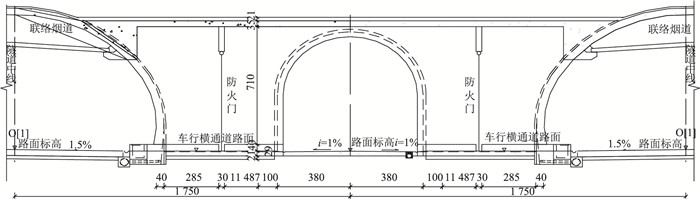
1 工程概况胶州湾第二隧道是连接青岛主城区和西海岸新区的海底隧道工程,西起青岛西海岸新区淮河东路,向东沿刘公岛路下方敷设,穿越胶州湾后至青岛港登陆,隧道全长14.36 km,采用设计速度80 km/h的双向六车道城市快速路标准进行建设。该工程采用双孔分离式3车道主线隧道加中间服务隧道的布置方式,每孔隧道内车道宽度(2×3.5+3.75) m,服务隧道路面宽度5.5 m。根据工程地质条件,隧道采用钻爆法和盾构法的组合工法施工,其中钻爆法隧道段长度约10 km,每750 m左右设置一处车行横通道,车行横通道与主洞及服务隧道相对位置关系图如图 1所示;盾构段隧道长度约3 300 m,不超过1 500 m设置一处车行横通道。根据《建筑设计防火规范(2018年版)》(GB50016—2014)要求和工程实际应用情况调研,横通道采用与主线隧道垂直布置方式。
|
| 图 1 车行横通道与主洞及服务隧道相对位置关系(单位: m) Fig. 1 Relative position of vehicle cross passage, main tunnels and service tunnel(unit: m) |
| |
2 消防车、清障车参数调研
隧道内用于救援的专用车辆主要有消防车和清障车,车辆的长度、宽度、轴距等主要参数是计算最小转弯半径,并据此确定横通道宽度的制约因素。
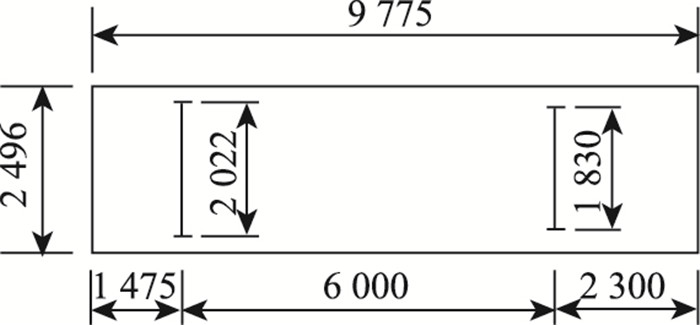
2.1 消防车参数研究消防车属于特种车辆,外廓尺寸不能直接参照《城市道路工程设计规范(2016年版)》(CJJ37—2012)中机动车设计车量及外廓尺寸取值,其通过性能也非强制性规定。根据《消防车第1部分通用技术条件》(GB 7956.1—2014),所有消防车宽度不超过2.5 m,车高不超过4.0 m,除了登高消防车和拖挂式消防车外,其他类型消防车车长均小于12 m。隧道内由于空间限制,隧道内消防救援不需使用登高车,目前常用的消防车长度一般不超过10 m。结合消防车相关规范,本次研究选取中国重汽汕德卡C7H重卡400马力水罐消防车底盘相关指标进行转弯性能计算,具体参数如下:长×宽×高:9.775 m×2.496 m×2.99 m;前悬:1 475 mm;后悬:2 300 mm;前轮距:2 022 mm;后轮距:1 830 mm;轴距:4 600+1 400 mm;最小转弯半径10 m,车辆几何尺寸简图如图 2所示。
|
| 图 2 消防车外部尺寸(单位:mm) Fig. 2 External dimensions of fire truck(unit: mm) |
| |
2.2 清障车参数研究
根据汽车行业标准《清障车》(QC/T 645—2018)的规定,清障车的宽度外廓尺寸限值宽2.55 m,高4.0 m,其轴距等参数在规范中没有具体要求。隧道内部清障车按照结构形式划分有4种系列,分别为普通型、平板型、托吊联体型和托吊分离型。按作业能力可分为轻型清障车、中型清障车、重型清障车以及超重型清障车。清障车与消防车类似,一般为定型二类汽车底盘改装得到的专用车辆,通过对胶州湾隧道现役清障车调研,如表 1所示,车长均小于10 m,故本次研究时,对9.68 m长的清障车采用与消防车相同的参数进行转弯能力分析。
| 车型 | 长×宽×高/m3 | 前、后悬/mm | 前、后轮距/mm | 轴距/mm |
| ZQS5161TQZBP5福田牌底盘 | 9.680×2.540×2.840 | 1 270、3 260 | 1 914、1 800 | 5 150 |
| ZQS5161TQZ斯达-斯太尔底盘 | 9.640×2.495×3.080 | 1 320、2 120 | 2 047、1 850 | 6 200 |
| ZQS5071TQZQPD五十铃牌底盘 | 7.240×2.300×2.270 | 1 015、2 410 | 1 504、1 425 | 3 815 |
| ZQS5102TAZ五十铃牌底盘 | 7.380×2.200×2.350 | 1 110、1 795 | 1 680、1 650 | 4 475 |
3 救援车从横通道进出主线隧道所需净宽分析
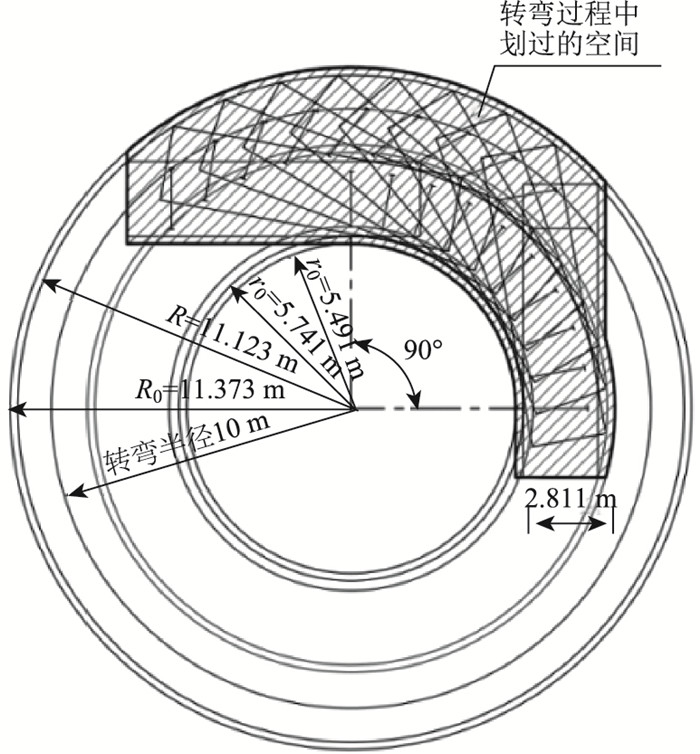
为了缩短救援时间,在不进行倒车、低速行驶情况下,研究救援车辆一次性转弯通过时所需车行横通道的最小宽度。结合选定的消防车参数,参考《车库建筑设计规范》(JGJ100—2015)中阿克曼几何原理,求得机动车环形外半径R为11.123 m,环形内半径r为5.741 m;考虑0.25 m的安全距离,环形车道外半径R0为11.373 m,环形车道内半径r0为5.491 m,如图 3所示。从图中可以看出车辆直角转弯时,两侧各考虑0.25 m安全距离,转弯之前所需宽度最小为3.311 m(0.25+2.811+0.25)m,主线隧道3条车道宽度组成为(3.75+3.5+3.5)m,满足转弯前最小宽度要求。
|
| 图 3 消防车转弯性能计算图 Fig. 3 Calculation diagram of turning performance of fire truck |
| |
结合现行规范最小值要求,本次研究针对横通道路面宽度分别为4.0 m和6.0 m和8.0 m时,车辆从横通道进入主线隧道、从主线隧道转入横通道等多种工况进行了研究,各工况编号和行驶路径等如表 2所示。
| 工况编号 | 路面宽 | 车辆行驶路线 | 车辆在主线隧道的位置 | 横通道及主线隧道加宽情况 |
| 1-1 | 4.0 m | 从主线隧道转入横通道 | 左侧车道 | 横通道加宽至7.764 m,加宽长度11.613 m;主线隧道加宽1.164 m,加宽长度12.126 m |
| 1-2 | 中间车道 | 横通道加宽至7.764 m,加宽长度9.277 m | ||
| 1-3 | 从横通道转入主线隧道 | 右侧车道 | 横通道加宽至7.428 m,加宽长度5.527 m | |
| 1-4 | 左侧车道 | 主线隧道加宽2.828 m,加宽长度13.604 m;需借助中间车道转弯 | ||
| 1-5 | 中间车道 | 不加宽,需借助右侧车道转弯 | ||
| 2-1 | 6.0 m | 从主线隧道转入横通道 | 左侧车道 | 主线隧道加宽5.302 m,加宽长度14.008 m |
| 2-2 | 中间车道 | 主线隧道加宽1.802 m,加宽长度6.490 m | ||
| 2-3 | 右侧车道 | 不加宽 | ||
| 2-4 | 从横通道转入主线隧道 | 左侧车道 | 主线隧道加宽0.841 m,加宽长度11.722 m;需借助中间车道转弯 | |
| 2-5 | 中间车道 | 不加宽,需借助右侧车道转弯 | ||
| 3-1 | 8.0 m | 从主线隧道转入横通道 | 左侧车道 | 不需加宽 |
3.1 工况1:横通道路面宽度4.0 m
车行横通道与主线隧道垂直正交,从主线隧道转入车行横通道时,无论沿着行车方向还是逆行车方向进入所需条件相同,考虑到消防车可能从火灾点前方逆行进入,故横通道设计时两个行车方向均需考虑,按照包络设计。
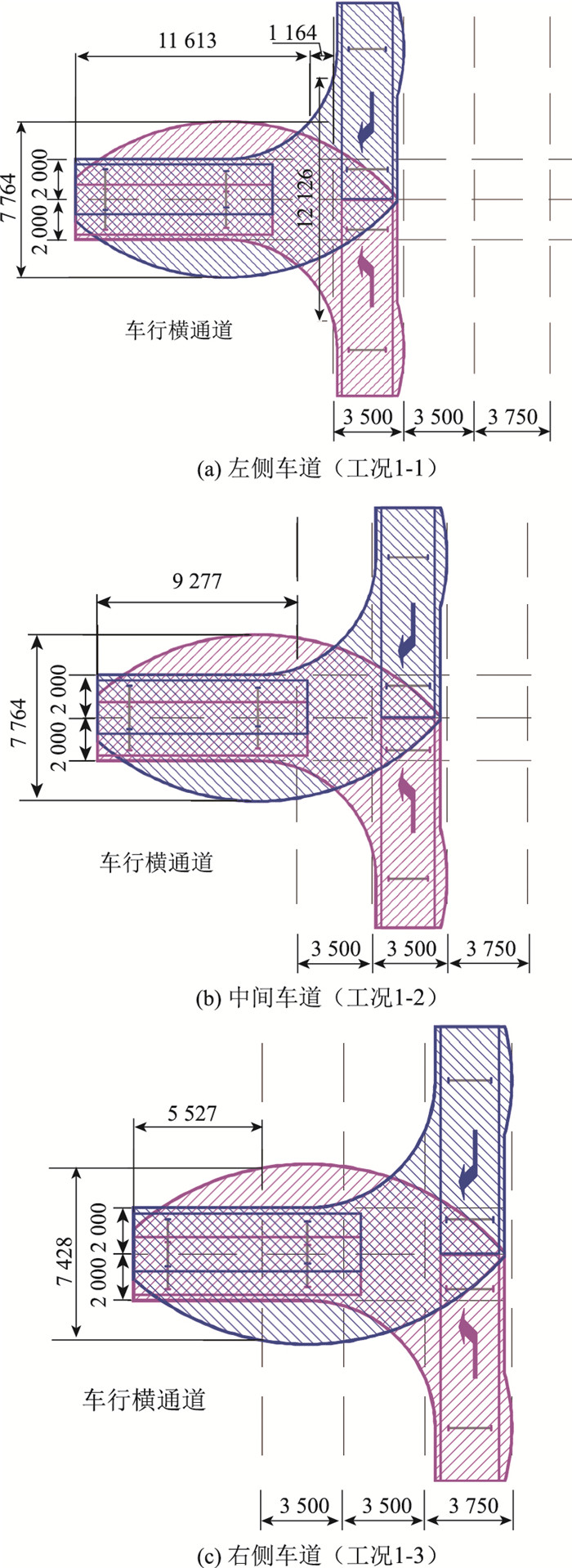
从主线隧道转入横通道时:车行横通道路面宽4 m,主线隧道转入车行横通道后在车行横通道边缘位置,从左侧车道、中间车道和右侧车道分别转入横通道的转弯情况如图 4所示,3种情况均需对车行横通道路面局部进行加宽,分别加宽至7.764 m(长度11.613 m)、7.764 m(长度9.277 m)和7.428 m(长度5.527 m),左侧车道转弯时主线隧道路面还需局部加宽1.164 m(长度12.126 m)。
|
| 图 4 从主线隧道转入横通道示意图(单位: mm) Fig. 4 Schematic diagrams of turning from right lane of main line tunnel to cross passage(unit: mm) |
| |
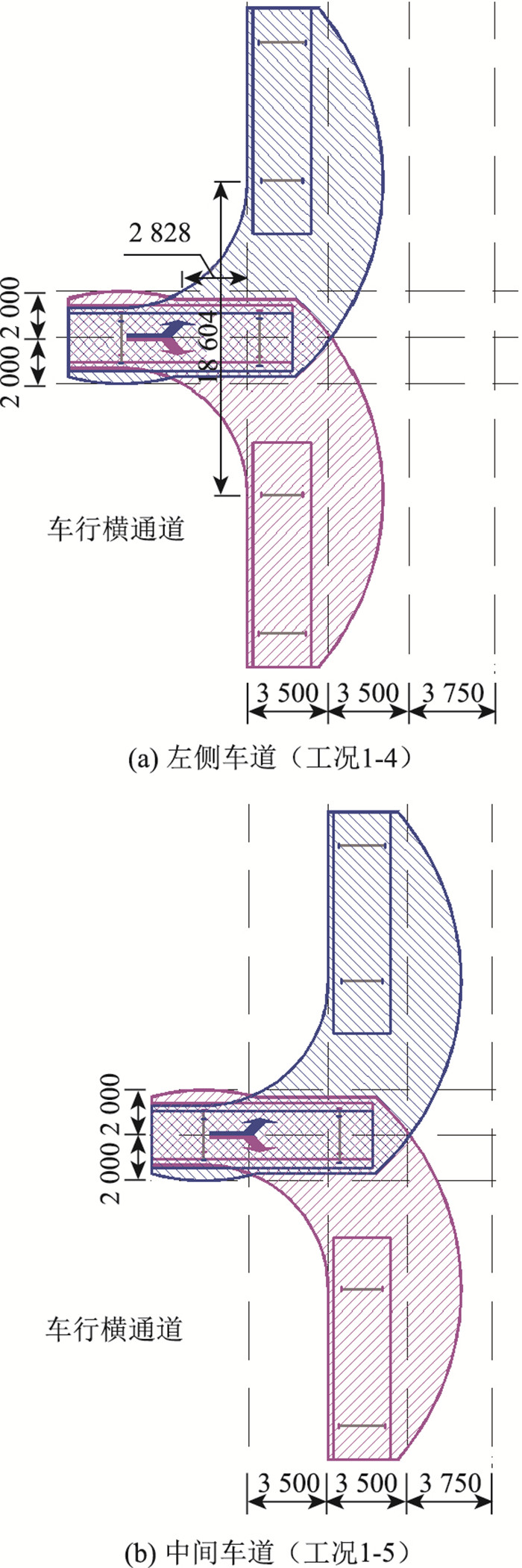
从横通道转入主线隧道时:转弯情况如图 5所示,如果实现一次性转至最左侧车道,主线隧道路面需局部加宽2.828 m(长度13.604 m);转至中间侧车道时,路面不需加宽。
|
| 图 5 从横通道转入主线隧道示意图(单位: mm) Fig. 5 Schematic diagrams of turning from cross passage to middle lane of main line tunnel(unit: mm) |
| |
3.2 工况2:横通道路面宽度6.0 m
当横通道路面宽度为6.0 m时,如图 6(a)所示,从主线隧道中间车道和右侧车道可直接转入横通道。如实现从左侧车道直接转入横通道,如图 6(b)所示,需对主线隧道与横通道交叉部位局部加宽。当消防车从横通道进入主线隧道时,如图 6(c)所示,可利用路缘带和检修带位置的路面局部加宽一次性转入左侧车道和中间车道。

|
| 图 6 从横通道转至主线隧道示意图(单位: mm) Fig. 6 Schematic diagrams of turning from cross passage to left lane of main line tunnel(unit: mm) |
| |
3.3 工况3:横通道路面宽度8.0 m
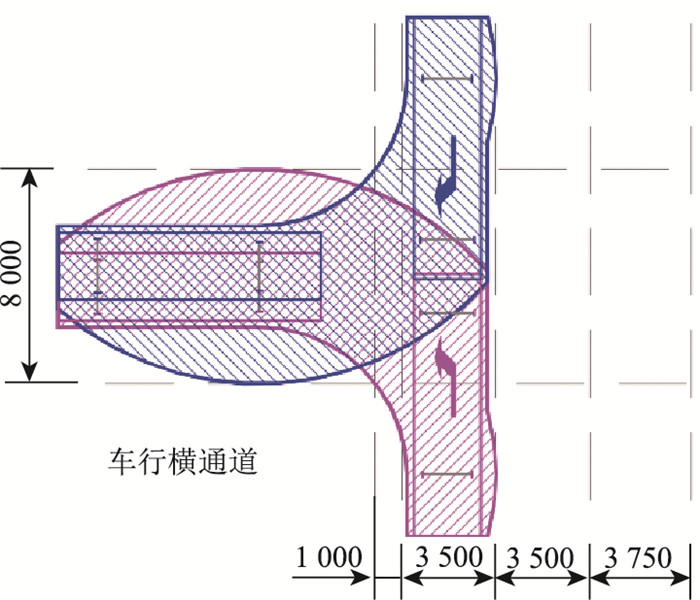
当车行横通道路面加宽至8.0 m时,可实现消防车从主线隧道三车道中任意一个车道一次性转入横通道,也可实现消防车从车行横通道一次性转至主线隧道三车道中任意一个车道。从主线隧道左侧车道转入横通道时转弯影响区域如图 7所示。
|
| 图 7 从主线隧道左侧车道转入横通道示意图(工况3-1) (单位: mm) Fig. 7 Schematic diagrams of turning from the left of main line tunnel to cross passage(condition 3-1)(unit: mm) |
| |
因此,当横通道路面取6.0 m时,相比现有规范最小值4.0 m的路面宽度,通过能力有极大的改善,可为海底隧道救援提供有利条件;当横通道路面宽度增大至8.0 m时,相对6.0 m宽度,仅增加了从主线隧道左侧车道一次性转入横通道的功能,总体上改善不大。
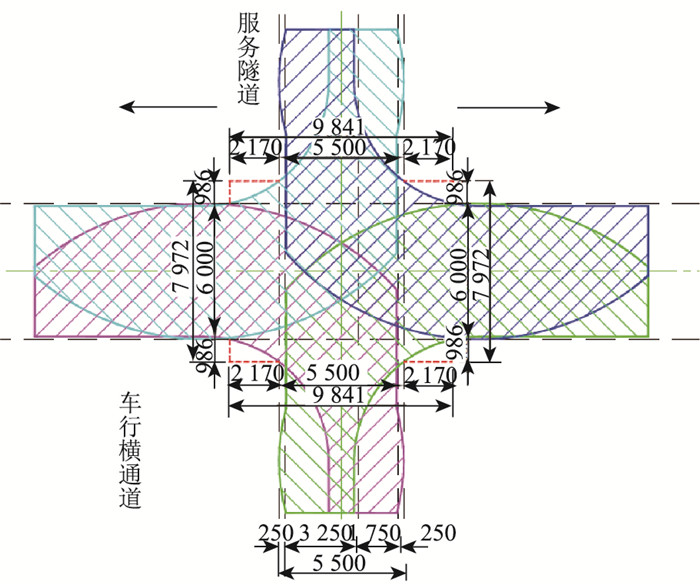
4 救援车从横通道进出服务隧道所需宽度分析与前述分析方法相同,对9.775 m长救援车辆从横通道进出中间服务隧道时车辆转弯影响区域进行了研究。如图 8所示,如果车行横通道路面宽度取6.0 m,从5.5 m宽服务隧道进出时,交叉口处路面宽度不够,需局部加宽为7.972 m,这样意味着当横通道宽度取8.0 m时,救援车辆可通过横通道进出中间服务隧道。
|
| 图 8 从横通道进出服务隧道示意图(单位:mm) Fig. 8 Schematic diagram of entering and exiting service tunnel from cross passage(unit: mm) |
| |
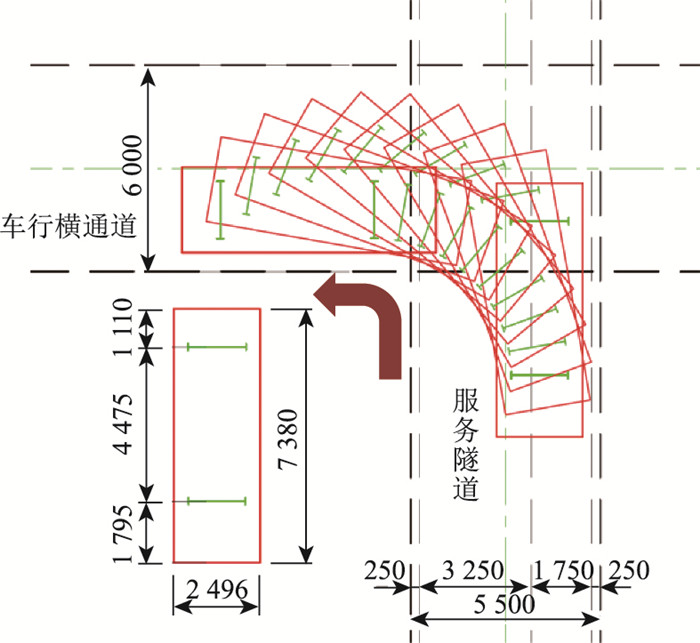
根据研究成果,胶州湾第二海底隧道工程在运营期间消防车不需通过中间服务隧道进行救援,中间服务隧道仅通行清障车和养护维修车辆(车辆尺寸比清障车小),结合表 3中清障车调研情况,对车长7.38 m的中型清障车通过横通道进出服务隧道时所需的横通道宽度进行了分析。车辆具体参数为:长度7 380 mm,宽度2 496 mm,轴距4 475 mm,如图 9所示。当横通道路面宽度6.0 m时,中型清障车可通过横通道一次性进出服务隧道。
| 车行横通道路面宽度/m | 开挖/m3 | C35喷射混凝土/m3 | ϕ25中空注浆锚杆/m | ϕ8钢筋网/kg | CF45二衬混凝土/m3 | 延米建安费/万元 |
| 4.0 | 44.93 | 5.02 | 27.00 | 93.26 | 7.20 | 4.20 |
| 6.0 | 64.64 | 6.25 | 67.50 | 111.34 | 9.57 | 5.94 |
| 8.0 | 87.68 | 7.33 | 76.50 | 130.71 | 13.72 | 7.94 |
| 注:本表延米工程量按Ⅳ级围岩拟定,考虑到防火门的安装,横通道实际宽度为路面宽度加1.0 m。 | ||||||
|
| 图 9 中型清障车进出服务服务隧道示意图(单位:mm) Fig. 9 Schematic diagram of medium-sized wrecker entering and exiting service tunnel(unit: mm) |
| |
5 不同宽度横通道工程费用分析
路面宽度为4.0,6.0 m和8.0 m的车行横通道主要工程量及延米建安费按估算如表 3所示。
对比分析显示,如果车行横通道路面宽度由规范规定的4.0 m(总宽5.0 m)改为6.0 m(总宽7.0 m),延米建安工程费将增加约41%;路面宽度由6.0 m(总宽7.0 m)改为8.0 m(总宽9.0 m),延米建安工程费将增加约34%;路面宽度由4.0 m(总宽5.0 m)改为8.0 m(总宽9.0 m),延米建安工程费将增加约89%。
6 结论本研究以青岛胶州湾第二海底隧道工程为研究背景,通过水下隧道防灾救援通行车辆几何尺寸参数等相关设计因素调研,基于车辆进出主线隧道和服务隧道时所需净宽分析,对海底隧道车行横通道的合理宽度进行了深入研究,研究结果为后续设计、施工提供参考借鉴。具体研究结论如下:
(1) 当车行横通道与主线隧道垂直、路面宽度取现行规范最小值4.0 m时,消防车从主线隧道内任一条车道均无法一次性转入横通道,仅能实现从通道一次性转至主线隧道的中间车道。
(2) 当横通道路面宽度为6.0 m时,能实现消防车从主线隧道中间车道或右侧车道一次性转入横通道;能实现消防车从横通道一次性转至主线隧道任一道;车长约7.4 m中型清障车可通过横通道一次性进出服务隧道。
(3) 当横通道路面宽度为8.0 m时,能实现消防车从主线隧道三车道中的任一车道进出横通道;可实现长约10 m的重型清障车通过横通道进出服务隧道。
(4) 横通道与主线隧道交叉段围岩体和衬砌结构受力复杂,横通道跨度越大,其施工风险和工程投资随之增加,路面宽度4.0,6.0, 8.0 m横通道对应的延米建安费(按照Ⅳ级围岩考虑)分别为:4.20,5.94,7.94万元。综合考虑工程建设难度和投资,车行横通道路面宽度采用6.0 m较为合理。
| [1] |
王梦恕. 水下交通隧道发展现状与技术难题: 兼论"台湾海峡海底铁路隧道建设方案"[J]. 岩石力学与工程学报, 2008, 27(11): 2161-2172. WANG Meng-shu. Current Developments and Technical Issues of Underwater Traffic Tunnel: Discussion on Construction Scheme of Taiwan Strait Undersea Railway Tunnel[J]. Chinese Journal of Rock Mechanics and Engineering, 2008, 27(11): 2161-2172. DOI:10.3321/j.issn:1000-6915.2008.11.001 |
| [2] |
周书明. 青岛胶州湾海底隧道总体设计与施工[J]. 隧道建设, 2013, 33(1): 38-44. ZHOU Shu-ming. Design and Construction of Jiaozhou Bay Subsea Tunnel in Qingdao[J]. Tunnel Construction, 2013, 33(1): 38-44. |
| [3] |
宋超业, 贺维国. 厦门轨道交通3号线复杂环境过海区间隧道设计关键技术[J]. 隧道建设, 2018, 38(3): 414-423. SONG Chao-ye, HE Wei-guo. Key Technology of Sea-crossing Interval Tunnel in Complex Environment Design of Xiamen Rail Transit Line 3[J]. Tunnel Construction, 2018, 38(3): 414-423. |
| [4] |
王景春, 侯卫红, 莫勋涛. 海底隧道施工安全评价的初步研究[J]. 岩石力学与工程学报, 2007(增2): 3756-3762. WANG Jing-chun, HOU Wei-hong, MO Xun-tao. Preliminary Research on Safety Evaluation for Subsea Tunnel Construction[J]. Chinese Journal of Rock Mechanics and Engineering, 2007(S2): 3756-3762. |
| [5] |
惠豫川, 肖益民, 黄浩天, 等. 单向长隧道极端条件下火灾安全疏散研究[J]. 地下空间与工程学报, 2020, 16(6): 1826-1835, 1848. HUI Yu-chuan, XIAO Yi-min, HUANG Hao-tian, et al. Research on Fire Safety Evacuation in Unidirectional and Long Tunnel under Extreme Conditions[J]. Chinese Journal of Underground Space and Engineering, 2020, 16(6): 1826-1835, 1848. |
| [6] |
王赤心. 多车道高速公路隧道人行横洞疏散安全分析[J]. 公路交通科技, 2015, 32(11): 100-106. WANG Chi-xin. Analysis of Multi-lane Expressway Tunnel Transverse-hole Evacuation Safety[J]. Journal of Highway and Transportation Research and Development, 2015, 32(11): 100-106. DOI:10.3969/j.issn.1002-0268.2015.11.016 |
| [7] |
王华牢, 刘学增, 马小君. 长大公路隧道火灾安全疏散研究[J]. 公路交通科技, 2010, 27(11): 83-87. WANG Hua-lao, LIU Xue-zeng, MA Xiao-jun. Research on Safe Evacuation in Long Road Tunnel during Fire[J]. Journal of Highway and Transportation Research and Development, 2010, 27(11): 83-87. DOI:10.3969/j.issn.1002-0268.2010.11.015 |
| [8] |
章庭瑞, 李维, 闫治国. 长大公路隧道纵向排烟与人员疏散特性研究[J]. 现代隧道技术, 2020, 57(增1): 651-661. ZHANG Ting-rui, LI Wei, YAN Zhi-guo. Research on Performance of Longitudinal Smoke Extraction Strategy and Personnel Evacuation in Road Tunnel[J]. Modern Tunnelling Technology, 2020, 57(S1): 651-661. |
| [9] |
蔡煜. 长大公路隧道内公交车火灾的人员安全疏散研究[D]. 北京: 北京交通大学, 2020. CAI Yu. Study on Safe Evacuation of Bus Fire in Long Road Tunnel[D]. Beijing: Beijing Jiaotong University, 2020. |
| [10] |
徐永, 廖少明, 李伟平. 钱江隧道火灾疏散可靠性分析[J]. 公路交通科技, 2015, 32(2): 108-113. XU Yong, LIAO Shao-ming, LI Wei-ping. Analysis on Analysis on Fire Evacuation Reliability of Qianjiang River Tunnel[J]. Journal of Highway and Transportation Research and Development, 2015, 32(2): 108-113. |
| [11] |
黄小进, 唐志辉. 消防车道最小转弯半径以及通道宽度的计算[J]. 华中建筑, 2009, 27(11): 67-68. HUANG Xiao-jin, TANG Zhi-hui. The Calculation of the Minimal Turning Radius and the Setting of the Fire Road Width[J]. Huazhong Architecture, 2009, 27(11): 67-68. |
| [12] |
陈文. 山区高速高桥隧比路段应急交通与救援关键技术研究[D]. 重庆: 重庆交通大学, 2019. CHEN Wen. Research on Key Technologies of Emergency Rescue in Mountainous Highway[D]. Chongqing: Chongqing Jiaotong University, 2019. |
| [13] |
CJJ221—2015, 城市地下道路工程设计规范[S]. CJJ221—2015, Code for Design of Urban Underground Road Engineering[S]. |
| [14] |
GB 50016—2014, 建筑设计防火规范[S]. GB 50016—2014, Code for Fire Protection Design of Buildings[S]. |
| [15] |
JTG 3370.1—2018, 公路隧道设计规范: 第一册土建工程[S]. JTG 3370.1—2018, Specification for Design Highway Tunnels — Section 1 — Civil Engineering[S]. |
| [16] |
秦峰, 丁浩, 方林. 公路隧道车行横洞行车道宽度及平面布设方式研究[C]//2011年公路隧道安全设计与运营管理暨水下隧道建设技术国际会议论文集. 重庆: 重庆大学出版社, 2011: 57-64. QIN Feng, DING Hao, FANG Ling. Research on Width and Plane Arrangement of Transverse Passageway in Road Tunnel[C]//Proceedings of 2011 International Conference on Highway Tunnel Safety Design and Operational Management and Underwater Tunnel Construction Technology. Chongqing: Chongqing University Press, 2011: 57-64. |
| [17] |
吕明, GRΦV E, NILSEN B, 等. 挪威海底隧道经验[J]. 岩石力学与工程学报, 2005, 24(23): 4219-4225. LÜ Ming, GRΦV E, NILSEN B, et al. Norwegian Experience in Subsea Tunnelling[J]. Chinese Journal of Rock Mechanics and Engineering, 2005, 24(23): 4219-4225. |
| [18] |
龚波. 基于运输车辆人员安全的公路隧道火灾疏散研究[D]. 西安: 长安大学, 2018. GONG Bo. Study on Fire Spread and Evacuation of Road Tunnel Based on Safety of Transportation Vehicle Personnel[D]. Xi'an: Chang'an University, 2018. |
| [19] |
姚海元, 扬懿, 查雅平, 等. 深中通道隧道埋深和口门宽度论证[J]. 公路, 2018, 63(12): 330-334. YAO Hai-yuan, YANG Yi, CHA Ya-ping, et al. Demonstration on the Buried Depth of Tunnel and the Width of Entrance in Shenzhen-Zhongshan Crossing Project[J]. Highway, 2018, 63(12): 330-334. |
| [20] |
孙延利. 城市社区机动车交通特性与交通设计研究[D]. 济南: 山东大学, 2019. SUN Yan-li. Research on Traffic Characteristics and Traffic Design of Urban Community Motor Vehicles[D]. Jinan: Shandong University, 2019. |
| [21] |
李术才, 王燕, 李树忱. 工程类比法在海底隧道岩石覆盖厚度研究中的应用[J]. 岩土力学, 2006, 27(增1): 279-282. LI Shu-cai, WANG Yan, LI Shu-chen. Application of Empirical Analogue Methods to Research of Rock Cover of Subsea Tunnel[J]. Rock and Soil Mechanics, 2006, 27(S1): 279-282. |
| [22] |
王雪松, 王婷, 陈亦新. 基于驾驶模拟技术的公路隧道车道宽度运行影响分析[J]. 中国安全科学学报, 2016, 26(6): 36-41. WANG Xue-song, WANG Ting, CHEN Yi-xin. Influence of Lane Width on Driving Behavior on Freeway Tunnel: Driving Simulator Study[J]. China Safety Science Journal, 2016, 26(6): 36-41. |