 2022, Vol. 39
扩展功能

文章信息
- 高小妮, 沈理斌, 沈健聪
- GAO Xiao-ni, SHEN Li-bin, SHEN Jian-cong
- 桥梁板式橡胶支座典型病害下的力学性能研究
- Study on Mechanical Properties of Bridge Plate Rubber Bearing in Typical Disease
- 公路交通科技, 2022, 39(10): 59-63
- Journal of Highway and Transportation Research and Denelopment, 2022, 39(10): 59-63
- 10.3969/j.issn.1002-0268.2022.10.008
-
文章历史
- 收稿日期: 2022-04-08


2. 嘉兴市快速路建设发展有限公司, 江苏 浙江 314000
2. Jiaxing Expressway Construction Development Co., Ltd., Zhejiang Jiangsu 314000, China
板式橡胶支座是桥梁支座中不可或缺的支座类型之一,具有性能可靠、安装和使用方便、造价低、吸收部分振动、减小活载对桥梁结构及墩台的冲击的特点,在20世纪50年代国内外已广泛开始应用[1]。在我国目前新建跨度小于30 m、位移量较小的公路桥梁中几乎全使用橡胶支座。但近年来,随着我国交通量的增大,以及橡胶产品生产质量、支座设计和施工不当等原因,橡胶支座出现大量病害。橡胶支座病害主要有不均匀外鼓、开裂(包括破损)、剪切变形大、脱空(包括缺失)、钢板外露、偏压、偏位和串位等[2-3]。通过对国内近16万个在用板式橡胶支座的检查结果进行初步统计分析(见表 1)表明:除了样本支座存在支座老化开裂现象外,同时支座偏压脱空现象、剪切变形超限现象也较为突出。
| 病害类型 | 老化开裂 | 不均匀外鼓及竖向压缩超限 | 剪切变形超限 | 偏位和移位 | 脱空和偏压 | 滑板磨损及不锈钢板脱落 |
| 数量/个 | 61 410 | 22 209 | 36 083 | 19 253 | 42 593 | 21 207 |
| 占比/% | 38.02 | 13.75 | 22.34 | 11.92 | 26.37 | 13.13 |
支座产品的费用占桥梁总造价很低,但支座更换的费用却非常高。我国公路桥梁采用板式橡胶支座数量较大,每年由于支座质量问题造成的经济损失巨大。国内外学者对板式橡胶支座已展开大量研究,刘利[2]利用FEA软件采用增加弹性模量和剪切模量对支座出现病害的情况进行了模拟分析;邬晓光等[3]通过建立板式橡胶支座的有限元模型,分析得出橡胶支座的极限脱空率和极限剪切角,并对支座同时存在脱空和剪切时的失效标准进行研究。这些研究仅对支座病害的某一种病害情况进行了模拟。通过调研发现支座出现的典型病害有老化开裂、偏压脱空现象、剪切变形超限等3种[4-5],支座的老化开裂影响因素较多。因此,本研究利用大型有限元分析软件对板式橡胶支座在脱空和剪切变形[6-8]两种病害情况下不同病害程度的支座力学性能进行分析。
1 基本理论橡胶支座的行为特征是非线性的,然而从简单性和实用性考虑,也可以应用线弹性理论来分析橡胶支座的受力特性[9]。根据试验测定橡胶材料的泊松比接近0.5,这表示橡胶的体积应变非常小,橡胶几乎是不可压缩的,橡胶只发生形状改变而体积不可改变。为了简便计算采用了基于连续介质力学理论的Mooney-Rivlin[10]形式的模型。
根据文献[11]中对橡胶支座的橡胶材料进行单轴拉伸试验,然后对所测得的试验数据进行拟合得出橡胶材料参数,本次分析计算取橡胶材料常数C01=0.187,C10=0.747。
2 橡胶支座数值模拟有限元模型建立 2.1 单元选择考虑到实际情况,无论在制作还是使用过程中橡胶支座内部橡胶和钢板之间都是始终约束在一起的,并且从模型的简化方面考虑,在有限元模型里将橡胶和钢板之间使用共同的节点,即采用共节点法。
根据在轴心受压状态下圆板式橡胶支座的几何形状和加载工况的对称特性, 可以建立平面模型进行有限元分析。在有限元模型[12-13]中橡胶材料采用PLANE182单元。支座内部薄钢板的应力-应变本构关系采用双线性描述,其弹性阶段模量取为206 GPa,泊松比为0.3。
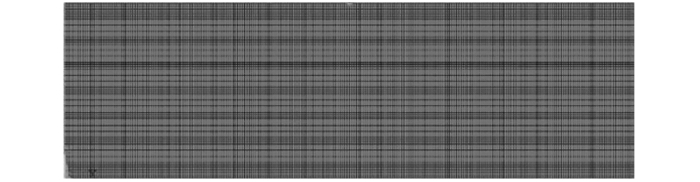
根据调查结果,选取20 m空心板常用的支座直径为250 mm的圆形支座作为研究对象。其平面模型如图 1所示。
|
| 图 1 橡胶支座GYZ250×77有限元平面模型 Fig. 1 Rubber bearing GYZ250 × 77 finite element plane model |
| |
2.2 荷载施加方式
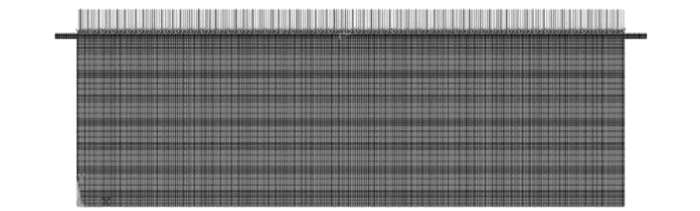
在试验中支座施加10 MPa荷载分级[14]进行加载。根据前期研究,在有限元分析时,模拟试验加载方法,在平面模型中采用增加钢板加载法,以满足计算要求。荷载施加情况如图 2所示。
|
| 图 2 增加钢板加载示意图 Fig. 2 Schematic diagram of adding steel plate loading |
| |
3 计算结果分析 3.1 局部脱空对支座受力性能影响
通过有限元平面模型分析,确定支座局部脱空对支座受力性能[15-17]的影响,分别为完好支座、支座未脱空(荷载已呈现梯形分布)、脱空面积10%以及脱空面积20%。局部脱空分析各工况的加载范围及应力如表 2所示。
| 工况分类 | 工况1 | 工况1 | 工况2 | 工况3 |
| 脱空面积/% | 完好 | 0 | 10 | 20 |
| 加载范围/mm | 250 | 250 | 225 | 200 |
| 边缘最大应力/MPa | 10 | 0~20 | 0~22.23 | 0~25 |
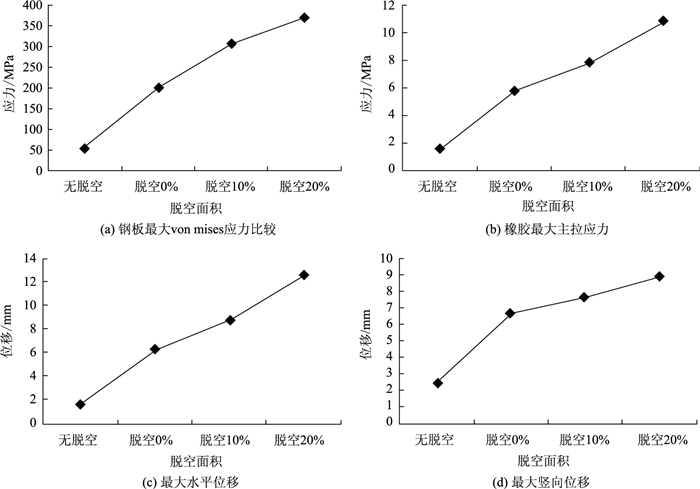
通过有限元模型分析,支座各工况钢板最大von mises应力、橡胶最大主拉应力、最大水平位移及最大竖向位移如表 3及图 3所示。
| 工况 | 描述 | 钢板最大von mises应力/MPa | 橡胶最大主拉应力/MPa | 最大水平位移/mm | 最大竖向位移/mm |
| 工况1 | 正常支座 | 55.66 | 1.58 | 1.64 | 2.43 |
| 工况2 | 脱空0% | 200.68 | 5.79 | 6.22 | 6.67 |
| 工况3 | 脱空10% | 306.06 | 7.78 | 8.72 | 7.69 |
| 工况4 | 脱空20% | 369.62 | 10.79 | 12.52 | 8.93 |
|
| 图 3 各工况下支座力学性能比较 Fig. 3 Comparison of mechanical properties of bearing under various working conditions |
| |
由支座脱空分析可知,钢板最大应力在55.66~369.62 MPa之间,最大拉应力在1.58~10.79 MPa之间,支座压缩变形在2.43~8.93 mm之间。
依据现行规范,对于板式橡胶支座GYZ250×77,钢板屈服强度为325 MPa,最大拉应力不大于17 MPa,支座压缩变形应小于3.92 mm。
因此,当支座发生脱空时,支座压缩变形为6.67 mm,超过支座允许压缩变形。支座发生脱空20%时,钢板最大应力不满足要求。可见,对于公路桥梁板式橡胶支座不允许其发生脱空。
3.2 剪切变形对支座受力性能影响在模拟板式橡胶支座剪切变形[18]对支座性能影响时,分5种工况进行分析,剪切角度分别为10°,20°,30°,35°及35.5°。根据现行标准规定支座进行剪切试验时,支座承受10 MPa竖向荷载以及水平荷载作用。剪切角度不同时,支座所需水平力如表 4所示。
| 工况分类 | 工况1 | 工况2 | 工况3 | 工况4 | 工况5 |
| 支座剪切角度/(°) | 10 | 20 | 30 | 35 | 35.5 |
| 正切值 | 0.177 | 0.364 | 0.577 | 0.700 | 0.712 |
| 所需水平荷载值/N | 62 | 136 | 217 | 265 | 290 |
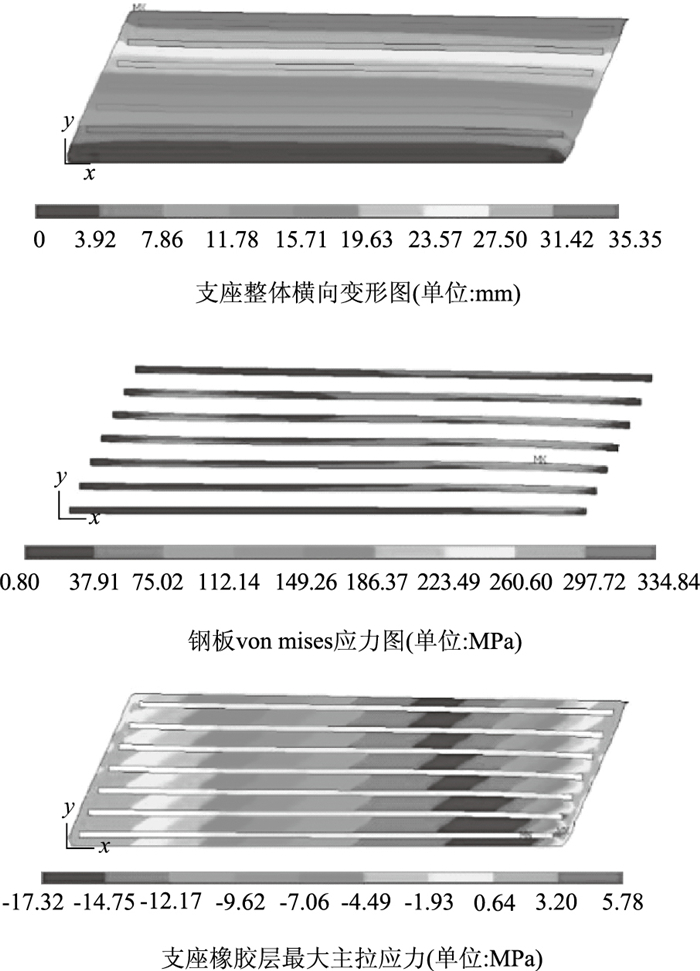
对各工况下板式橡胶支座的力学性能进行分析,分别提取橡胶支座内部钢板、橡胶层及钢板和橡胶黏结处应力及变形等力学指标,介于篇幅,仅示出工况5的结果,如图 4所示。
|
| 图 4 剪切角度35.5°支座受力情况 Fig. 4 Stress of bearing at 35.5° shear angle |
| |
由图可知,支座发生剪切变形后,支座横向变形各横截面变化基本相似,顶部横向变形最大;支座钢板应力变化较均匀;支座最大拉应力呈现不对称,最大拉应力基本出现在支座施加荷载侧,最大压应力出现在非加载侧的橡胶底部区域。支座剪切作用下的力学性能如表 5及图 5所示。
| 工况 | 工况1 | 工况2 | 工况3 | 工况4 | 工况5 |
| 剪切角/(°) | 10 | 20 | 30 | 35 | 35.5 |
| 最大水平位移/mm | 8.13 | 16.74 | 26.57 | 32.36 | 35.36 |
| 钢板最大von mises应力/MPa | 86.43 | 158.82 | 248.85 | 304.98 | 334.86 |
| 橡胶最大主拉应力/MPa | 1.93 | 2.95 | 4.36 | 5.27 | 5.77 |
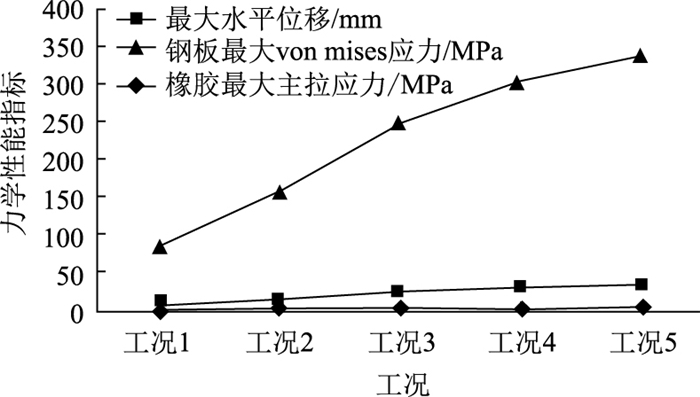
|
| 图 5 剪切角度不同橡胶支座受力性能对比 Fig. 5 Comparison of mechanical performance of rubber bearings with different shear angles |
| |
由支座剪切角度不同橡胶支座受力性能比较分析可知,钢板最大应力、橡胶最大拉应力及最大水平位移随着剪切角度增大而增大。钢板最大应力在86.43~334.86 MPa之间,橡胶最大拉应力在1.93~5.77 MPa之间,最大水平位移在8.13~35.36 mm。
因此,当支座剪切角度大于35°时,钢板最大应力为334.86 MPa,超过钢板屈服强度325 MPa。
4 结论通过对板式橡胶支座在典型病害(支座脱空和支座剪切变形)下的受力性能指标分析,探讨了典型病害对支座受力性能的影响,得出如下结论:
(1) 板式橡胶支座脱空面积小于20%时,支座压缩变形超过支座允许压缩变形,对支座性能影响较大;脱空面积大于20%时,出现钢板最大应力不满足要求,对支座性能影响非常大。因此,对于公路桥梁板式橡胶支座不允许其发生脱空。
(2) 支座发生剪切变形后,支座顶部横向变形最大,支座钢板应力变化较均匀,支座最大拉应力呈现不对称,最大拉应力基本出现在支座施加荷载侧,最大压应力出现在非加载侧的橡胶底部区域。
(3) 支座钢板最大应力、支座橡胶最大拉应力及支座最大水平位移随着剪切角度增大而增大,当板式橡胶支座剪切变形大于0.7(剪切角度大于35°)时,钢板最大应力超过钢板屈服强度,对支座性能影响很大,支座可能产生不可恢复的剪切塑性变形。
文中研究成果可为桥梁板式橡胶支座劣化分级及评定标准提供参考,但由于计算量有限,可进一步详细分析各影响因素对支座的影响。为了更准确地对支座病害进行判断,在今后的研究中可结合试验进行验证。
| [1] |
庄军生. 桥梁支座[M]. 3版. 北京: 中国铁道出版社, 2008. ZHUANG Jun-sheng. Bridge Bearings[M]. 3rd ed. Beijing: China Railway Publishing House, 2008. |
| [2] |
刘利. 在役公路桥梁板式橡胶支座病害分析及对策研究[D]. 北京: 中国铁道科学研究院, 2012. LIU Li. Study on Disease Analysis and Coping Strategies of Plate Type Elastomeric Pad Bearings for Highway Bridges Inservice[D]. Beijing: China Academy of Railway Sciences, 2012. |
| [3] |
邬晓光, 贺书磊, 郑鹏, 等. 公路桥梁板式橡胶支座失效标准研究[J]. 郑州大学学报(工学版), 2019, 40(1): 67-71. WU Xiao-guang, HE Shu-lei, ZHENG Peng, et al. Study on Failure Standard of Highway Bridge Rubber Bearing[J]. Journal of Zhengzhou University (Engineering Science Edition), 2019, 40(1): 67-71. |
| [4] |
陈顺林. 板式橡胶支座在缺陷状态下的力学性能分析[J]. 交通标准化, 2013(12): 77-80. CHEN Shun-lin. Mechanical Properties of Laminated Rubber Bearings in Defect Condition[J]. Transportation Standardization, 2013(12): 77-80. |
| [5] |
黄海新, 李炫钢, 李帆, 等. 老化与偏心受压下板式橡胶支座抗震性能拟静力试验研究[J]. 土木与环境工程学报, 2021(3): 51-58. HUANG Hai-xin, LI Xuan-gang, LI Fan, et al. Pseudo Static Test of Seismic Performance of Rubber Bearing Plate under Aging and Eccentric Compression[J]. Journal of Civil and Environmental Engineering, 2021(3): 51-58. |
| [6] |
GU H S, ITOH Y, SATOH K. Deterioration Assessment of Bridge Rubber Bearings[C]//The First International Conference on Structural Condition Assessment. Perth, Australia: [s. n. ], 2005.
|
| [7] |
ITOH Y, GU H S, SATOH K. Long-term Deterioration of High Damping Rubber Bearing[J].
Journal of Structural Engineering/Earthquake Engineering, JSCE, 2006, 23(2): 215-227.
DOI:10.2208/jsceseee.23.215s |
| [8] |
STEELMAN J S, FAHNESTOCK L A, FILIPOV E T, et al. Shear and Friction Response of Nonseismic Laminated Elastomeric Bridge Bearings Subject to Seismic Demands[J].
Journal of Bridge Engineering, 2013, 18(7): 612-623.
DOI:10.1061/(ASCE)BE.1943-5592.0000406 |
| [9] |
杨常生. 公路桥梁板式橡胶支座应用分析与研究[D]. 天津: 天津大学, 2007. YANG Chang-sheng. Analysis and Study on Application of Plate Type Elastomeric Pad Bearings for Highway Bridges[D]. Tianjin: Tianjin University, 2007. |
| [10] |
MOONEY M. A Theory of Large Elastic Deformation[J].
Journal of Applied Physics, 1940, 11(9): 582-592.
DOI:10.1063/1.1712836 |
| [11] |
秦德生. 板式橡胶支座力学性能试验研究及数值模拟[D]. 大连: 大连理工大学, 2008. QIN Deng-sheng. Test Research and Numerical Simulation of Mechanical Properties of Plate Type Elastomeric Pad Bearings[D]. Dalian: Dalian University of Technology, 2008. |
| [12] |
周梦舜. 抗横移板式橡胶支座的数值模拟研究[D]. 长沙: 国防科学技术大学, 2008. ZHOU Meng-shun. Numerical Simulation on Lateral-displacement-resisted Plate Rubber Support[D]. Changsha: National University of Defense Technology, 2008. |
| [13] |
刘岳兵. 铁路桥梁支座数值仿真研究[D]. 成都: 西南交通大学, 2010. LIU Yue-bing. Numerical Simulation of Railway Bridge Bearing[D]. Chengdu: Southwest Jiaotong University, 2010. |
| [14] |
JTG D62—2004, 公路钢筋混凝土及预应力混凝土桥涵设计规范[S]. JTG D62—2004, Specifications for Design of Highway Reinforced Concrete and Prestressed Concrete Bridges and Culverts [S]. |
| [15] |
吴刚, 王克海, 张盼盼, 等. 不同边界约束对橡胶支座受力性能影响研究[J]. 公路交通科技, 2019, 36(4): 88-94. WU Gang, WANG Ke-hai, ZHANG Pan-pan, et al. Study on Mechanical Property of Rubber Bearings for Different Boundary Conditions[J]. Journal of Highway and Transportation Research and Development, 2019, 36(4): 88-94. |
| [16] |
李枝军, 葛飞, 徐秀丽, 等. 板式橡胶支座性能有限元模拟与试验研究[J]. 东南大学学报(自然科学版), 2013, 43(6): 1299-1304. LI Zhi-jun, GE Fei, XU Xiu-li, et al. Finite Element Simulation and Experimental Study of Property for Elastomeric Pad Bearing[J]. Journal of Southeast University (Natural Science Edition), 2013, 43(6): 1299-1304. |
| [17] |
项乃亮, 崔侠侠, 李建中. 板式橡胶支座滑动摩擦性能试验及其力学模型[J]. 同济大学学报(自然科学版), 2016, 44(12): 1828-1834. XIANG Nai-liang, CUI Xia-xia, LI Jian-zhong. Experimental Study on Sliding Friction Behavior of Laminated Rubber Bearing and Its Mechanical Model[J]. Journal of Tongji University(Natural Science Edition), 2016, 44(12): 1828-1834. |
| [18] |
MOGHADAM S R, KONSTANTINIDIS D. Finite Element Study of the Effect of Support Rotation on the Horizontal Behavior of Elastomeric Bearings[J].
Composite Structures, 2017, 163: 474-490.
|