 2022, Vol. 39
扩展功能

文章信息
- 徐俊峰, 冯志敏, 李宏伟, 刘小锋
- XU Jun-feng, FENG Zhi-min, LI Hong-wei, LIU Xiao-feng
- 基于动态监测的斜拉桥索振动幅值与索力识别研究
- Study on Vibration Amplitude and Force Identification of Cables of Cable-stayed Bridge Based on Dynamic Monitoring
- 公路交通科技, 2022, 39(2): 111-116
- Journal of Highway and Transportation Research and Denelopment, 2022, 39(2): 111-116
- 10.3969/j.issn.1002-0268.2022.02.013
-
文章历史
- 收稿日期: 2020-07-07


2. 宁波杉工智能安全科技股份有限公司, 浙江 宁波 315100
2. Ningbo Shangong Intelligent Security Technology Co., Ltd., Ningbo Zhejiang 315100, China
斜拉索是斜拉桥的重要受力构件,掌握准确可靠的索力具有重要意义。由于斜拉索能将桥跨结构的恒载和桥面荷载传递给桥塔,其索力直接影响桥梁的应力和变形[1-2]。目前,工程中常用的索力测量方法有压力传感器测试法、电阻应变式测试法、油压表读数法、振动频率法、弹性磁通法等[3-6]。其中,振动频率法具有操作简单、经济高效、测试精度高等优点,所以应用最为广泛[7-8]。但是运用振动频率法测试索力时,影响频率与索力间换算关系的因素很多,如:减振器刚度、索的垂度和倾角角度、索的抗弯刚度等[9]。目前,国内外对索力识别外界因素的影响已有很深入的研究[10],樊帅等[11]研究了减振器对斜拉索索力测量的影响;陈涛等[12]验证了外界温度对索力测试值的影响;文献[13]在考虑索的垂度、抗弯刚度的影响下,推导出了频率与索力间的实用换算公式。但目前关于不同索结构振动幅值大小对索力识别影响的研究还较少。
本研究利用振动频率法对某斜拉桥24 h测得的拉索加速度数据进行研究,并基于FFT算法进行频谱分析,考察振动幅值大小对索力识别的影响规律。
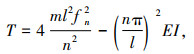
1 测试原理 1.1 频率法原理索力传感器的测量量是加速度,而索力是由加速度传感器数据通过振动法计算获取的。在环境的随机激励下,利用加速度传感器将拉索的随机振动信号转化为电信号。对振动信号进行电荷放大和滤波处理,并对其频谱进行分析,根据频谱图来识别出斜拉索的自振频率。根据弦振动理论[14-15],在已知自振频率、材料参数和索长的情况下,索力与自振频率的关系公式为:
|
(1) |
式中,T,EI,l,m,fn分别为斜拉索索力、抗弯刚度、索长、线密度、第n阶频率。
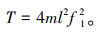
采用基频法进行计算,忽略了拉索弯曲刚度的影响。由于斜拉桥拉索一般较长,索力简化计算公式为:
|
(2) |
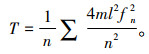
考虑到传感器安装条件限制和拉索垂度对低阶频率会产生较大影响,拾取信号中基频成分相对较小等因素[16]。本研究不使用直接基频法,而是从振动信号频谱图中提取出前n阶低阶频率,然后分别计算前n阶的索力值,并求和取平均值。该方法同时减少了人工从频域图中选取各阶频率的误差。计算公式为:
|
(3) |
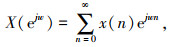
为了获得拉索振动信号的频谱图,采用快速傅立叶变换(FFT)来实现。傅立叶变换是信号分析的重要工具[17-18], 离散时间信号x(n)的连续傅立叶变换定义为:
|
(4) |
式中j和w分别为虚数单位、角频率。
X(ejw)不能直接在计算机上进行数值计算,因为它是一个连续函数。对x(n)的频谱作离散近似,以实现频谱分析。有限长离散信号x(n)的离散傅立叶变换定义为:
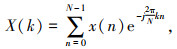
|
(5) |
式中,k= 0, 1, 2, …, N-1;N为离散傅里叶变换区间长度。
令
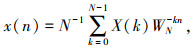
|
(6) |
式中t=0, 1, 2, …, N-1。
1965年,Cooley和Tukey利用e-j2π(v/N)t因子的对称性和周期性, 通过数学变换提出了FFT算法。此后FFT算法被广泛运用于各种计算领域。
1.3 方差分析原理在利用振动频率法得到各组幅值不同的索力之后,对数据进行方差分析,验证各组索力间的相关性。采用单因素方差分析法,因为本研究只讨论1个分类型自变量(索长短)对1个数据型自变量(幅值大小)的影响。单因素方差分析用于研究不同水平下各个总体均值的显著性差异。总变异平方和SST由2部分组成:组间离差平方和SSA,由控制变量引起;组内离差平方和SSE,由随机变量引起。于是有:

|
(7) |
式中,SSE反映了数据抽样误差的大小,是各检验结果与本组均值离差的平方和; SSA反映的是控制变量的影响,是各组平均值和总体平均值离差的平方和。
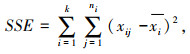
|
(8) |
式中,xij为第j个水平的第i个样本; xi为第i个水平的样本均值。
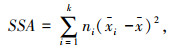
|
(9) |
式中,k为水平数;ni为第i个水平下的样本容量; x为总均数。
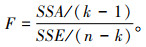
单因素方差分析采用计算F统计量的统计推断方法进行F检验。F是组间和组内平方和的比值,计算公式为:
|
(10) |
从式(10)可以看出,当SSE较大时,F值也较小,说明控制变量的不同水平对试验结果没有显著影响;相反,当SSA较大时,F值较大,说明控制变量的不同水平对试验结果有显著影响。
2 工程概况某大桥采用三塔双边箱预应力混凝土梁斜拉桥体系,全桥共计100对斜拉索,均采用ϕ7高强镀锌钢丝,外套聚乙烯防护套,主桥全长768 m。拉索振动信号使用加速度传感器采集,采样频率为50 Hz。
对该斜拉桥拉索24 h的现场索力测试数据进行研究,以110 m为参考标准,长度在110 m以下设定为短索,长度在110 m以上设定为长索。选择2根长度不同但其他条件相似的编号为N1和N2的斜拉索进行分析,拉索参数如表 1所示。
| 拉索编号 | 拉索规格 | 线密度/(kg·m) | 锚固点间距离/m | 标定后的索力值/kN | 实测基频值/Hz |
| N1 | ϕ7-301 | 96.9 | 219.41 | 6 991 | 0.682 4 |
| N2 | ϕ7-301 | 96.9 | 103.937 | 6 567 | 1.278 9 |
3 实测信号分析 3.1 长索分析
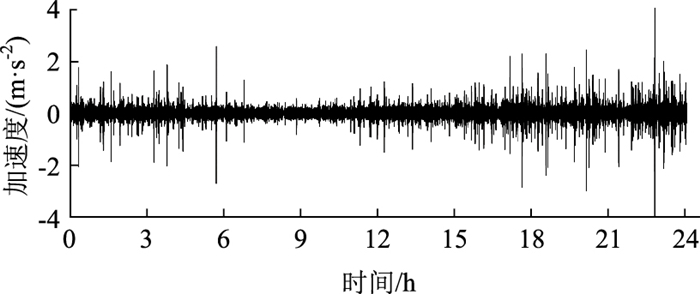
采集仪采集了24 h总共4 018 350个N1索加速度数据,其整体时域图如图 1所示。
|
| 图 1 N1索的加速度时程曲线 Fig. 1 Acceleration time history curve of cable N1 |
| |
从图 1可看出,N1索振动加速度幅值有大有小,总体集中在1 m/s2以下,最大幅值达到4 m/s2。以0.1 m/s2为参考标准,幅值95%在0.1 m/s2以下设定为小幅值,选出6个小幅值区间;幅值至少40%在0.1 m/s2以上设定为大幅值,选出6个大幅值区间。
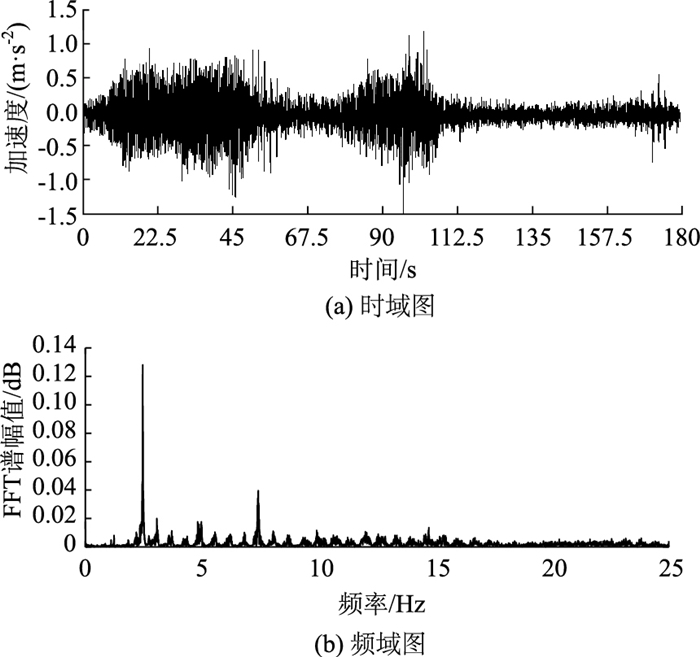
3.1.1 N1索高幅值频谱分析使用FFT算法对高幅值区间数据进行分析。限于篇幅, 本研究仅给出第1个高幅度区间的频谱分析图,如图 2所示。
|
| 图 2 N1索第1个高幅度区间频谱分析图 Fig. 2 Spectrum analysis diagrams of the first high amplitude interval of cable N1 |
| |
3.1.2 N1索低幅值频谱分析
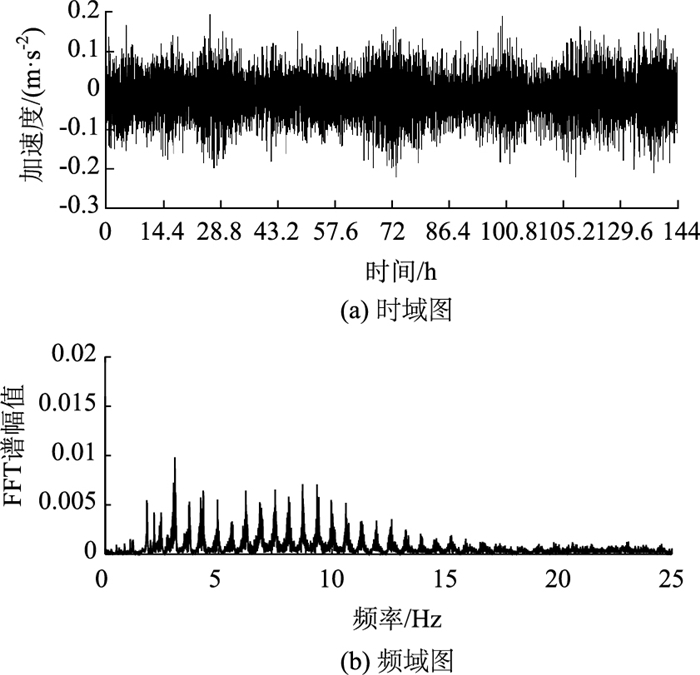
同样使用FFT算法对低幅值区间数据进行分析。本研究仅给出第1个低幅度区间的频谱分析图,如图 3所示。
|
| 图 3 N1索第1个低幅度区间频谱分析图 Fig. 3 Spectrum analysis diagrams of the first low amplitude interval of cable N1 |
| |
3.1.3 N1索索力方差分析
从振动信号频谱中提取出前6阶低阶频率,利用式(3),分别计算各区间的索力值,结果如表 2所示。
| 幅值 | 40%在0.1 m/s2以上 | 95%在0.1 m/s2以下 |
| 各区间索力值/kN | 7 094.39 | 7 121.78 |
| 7 078.68 | 7 116.45 | |
| 7 046.59 | 7 222.32 | |
| 7 035.65 | 7 100.27 | |
| 6 979.67 | 7 109.64 | |
| 6 972.16 | 7 076.64 |
使用单因素分析法,在MATLAB中对表 2数据进行处理和分析,得到方差分析表,如表 3所示。其中因变量为索力值,因素变量为幅值大小。
| 来源 | 平方和 | 自由度 | 均方 | F统计量 | 显著性 |
| 组间 | 2.429 6e+04 | 1 | 2.429 6e+04 | 9.596 4 | 0.011 3 |
| 组内 | 2.531 8e+04 | 10 | 2.531 8e+03 | — | — |
| 总数 | 4.961 5e+04 | 11 | — | — | — |
从表 3可以看出,F值等于9.596 4,其所对应的概率值P为0.011 3,小于0.05,表明N1索幅值大时的索力与幅值小时的索力有显著的差异。
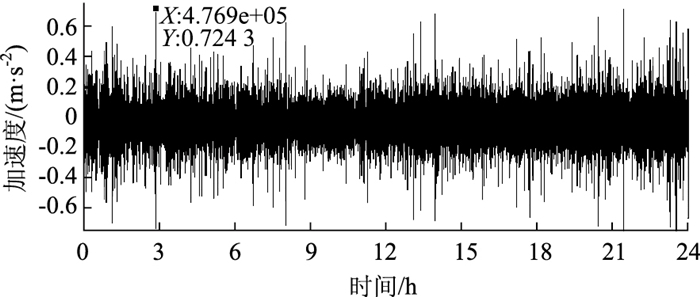
3.2 短索分析采集仪采集了24 h总共4 018 350个N2索加速度数据,其时域图如图 4所示。
|
| 图 4 N2索时域图 Fig. 4 Time domain diagram of cable N2 |
| |
从图 4可以看出, N2索振动加速度幅值总体集中在0.3 m/s2以下,最大幅值达到0.724 2 m/s2。以0.1 m/s2为参考标准,幅值95%在0.1 m/s2以下设定为小幅值,选出6个小幅值区间;幅值至少40%在0.1 m/s2以上设定为大幅值,选出6个大幅值区间。
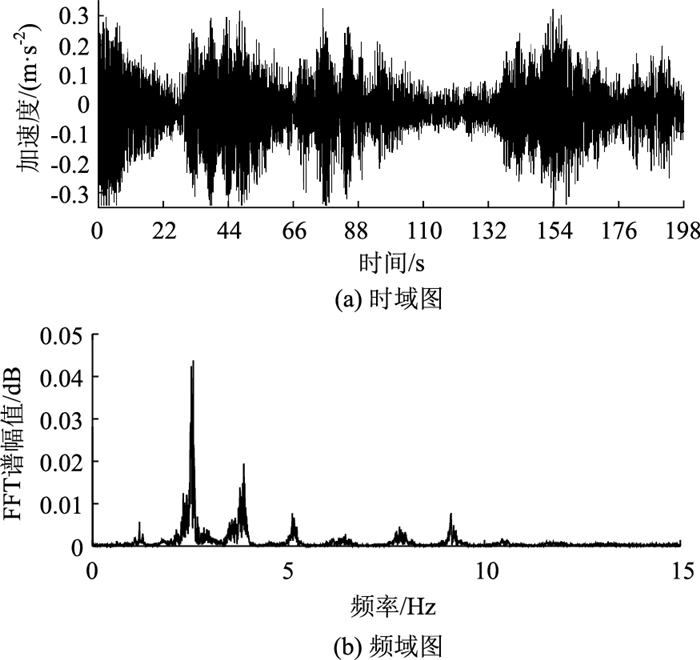
3.2.1 N2索高幅值频谱分析使用FFT算法对高幅值区间数据进行分析。本研究仅给出第1个高幅度区间的频谱分析图,如图 5所示。
|
| 图 5 N2索第1个高幅度区间频谱分析图 Fig. 5 Spectrum analysis diagrams of the first high amplitude interval of cable N2 |
| |
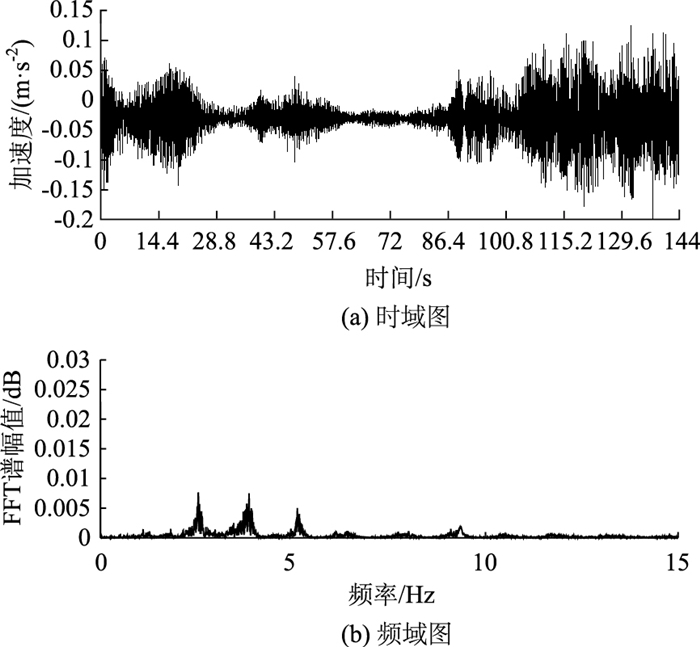
3.2.2 N2索低幅值频谱分析
同样使用FFT算法对低幅值区间数据进行分析。本研究仅给出第1个低幅度区间的频谱分析图,如图 6所示。
|
| 图 6 N2索第1个低幅度区间频谱分析图 Fig. 6 Spectrum analysis diagrams of the first low amplitude interval of cable N2 |
| |
3.2.3 N2索索力方差分析
从振动信号频谱图中提取出前6阶低阶频率,利用式(3),分别计算各区间的索力值,结果如表 4所示。
| 幅值 | 40%在0.1 m/s2以上 | 95%在0.1 m/s2以下 |
| 各区间索力值/kN | 6 852.62 | 6 981.72 |
| 6 839.26 | 6 727.58 | |
| 6 814.04 | 6 896.52 | |
| 6 656.81 | 6 881.59 | |
| 6 873.46 | 6 907.82 | |
| 6 835.30 | 6 915.54 |
使用单因素分析法,在MATLAB中对表 4数据进行处理和分析,得到方差分析表,如表 5所示。
| 来源 | 平方和 | 自由度 | 均方 | F统计量 | 显著性 |
| 组间 | 2.033 9e+10 | 1 | 2.033 9e+10 | 3.059 8 | 0.110 8 |
| 组内 | 6.647 2e+10 | 10 | 6.647 2e+09 | — | — |
| 总数 | 8.681 1e+10 | 11 | — | — | — |
从表 5可以看出,F值等于3.059 8,其所对应的概率值P为0.110 8,大于0.05,表明N2索幅值大时与幅值小时的索力没有显著差异。
从振动幅值入手,研究在长索和短索下振动幅值与索力的关系。造成上述现象的原因是:相较于短索,长索的振动本身是非线性的,导致用长索的大振幅部分与小振幅部分得到的索力不同。
4 结论使用振动频率法对某桥斜拉索24 h的索力识别数据进行研究,分析了长索和短索在加速度大幅值和小幅值时对索力识别的影响,利用方差分析法分析了索力间差异性,得到以下结论:
(1) 长索振动幅值的大小对索力识别具有显著性影响,在索结构振幅较大状态下,基于频率法识别的索力较幅值较小的状态明显偏小。短索结构振动幅值大小对索力识别无显著影响。因此要加强对长索的索力识别。
(2) 由于斜拉索受到各类环境荷载激励,索结构会发生振幅的随机变化,为准确获取索结构振动,基于频率法的索力识别应选择幅值相对较小、振动相对平稳的时间区段进行。
| [1] |
刘晨凯, 郑万山. 基于模态识别的短索索力识别方法[J]. 公路交通科技, 2020, 37(1): 74-84. LIU Chen-kai, ZHENG Wan-shan. An Estimation Method of Short Cable Force Based on Modal Identification[J]. Journal of Highway and Transportation Research and Development, 2020, 37(1): 74-84. |
| [2] |
马文刚, 黄侨, 陈晓强, 等. 基于两次等效索长的斜拉桥索力测量[J]. 公路交通科技, 2011, 28(9): 66-70, 88. MA Wen-gang, HUANG Qiao, CHEN Xiao-qiang, et al. Cable Force Measurement of Cable-stayed Bridge Based on Twice Equivalent Cable Length[J]. Journal of Highway and Transportation Research and Development, 2011, 28(9): 66-70, 88. |
| [3] |
王家林, 曹珂瑞. 一种基于指定应力的斜拉桥成桥索力调整方法[J]. 公路交通科技, 2020, 37(7): 72-78. WANG Jia-lin, CAO Ke-rui. A Method for Adjusting Cable Force of Cable-stayed Bridge in Finished State Based on Specified Stress[J]. Journal of Highway and Transportation Research and Development, 2020, 37(7): 72-78. |
| [4] |
孟少平, 杨睿, 王景全. 一类精确考虑抗弯刚度影响的系杆拱桥索力测量新公式[J]. 公路交通科技, 2008, 25(6): 87-91. MENG Shao-ping, YANG Rui, WANG Jing-quan. Novel Formula of Tension Measurement for Tied Arch Bridges in Precise Consideration of Flexural Rigidity[J]. Journal of Highway and Transportation Research and Development, 2008, 25(6): 87-91. |
| [5] |
袁博. 斜拉索索力测试影响因素分析及模型修正方法研究[D]. 西安: 长安大学, 2012. YUAN Bo. Study on Influencing Factors of Cable Tension Measurement and Model Updating Method[D]. Xi'an: Chang'an University, 2012. |
| [6] |
肖祥, 鄢宇, 赵璐, 等. 不确定边界和索长的斜拉索索力检测方法[J]. 武汉理工大学学报, 2017, 39(8): 75-81. XIAO Xiang, YAN Yu, ZHAO Lu, et al. A Cable Force Test Method for Cable Stayed Bridge with Uncertain Boundary and Length[J]. Journal of Wuhan University of Technology, 2017, 39(8): 75-81. |
| [7] |
蔡玉龙, 李周, 危媛丞, 等. 考虑频率测试结果不确定性的拉索索力识别方法[J]. 科学技术与工程, 2019, 19(17): 314-319. CAI Yu-long, LI Zhou, WEI Yuan-cheng, et al. Identification of Tension in Cables with Uncertainty Frequency Measurement Using Set Inversion via Interval Analysis[J]. Science Technology and Engineering, 2019, 19(17): 314-319. |
| [8] |
周光伟, 钱长照. 张弦桥结构静力分析方法与受力特点研究[J]. 公路交通科技, 2020, 37(12): 63-69. ZHOU Guang-wei, QIAN Chang-zhao. Study on Static Structural Analysis Method and Mechanical Characteristics of String-tensioned Bridge[J]. Journal of Highway and Transportation Research and Development, 2020, 37(12): 63-69. |
| [9] |
韩州斌, 李东升, 杨洋. 等值张拉时基于振动法的平行钢绞线索索力测试分析[J]. 公路交通科技, 2018, 35(2): 55-61. HAN Zhou-bin, LI Dong-sheng, YANG Yang. Measurement and Analysis of Cable Tension of Parallel Strands under Equivalent Tension Based on Vibration Method[J]. Journal of Highway and Transportation Research and Development, 2018, 35(2): 55-61. |
| [10] |
闫维明, 许晓建, 李勇, 等. 基于振动频率法和优化功能的斜拉索索力测试研究[J]. 公路交通科技, 2015, 32(11): 61-67. YAN Wei-ming, XU Xiao-jian, LI Yong, et al. Cable Force Measurement Based on Vibration Frequency Method and Optimization Function[J]. Journal of Highway and Transportation Research and Development, 2015, 32(11): 61-67. |
| [11] |
朱传聪. 斜拉索索力识别及其影响因素分析[D]. 广州: 华南理工大学, 2018. ZHU Chuan-cong. Identification of Cable Tension and Its Influencing Factors[D]. Guangzhou: South China University of Technology, 2018. |
| [12] |
樊帅, 王文静. 减震器影响下的斜拉索等效索长计算及索力测量[J]. 湖南交通科技, 2014, 40(2): 85-88. FAN Shuai, WANG Wen-jing. Calculation of Equivalent Cable Length and Cable Force Measurement of Cable Stay under Influence of Shock Absorber[J]. Hunan Communication Science and Technology, 2014, 40(2): 85-88. |
| [13] |
陈涛, 刘慈军, 李宏伟, 等. 基于环境振动的斜拉桥索力监测研究[J]. 湖南交通科技, 2014, 40(2): 80-84, 88. CHEN Tao, LIU Ci-jun, LI Hong-wei, et al. Study on Cable Force Monitoring of Cable-stayed Bridge Based on Environmental Vibration[J]. Hunan Communication Science & Technology, 2014, 40(2): 80-84, 88. |
| [14] |
ZUI H, SHINKE T, NAMITA Y. Practical Formulas for Estimation of Cable Tension by Vibration Method[J].
Journal of Structural Engineering, 1996, 122(6): 651-656.
|
| [15] |
谭艳. 斜拉桥索力测量及索力状态评估研究[D]. 湘潭: 湖南科技大学, 2009. TAN Yan. Cable Tension Measurement and Condition Assessment for Cable-stayed Bridges[D]. Xiangtan: Hunan University of Science and Technology, 2009. |
| [16] |
梁鹏, 徐岳, 刘永健. 斜拉索分析统一理论及其应用[J]. 建筑科学与工程学报, 2006, 23(1): 68-77. LIANG Peng, XU Yue, LIU Yong-jian. Unified Analysis Theory of Cable Stay and Its Applications[J]. Journal of Architecture and Civil Engineering, 2006, 23(1): 68-77. |
| [17] |
陈岩, 胡时胜, 宋力. 斜拉桥桥索张力测量[J]. 实验力学, 1997, 12(3): 347-350. CHEN Yan, HU Shi-sheng, SONG Li. Measurement of Cable Tension for Stayed Cable Bridge[J]. Journal of Experimental Mechanics, 1997, 12(3): 347-350. |
| [18] |
叶伏秋. 基于FFT的傅里叶光谱Matlab仿真分析[J]. 吉首大学学报(自然科学版), 2011, 32(1): 49-51, 62. YE Fu-qiu. Matlab Simulation Analysis of Fourier Spectrum Based on FFT[J]. Journal of Jishou University (Natural Science Edition), 2011, 32(1): 49-51, 62. |